Star Trek Ongoing 1-3
IDW Publishing
Mike Johnson, writer
Stephen Molnar, artist
IDW has produced some great Star Trek comics since obtaining the license several years ago. This comic, set in the rebooted film universe, looks to be another fine addition to their catalog of Trek.
The first two issues of the series revisit events from the classic original series episode "Where No Man Has Gone Before," and the third issue begins a two-part re-examining of the events from the episode "The Galileo Seven." That doesn't mean these tales are simple re-tellings of events already played out. Keeping consistent with the premise of the J.J. Abrams movie from 2009, these tales incorporate some subtle and some not-so-subtle changes to what fans recall. And the art has just the right level of modeling the new actors' features one would expect from a property based on live-action television or film.
Of course, it would be nice to see these creators stretch and produce some completely original tales with these characters traveling a slightly different path than expected, but these initial three issues are a delight for long-time fans who can quote chapter and verse of what has gone before, and seem quite accessible and entertaining for someone new to the franchise.
Friday, July 27, 2012
Tuesday, July 24, 2012
Hitting The Ground Running
Nightwing 1-4
DC Comics
Kyle Higgins, writer
Eddy Barrows, artist
I'd been actually dreading this title quite a bit. I'd heard bad things about Green Arrow and had really low expectations going in, which likely helped me see the positives of that title. Aquaman, another favorite hero of mine, has gotten nothing but good press so far. So I'm anxious to read it and not nervous at all. Nightwing though, I haven't heard much about. I've always liked Dick Grayson, so I had high hopes for this book. But I don't care for the redesigned costume. I can live with it, but I prefer the previous version. I was afraid the same might be true of the story.
Well, the first story arc isn't quite over yet, but this is still MY Dick Grayson. I can see this character as being a slightly altered version of the one I've been reading for years, which is what I want from the New 52 when I already liked the character to begin with. Please, sir, just give me more of the same.
This has acrobatics, Haly's circus, a cameo by Barbara "Batgirl" Gordon, some sleuthing, some levity.
Kudos to the creative team of this series. Please, keep up the good work.
DC Comics
Kyle Higgins, writer
Eddy Barrows, artist
I'd been actually dreading this title quite a bit. I'd heard bad things about Green Arrow and had really low expectations going in, which likely helped me see the positives of that title. Aquaman, another favorite hero of mine, has gotten nothing but good press so far. So I'm anxious to read it and not nervous at all. Nightwing though, I haven't heard much about. I've always liked Dick Grayson, so I had high hopes for this book. But I don't care for the redesigned costume. I can live with it, but I prefer the previous version. I was afraid the same might be true of the story.
Well, the first story arc isn't quite over yet, but this is still MY Dick Grayson. I can see this character as being a slightly altered version of the one I've been reading for years, which is what I want from the New 52 when I already liked the character to begin with. Please, sir, just give me more of the same.
This has acrobatics, Haly's circus, a cameo by Barbara "Batgirl" Gordon, some sleuthing, some levity.
Kudos to the creative team of this series. Please, keep up the good work.
Friday, July 20, 2012
Two For the Price of One, But Both Disappointing
Catwoman 1-4
DC Comics
Judd Winick, writer
Guillem March, artist
Not much to say about this title. There have been some really good runs on Catwoman in recent years making her a solid headlining character in her own right and not just a Batman rogue. This series seems kind of like a step backward. I've liked Winick's writing on past titles, but he's rather disappointing here. There just doesn't seem to be much new territory here, and if all the title is going to do is rehash existing material, the first time around was often better.
Red Hood and the Outlaws 1-3
DC Comics
Scott Lobdell, writer
Kenneth Rocafort, artist
Another disappointing title. This one didn't even stay on my pull list for the fourth issue. I initially ordered the book for its ties to former Titans characters, but apparently only the names were being used. These two aren't the Arsenal and Starfire I know. I'd rather keep my untarnished memories of the past exploits of characters I enjoyed than try to find some semblance of those characters in these travesties.
DC Comics
Judd Winick, writer
Guillem March, artist
Not much to say about this title. There have been some really good runs on Catwoman in recent years making her a solid headlining character in her own right and not just a Batman rogue. This series seems kind of like a step backward. I've liked Winick's writing on past titles, but he's rather disappointing here. There just doesn't seem to be much new territory here, and if all the title is going to do is rehash existing material, the first time around was often better.
Red Hood and the Outlaws 1-3
DC Comics
Scott Lobdell, writer
Kenneth Rocafort, artist
Another disappointing title. This one didn't even stay on my pull list for the fourth issue. I initially ordered the book for its ties to former Titans characters, but apparently only the names were being used. These two aren't the Arsenal and Starfire I know. I'd rather keep my untarnished memories of the past exploits of characters I enjoyed than try to find some semblance of those characters in these travesties.
Tuesday, July 17, 2012
All-Ages Honest-To-Goodness FUN!
Super Dinosaur 1-6, Origin Issue
Image Comics
Robert Kirkman, writer
Jason Howard, artist
This creative team was responsible for the 25-issue Astonishing Wolf-Man series which I very much enjoyed. They followed that title up with this one. The book follows the adventures of Derek Dynamo, a pretty brilliant young boy, his super-scientist dad, and his genetically altered tyrannosaurus Rex best friend. The T-Rex wears battle armor to enhance his natural, dino-fighting skills. There are other enhanced dinos, but they're some of the bad guys. So this series is all about fighting dinosaurs in battle armor. This is a truly fun book! Do you really need to know more?
Image Comics
Robert Kirkman, writer
Jason Howard, artist
This creative team was responsible for the 25-issue Astonishing Wolf-Man series which I very much enjoyed. They followed that title up with this one. The book follows the adventures of Derek Dynamo, a pretty brilliant young boy, his super-scientist dad, and his genetically altered tyrannosaurus Rex best friend. The T-Rex wears battle armor to enhance his natural, dino-fighting skills. There are other enhanced dinos, but they're some of the bad guys. So this series is all about fighting dinosaurs in battle armor. This is a truly fun book! Do you really need to know more?
Friday, July 13, 2012
He's the MONSTER; Frankenstein is the DOCTOR!
Frankenstein, Agent of S.H.A.D.E. 1-4
DC Comics
Jeff Lemire, writer
Alberto P, artist
I don't like to ever call someone else's art bad. Even if I don't care for it, someone else may see merit and appreciate it, and even if no one does, odds are, the artist in question has done a much better job than I could've done. That said, this art is not for me. Especially when it is placed behind those gorgeous J.G. Jones covers this series features; that's what I would like the interiors of this book to look like.
I'm curious if this is a completely original take on the Frankenstein's monster character or if this version is based on the re-imagining of the character from Grant Morrison's Seven Soldiers series. If the latter is true, I'm even more curious about finally checking out that series. So how about it, anyone out there who can give me an answer on this question?
Anyway, back to this title, I've always liked the concept of the Creature Commandos, and I liked the ideas used in the Flashpoint title which preceded this relaunch, Frankenstein and the Creatures of the Unknown. I like some of the basic concepts presented here by writer Jeff Lemire and really want to follow this title. But that art is just ruining this book for me. I've been trying to make some cuts of late, and this title didn't survive the cut despite my wanting to enjoy it. Chalk it up to the art, at least in the case of this cut.
DC Comics
Jeff Lemire, writer
Alberto P, artist
I don't like to ever call someone else's art bad. Even if I don't care for it, someone else may see merit and appreciate it, and even if no one does, odds are, the artist in question has done a much better job than I could've done. That said, this art is not for me. Especially when it is placed behind those gorgeous J.G. Jones covers this series features; that's what I would like the interiors of this book to look like.
I'm curious if this is a completely original take on the Frankenstein's monster character or if this version is based on the re-imagining of the character from Grant Morrison's Seven Soldiers series. If the latter is true, I'm even more curious about finally checking out that series. So how about it, anyone out there who can give me an answer on this question?
Anyway, back to this title, I've always liked the concept of the Creature Commandos, and I liked the ideas used in the Flashpoint title which preceded this relaunch, Frankenstein and the Creatures of the Unknown. I like some of the basic concepts presented here by writer Jeff Lemire and really want to follow this title. But that art is just ruining this book for me. I've been trying to make some cuts of late, and this title didn't survive the cut despite my wanting to enjoy it. Chalk it up to the art, at least in the case of this cut.
Tuesday, July 10, 2012
Great Setup; Uneven Follow-Through
Supreme Power (2011) 1-4
Marvel Max
Kyle Higgins, writer
Manuel Garcia, artist
The biggest problem with this limited series is its ending.
I first came to the concept of the Squadron Supreme with the 1985 12-part series from Marvel. The characters pre-date that limited series as occasional secondary characters in The Avengers and several other Marvel titles. Each of the various heroes on the team is a direct analogue of a member of the Justice League. A few years ago, the concept was rebooted as Supreme Power. The series ran for 18 issues, and then has had several follow-up limited series.
That initial reimagining by Gary Frank was very good, but some of the later series seemed to wander away from the core concepts a little too far. This series, focusing on Joe Ledger and Hyperion, returns the series to that core concept and is a very good read because of that fact and a marvelous story from Higgins. In fact, the only shortcoming of the series, as mentioned above, is the ending, or rather, the lack thereof. Obviously, this series is intended to lead right into another one, one which hasn't yet materialized almost two years later. That is a little disappointing.
Marvel Max
Kyle Higgins, writer
Manuel Garcia, artist
The biggest problem with this limited series is its ending.
I first came to the concept of the Squadron Supreme with the 1985 12-part series from Marvel. The characters pre-date that limited series as occasional secondary characters in The Avengers and several other Marvel titles. Each of the various heroes on the team is a direct analogue of a member of the Justice League. A few years ago, the concept was rebooted as Supreme Power. The series ran for 18 issues, and then has had several follow-up limited series.
That initial reimagining by Gary Frank was very good, but some of the later series seemed to wander away from the core concepts a little too far. This series, focusing on Joe Ledger and Hyperion, returns the series to that core concept and is a very good read because of that fact and a marvelous story from Higgins. In fact, the only shortcoming of the series, as mentioned above, is the ending, or rather, the lack thereof. Obviously, this series is intended to lead right into another one, one which hasn't yet materialized almost two years later. That is a little disappointing.
Friday, July 06, 2012
Return of the Bat ... girl
Batgirl 1-4
DC Comics
Gail Simone, writer
Ardian Syaf and Vicente Cifuentes, artists
I've always liked the Barbara Gordon Batgirl, and I sincerely hope her book succeeds. Simone is a terrific writer who handled the character superbly as the brains behind the Birds of Prey team, and now that Barbara has been restored to her unassisted mobility, Simone is going gangbusters. Little detail has so far been given for how Barbara was healed and left her wheelchair behind, but the wheelchair history is not ignored, either.
Batgirl is again on the rooftops of Gotham City, enjoying the night, when she thwarts the plans of some thrill-seeking serial killers. While terrorizing a family, the killers freely admit they are breaking into homes, torturing and killing people, all for kicks. Batgirl interrupts the quartet's "fun," sending one of the thugs to the hospital. It is here that Batgirl first confronts the main villain of her debut DCnU adventure, a mysterious masked figure calling himself Mirror. His m.o. is to kill those who have cheated death somehow after first showing them their "true" face. Both the face of his mask and the inside of his dark cape seem to be constructed by shattered mirror fragments, reflecting back at his intended victims cracked visions of reality.
Between confrontations with Mirror and trying to track down his identity and motivations, Barbara sets herself up in a new apartment with a new roommate and a new post-Birds life that promises to be an interesting journey. And the art in this book is top notch. No complaints on that score this time out.
Batgirl is a keeper!
DC Comics
Gail Simone, writer
Ardian Syaf and Vicente Cifuentes, artists
I've always liked the Barbara Gordon Batgirl, and I sincerely hope her book succeeds. Simone is a terrific writer who handled the character superbly as the brains behind the Birds of Prey team, and now that Barbara has been restored to her unassisted mobility, Simone is going gangbusters. Little detail has so far been given for how Barbara was healed and left her wheelchair behind, but the wheelchair history is not ignored, either.
Batgirl is again on the rooftops of Gotham City, enjoying the night, when she thwarts the plans of some thrill-seeking serial killers. While terrorizing a family, the killers freely admit they are breaking into homes, torturing and killing people, all for kicks. Batgirl interrupts the quartet's "fun," sending one of the thugs to the hospital. It is here that Batgirl first confronts the main villain of her debut DCnU adventure, a mysterious masked figure calling himself Mirror. His m.o. is to kill those who have cheated death somehow after first showing them their "true" face. Both the face of his mask and the inside of his dark cape seem to be constructed by shattered mirror fragments, reflecting back at his intended victims cracked visions of reality.
Between confrontations with Mirror and trying to track down his identity and motivations, Barbara sets herself up in a new apartment with a new roommate and a new post-Birds life that promises to be an interesting journey. And the art in this book is top notch. No complaints on that score this time out.
Batgirl is a keeper!
Tuesday, July 03, 2012
Fresh Face, But Same Attitude
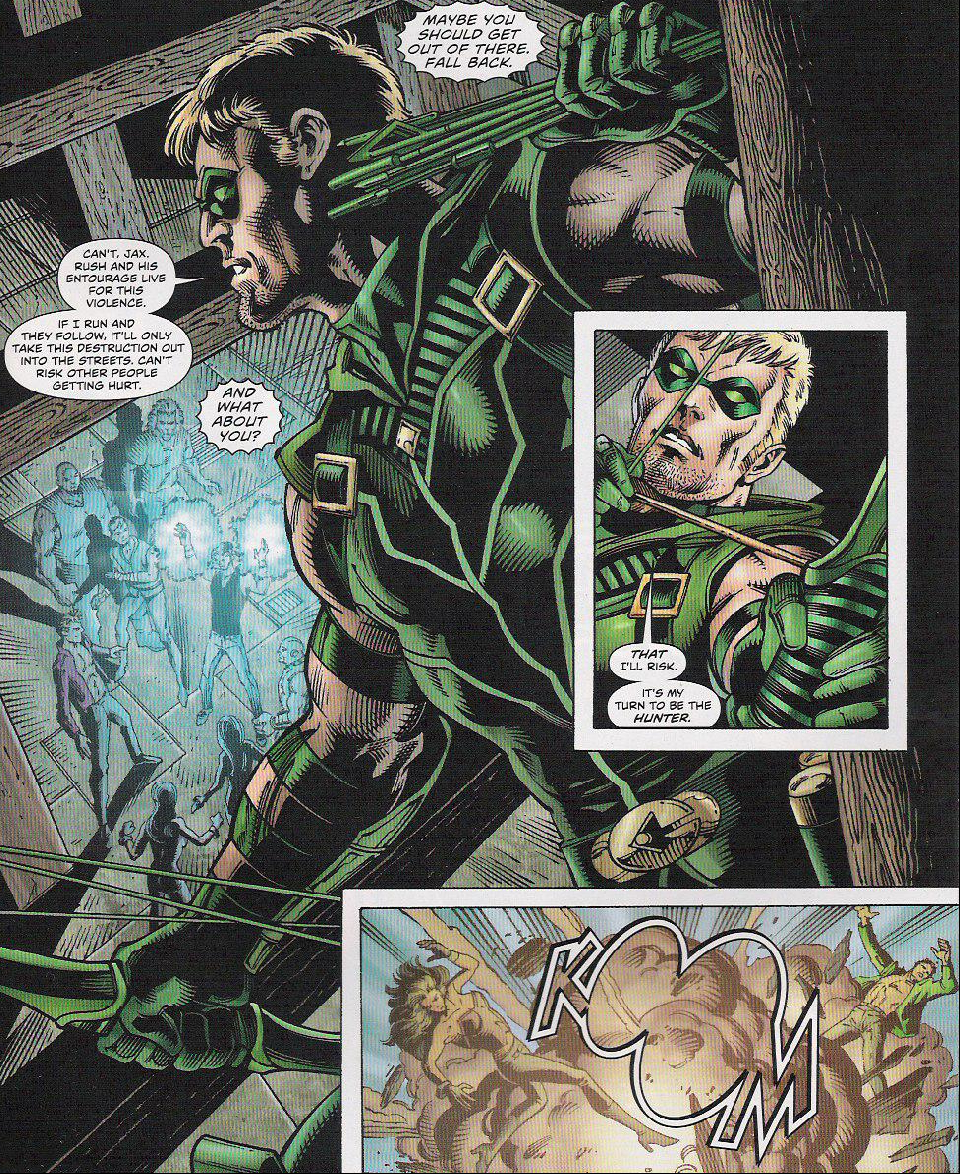
Green Arrow 1-4
DC Comics
J.T. Krul, writer
Dan Jurgens and George Perez, artists
Now this is a book I can sink my teeth into.
I've read some complaints online that Green Arrow is leaving readers cold, but as a longtime fan of the character, I like this book, and I think it lives up to what I believe the DCnU is trying to do. The hero of this title is not the same archer I was reading about before the rebooted universe came into existence, so it is a new start for new readers looking for something fresh to latch onto. Having said that, though, there are quite a few similar traits in this Oliver Queen to not alienate a longtime fan such as myself with a character I can no longer feel a connection to.
This first arc introduces us to a young, confident Oliver Queen who has inherited Queen Industries from his father. But instead of having a young heir run what is likely a multi-billion dollar conglomerate of companies, Oliver heads the trendy gadget division Q-Core, which produces Q-phones and Q-pads and other high-tech toys for those who can afford them. Q-Core also secretly produces the special arrows and other devices Oliver uses in his covert work as a superhero, and a small team of creative types at Q-Core help the young adventurer create his arsenal of weapons and coordinate his costumed activities.
It makes sense that if GA really existed, he wouldn't be as effective operating completely alone, without the help of a team of support folks. And it is also more realistic that he would have a board of directors and numerous division heads over the various aspects of a real company such as Queen Industries.
Continuing that reality-based theme, this first arc pits GA against a gang of young, super powered villains who don't commit crimes so much for the monetary gain as for the celebrity they receive filming themselves committing crimes and terrorizing people, then posting those videos online. These individuals thrive on the ego-boost they receive from hits and views online.
I hear this is one of the books slated for some creative personnel changes in the near future. I hope I continue to like this book, because so far, for this fan, this one has not disappointed.
DC Comics
J.T. Krul, writer
Dan Jurgens and George Perez, artists
Now this is a book I can sink my teeth into.
I've read some complaints online that Green Arrow is leaving readers cold, but as a longtime fan of the character, I like this book, and I think it lives up to what I believe the DCnU is trying to do. The hero of this title is not the same archer I was reading about before the rebooted universe came into existence, so it is a new start for new readers looking for something fresh to latch onto. Having said that, though, there are quite a few similar traits in this Oliver Queen to not alienate a longtime fan such as myself with a character I can no longer feel a connection to.
This first arc introduces us to a young, confident Oliver Queen who has inherited Queen Industries from his father. But instead of having a young heir run what is likely a multi-billion dollar conglomerate of companies, Oliver heads the trendy gadget division Q-Core, which produces Q-phones and Q-pads and other high-tech toys for those who can afford them. Q-Core also secretly produces the special arrows and other devices Oliver uses in his covert work as a superhero, and a small team of creative types at Q-Core help the young adventurer create his arsenal of weapons and coordinate his costumed activities.
It makes sense that if GA really existed, he wouldn't be as effective operating completely alone, without the help of a team of support folks. And it is also more realistic that he would have a board of directors and numerous division heads over the various aspects of a real company such as Queen Industries.
Continuing that reality-based theme, this first arc pits GA against a gang of young, super powered villains who don't commit crimes so much for the monetary gain as for the celebrity they receive filming themselves committing crimes and terrorizing people, then posting those videos online. These individuals thrive on the ego-boost they receive from hits and views online.
I hear this is one of the books slated for some creative personnel changes in the near future. I hope I continue to like this book, because so far, for this fan, this one has not disappointed.
Friday, June 29, 2012
Ewwwwwww ...
Animal Man 1-4
DC Comics
Jeff Lemire, writer
Travel Foreman, artist
Not quite sure what to make of this book.
I initially became aware of the Buddy Baker Animal Man character with Grant Morrison's re-imagining of the title as a Vertigo comic before Vertigo even existed. I liked the first five issues, and then dropped the title for some reason I can no longer recall, likely money and/or too many other titles I liked better. I later purchased the entire Morrison run on the title through the three trades DC collected them in. Not sure I was ready for the title when the individual issues came out, but I liked it enough to keep an eye out for the remainder of the series as it went through several subsequent writers. I have since purchased all of the issues of the Vertigo Animal Man after Morrison's run, but have not yet had/taken time to read them.
I next got a taste of Animal Man in the pages of 52, which returned him to a more super-hero style, in my mind, but I like that Animal Man. He wants to be a hero and has super powers, but he's also a family man and the superheroing is kind of like a part-time hobby for him. It's an interesting and not too common dynamic for a superhero title.
Then with the announcement of the DCnU, I learned that Animal Man would be one of the new titles DC was starting out with. I was excited by the idea of a monthly Animal Man book, while also trepidacious about all the talk of it being a horror title by a writer known for horror.
Buddy still has his wife and two kids, and he's a former stunt man who developed the ability to draw on the strengths of various animals. He's a part-time hero/adventurer and a full-time family man. But that family life is threatened when his young daughter, Maxine, begins displaying some abilities of her own. Dead animals seem to be re-animating and being drawn to her. They share with her, and she tries to tell her father, about the dangers of something called The Rot about the same time three monsters, agents of The Rot, show up to try to destroy her. It seems Maxine is a defender of The Red — kind of a carnivore's equivalent to The Green for plants in Swamp Thing — and The Rot wants to corrupt her to its own ends. All of this is new to Animal Man, and he must defend his daughter from these opposing forces.
Well, now that I've read the first four issues, I'm not sure I would exactly call this horror, but it isn't exactly my taste either. This title also seems like it will be heavily interacting and crossing over with Swamp Thing and a few other similarly themed books I don't have much interest in buying. Not sure this is my style of book plus it will tie in with several other books I'm not reading equals this is looking like a book for me to drop.
And, unless this is a completely original take on Lemire's part, it is making me think I might not like some of those later issues of that earlier Animal Man run I have yet to read.
Tuesday, June 26, 2012
Back To Basics, And It Feels So Wrong
Justice League International 1-4
DC Comics
Dan Jurgens, writer
Aaron Lopestri and Matt Ryan, artists
I wanted to like this book. It features Booster Gold prominently as team leader and is written by the man who created the character and later helped bring Booster to, in my opinion at least, true greatness following the events of 52 and Geoff Johns' efforts to reshape him into the time-policing "greatest hero you've never heard of." And maybe, given time, Jurgens will bring that feel of competence and confidence back to Booster. But it isn't there yet.
Yeah, the whole point of the DCnU is to restart these heroes' careers, but Booster really feels like he's coming out a loser from this reboot. And while the characters might not remember what has gone before, I read and liked the stories which preceded the DCnU relaunch and feel shortchanged on their behalf.
This title follows the efforts of the United Nations to create an international super-powered group of heroes they control. You know, because the Justice League has only been around for five years according to the set-up and has saved the world how many times in that history, so they have no allegiance to any nation and can't be trusted. Anyway, weak rationale aside, they pick a known pitch man, Booster, to lead the team because he ought to be controllable, right? Then they fill out the team with Ice from Norway, Vixen from Zambesi, Fire from Brazil, Rocket Red from Russia, August General in Iron from China and Godiva from Great Britain. They also select Guy Gardner to include a powerhouse Green Lantern on the team, but Guy balks at first, especially if he has to take orders from Booster. Oh, and they decide they don't want Batman involved, but the Dark Knight, as always, has his own plans. Not a bad roster of characters, many of whom have been on this team during past timelines, so there's a nod to tradition.
The team's first mission does not go well, however, and it takes first Batman's uncharacteristic encouragement to Booster, and then August General's additional support to hold the various heroes together. They are not yet a cohesive team by the end of the fourth issue, but then, neither is the story arc over yet, so there's time.
As I said, I wanted to like this book. And really, it's not bad. It is, in fact, an entertaining read. But in trying to winnow down my pull list and re-assess my current collecting, I'm afraid this title isn't quite good enough to stay. These days, I'm not just looking for good; I'm looking for great. Sadly, this book is falling short of that so far.
Update: After I read these first four issues but before this post was published, it has been announced that JLI is being canceled following its 12th issue. Guess I wasn't the only one who found this title somewhat lacking.
Friday, June 22, 2012
Everything Old Is New Again
Action Comics 1-4DC Comics
Grant Morrison, writer
Rags Morales and Gene Ha, artists
This book has been so hyped, it offered few surprises; but it DOES offer a solid read with some pretty pictures to go with it.
The story line returns Superman/Clark Kent to his activist, ultra-liberal, fighting against The Man's injustice, 1938 roots. A young Clark Kent is finding his way in Metropolis as a reporter for the Daily Star, making friends with Jimmy Olsen, a photographer from a rival newspaper, The Daily Planet, and butting heads with Lois Lane, a reporter for the Planet. Clark's portrayal is more nerdy than bumbling.
And as for Superman, he's more angry, lone vigilante than his usual portrayal, but that works for this early stage in his career. The first time we see the Man of Steel in action, he plows effortlessly through the hired muscle, straight to one of the city's worst robber-baron types, a man Superman quickly suspends upside down from the top of a building (in a patented Batman move) while he works to scare a confession out of the "rat."
There are changes in this book -- the S-symbol is a bit more stylized, life on Krypton isn't quite like previous portrayals, relationships are tweaked here and there for several familiar faces -- but all of the basics of the story remain the same. I'll continue to pick this book up for a while for Morrison's fresh take on the character.
Grant Morrison, writer
Rags Morales and Gene Ha, artists
This book has been so hyped, it offered few surprises; but it DOES offer a solid read with some pretty pictures to go with it.
The story line returns Superman/Clark Kent to his activist, ultra-liberal, fighting against The Man's injustice, 1938 roots. A young Clark Kent is finding his way in Metropolis as a reporter for the Daily Star, making friends with Jimmy Olsen, a photographer from a rival newspaper, The Daily Planet, and butting heads with Lois Lane, a reporter for the Planet. Clark's portrayal is more nerdy than bumbling.
And as for Superman, he's more angry, lone vigilante than his usual portrayal, but that works for this early stage in his career. The first time we see the Man of Steel in action, he plows effortlessly through the hired muscle, straight to one of the city's worst robber-baron types, a man Superman quickly suspends upside down from the top of a building (in a patented Batman move) while he works to scare a confession out of the "rat."
There are changes in this book -- the S-symbol is a bit more stylized, life on Krypton isn't quite like previous portrayals, relationships are tweaked here and there for several familiar faces -- but all of the basics of the story remain the same. I'll continue to pick this book up for a while for Morrison's fresh take on the character.
Tuesday, June 19, 2012
It's A Team Book, Dammit
Justice League 1-4
DC Comics
Geoff Johns, writer
Jim Lee, artist
I've heard a lot of people complain that for a writer known for his character work, Geoff Johns has dropped the ball with this title because it lacks any real characterization, instead opting for little more than slam-bam fights and too-cutesy quips. The criticism is usually joined with the charge that this book, above all others as the flagship title of The New 52! relaunch, deserves better.
After finally having a chance to read some of the DCnU debut titles, I say that Johns DOES add character moments in this title, albeit small ones, and that because this is the BIG team book leading off the relaunch effort, it must be mostly big and splashy or fans would decry the effort as lackluster.
Those of you who've been to this blog before know I tend to be somewhat behind in my comics reading. Life intrudes and quiet moments to sit and read are often precious and few, especially with a new baby in the house. So now that I've finally reached the beginnings of the relaunched titles from DC, I opted to read the first four issues of the titles I bought to get a real feel for the books before commenting. I'm so behind much of the time anyway, maybe I should just trade-wait most of my comic purchases, and do on some titles, but haven't made that switch completely.
Anyway, back to Justice League. This book in particular benefits from reading four issues at once, or even the entire arc. I have no defense for anyone wishing to complain about this book being a little slow in monthly form. This truly is an arc that would be better as a trade so the reader doesn't lose momentum between issues. Because momentum is what a book featuring this many big guns is all about. Early on in their careers, these heroes all give new meaning to the term big guns. Each of these heroes is new to superheroing, and even newer to working with others. I can handle the excess bravado and one-upmanship amply on display here because of that lack of experience. Those attitudes should not continue once this book leaves behind the League's origin and moves to more contemporary stories where the heroes are seasoned by five years of working together.
Also, let's face it: Most of these characters -- all of them, in fact, except Cyborg -- star in at least one title of their own. Those books, most written by other creators, are where the early character development will happen for Aquaman, Batman, Flash, Green Lantern, Superman and Wonder Woman. Those other creators would resent Johns stealing their individual character-defining moments for his group book.
This is a fun superhero romp, and I'm enjoying the ride. If you are wanting deeper characterization, seek out these heroes' individual titles. This book is all about the larger dynamic.
DC Comics
Geoff Johns, writer
Jim Lee, artist
I've heard a lot of people complain that for a writer known for his character work, Geoff Johns has dropped the ball with this title because it lacks any real characterization, instead opting for little more than slam-bam fights and too-cutesy quips. The criticism is usually joined with the charge that this book, above all others as the flagship title of The New 52! relaunch, deserves better.
After finally having a chance to read some of the DCnU debut titles, I say that Johns DOES add character moments in this title, albeit small ones, and that because this is the BIG team book leading off the relaunch effort, it must be mostly big and splashy or fans would decry the effort as lackluster.
Those of you who've been to this blog before know I tend to be somewhat behind in my comics reading. Life intrudes and quiet moments to sit and read are often precious and few, especially with a new baby in the house. So now that I've finally reached the beginnings of the relaunched titles from DC, I opted to read the first four issues of the titles I bought to get a real feel for the books before commenting. I'm so behind much of the time anyway, maybe I should just trade-wait most of my comic purchases, and do on some titles, but haven't made that switch completely.
Anyway, back to Justice League. This book in particular benefits from reading four issues at once, or even the entire arc. I have no defense for anyone wishing to complain about this book being a little slow in monthly form. This truly is an arc that would be better as a trade so the reader doesn't lose momentum between issues. Because momentum is what a book featuring this many big guns is all about. Early on in their careers, these heroes all give new meaning to the term big guns. Each of these heroes is new to superheroing, and even newer to working with others. I can handle the excess bravado and one-upmanship amply on display here because of that lack of experience. Those attitudes should not continue once this book leaves behind the League's origin and moves to more contemporary stories where the heroes are seasoned by five years of working together.
Also, let's face it: Most of these characters -- all of them, in fact, except Cyborg -- star in at least one title of their own. Those books, most written by other creators, are where the early character development will happen for Aquaman, Batman, Flash, Green Lantern, Superman and Wonder Woman. Those other creators would resent Johns stealing their individual character-defining moments for his group book.
This is a fun superhero romp, and I'm enjoying the ride. If you are wanting deeper characterization, seek out these heroes' individual titles. This book is all about the larger dynamic.
Friday, June 15, 2012
Let's Just Keep Them A Secret
Secret Avengers 16-20
Marvel Comics
Warren Ellis, writer
various, artist
I liked the first couple story arcs of this covert Avengers team operating under the guiding hand of a costumeless Steve Rogers. The book had several characters I like teamed for specific missions alongside series regulars Rogers, the Black Widow and Beast. They were fun team-book stories under the authorship of Ed Brubaker. Between Brubaker's tenure and the announced new writer, Rick Remender, taking charge, this title featured several done-in-one tales penned by Warren Ellis. I like the done-in-one concept, something all too often missing from today's comics, and there's no denying that Ellis is a fantastic writer. These five issues are imaginative, filled with both action and character moments, and the artwork provided by each creator matches the tone of the respective story nicely. And yet, these five issues left me feeling ... meh. The characterization for Steve Rogers seemed sometimes a bit too harsh. Cap is a soldier and has no problem giving orders, but he seemed a little on the cold and distant side, almost mean-spirited, in some segments where he is interacting with other members of his team. That is NOT Steve Rogers, at least not for me. That's a deal-breaker on this series for me.
Marvel Comics
Warren Ellis, writer
various, artist
I liked the first couple story arcs of this covert Avengers team operating under the guiding hand of a costumeless Steve Rogers. The book had several characters I like teamed for specific missions alongside series regulars Rogers, the Black Widow and Beast. They were fun team-book stories under the authorship of Ed Brubaker. Between Brubaker's tenure and the announced new writer, Rick Remender, taking charge, this title featured several done-in-one tales penned by Warren Ellis. I like the done-in-one concept, something all too often missing from today's comics, and there's no denying that Ellis is a fantastic writer. These five issues are imaginative, filled with both action and character moments, and the artwork provided by each creator matches the tone of the respective story nicely. And yet, these five issues left me feeling ... meh. The characterization for Steve Rogers seemed sometimes a bit too harsh. Cap is a soldier and has no problem giving orders, but he seemed a little on the cold and distant side, almost mean-spirited, in some segments where he is interacting with other members of his team. That is NOT Steve Rogers, at least not for me. That's a deal-breaker on this series for me.
Tuesday, June 12, 2012
Pulling It All Together
Zorro Rides Again 1-6
Dynamite Entertainment
Matt Wagner, writer
Esteve Polls, artist
I've always liked Zorro, so picking up Dynamite's first Zorro series penned by Matt Wagner was a no-brainer. That series lasted for 20 issues and served to re-tell the origins of the character in details that, if not completely original, were certainly new to me. Diego de la Vega received much of his training at the hands of a secret society of masked vigilantes in Spain. His adopting the identity of el Zorro, the fox, is in keeping with the traditions of this secret society, as all of the adventurers in the society have similar names and spirit animals.
After a marvelous 20-issue run, Wagner took a short break, but promised to return to the series. In the interim, Dynamite published a pair of limited series centered on the character. First was a four-issue tale by Don MacGregor, no stranger to Zorro tales. The second served to link the legends of Zorro and the Lone Ranger.
Now Wagner has returned for Zorro Rides Again, which has been billed as only a 12-issue run. These first six issues make it clear that Zorro has had many adventures since the origin tale Wagner first told and that this may well prove to be the hero of California's final outing. Already in just the first six issues, several characters long-associated with the legend of Zorro have either met a final fate or been changed in quite drastic ways. In the hands of a lesser writer, that might make this seem like less a Zorro tale than one featuring some other hero masquerading as the true Zorro. But in Wagner's hands, the story unfolds in a manner that seems quite natural for the characters, and gives the events a weight that makes the reader feel for these characters as though they were flesh and blood individuals.
The artwork in these issues is also top-notch. Polls brings a fluidity to the characters' movements that evokes the swordplay they are known for, and his California countryside backgrounds look spectacular. Adding to the feel of the artwork is the wonderful use of colors, so thanks and praise must also be extended to colorist Oscar Manuel Martin.
Dynamite Entertainment
Matt Wagner, writer
Esteve Polls, artist
I've always liked Zorro, so picking up Dynamite's first Zorro series penned by Matt Wagner was a no-brainer. That series lasted for 20 issues and served to re-tell the origins of the character in details that, if not completely original, were certainly new to me. Diego de la Vega received much of his training at the hands of a secret society of masked vigilantes in Spain. His adopting the identity of el Zorro, the fox, is in keeping with the traditions of this secret society, as all of the adventurers in the society have similar names and spirit animals.
After a marvelous 20-issue run, Wagner took a short break, but promised to return to the series. In the interim, Dynamite published a pair of limited series centered on the character. First was a four-issue tale by Don MacGregor, no stranger to Zorro tales. The second served to link the legends of Zorro and the Lone Ranger.
Now Wagner has returned for Zorro Rides Again, which has been billed as only a 12-issue run. These first six issues make it clear that Zorro has had many adventures since the origin tale Wagner first told and that this may well prove to be the hero of California's final outing. Already in just the first six issues, several characters long-associated with the legend of Zorro have either met a final fate or been changed in quite drastic ways. In the hands of a lesser writer, that might make this seem like less a Zorro tale than one featuring some other hero masquerading as the true Zorro. But in Wagner's hands, the story unfolds in a manner that seems quite natural for the characters, and gives the events a weight that makes the reader feel for these characters as though they were flesh and blood individuals.
The artwork in these issues is also top-notch. Polls brings a fluidity to the characters' movements that evokes the swordplay they are known for, and his California countryside backgrounds look spectacular. Adding to the feel of the artwork is the wonderful use of colors, so thanks and praise must also be extended to colorist Oscar Manuel Martin.
Friday, June 08, 2012
Everything(in this miniseries)'s Archie
Criminal: The Last of the Innocent 1-4
Marvel Icon
Ed Brubaker, writer
Sean Phillips, artist
***mature content warning***
This is another series I picked up based on the strength of previous work by these same creators, and once again, I was not disappointed. I've enjoyed Brubaker's and Phillips's Criminal titles and hope they return to that world before long. As with previous outings from this series, the pair showcase a world in which few of the characters are "good" people, but I still find myself empathizing with the characters and rooting for them to triumph despite the often long odds against them. The particular twist in this four-issue story arc is that while the names of the characters are not at all familiar, it is not much of a stretch to see them living out very nearly the same lives in a little town called Riverdale.
Brubaker tells the story both in the present and with flashbacks to the characters' childhood days. To further the mental connection with another gang of high school characters, Phillips uses his usual gritty, realistic style for the contemporary sequences and a style similar to that found in Archie Comics for the flashback scenes. Kudos to this team as they knock another one out of the park.
Check back Tuesday for another review!
Marvel Icon
Ed Brubaker, writer
Sean Phillips, artist
***mature content warning***
This is another series I picked up based on the strength of previous work by these same creators, and once again, I was not disappointed. I've enjoyed Brubaker's and Phillips's Criminal titles and hope they return to that world before long. As with previous outings from this series, the pair showcase a world in which few of the characters are "good" people, but I still find myself empathizing with the characters and rooting for them to triumph despite the often long odds against them. The particular twist in this four-issue story arc is that while the names of the characters are not at all familiar, it is not much of a stretch to see them living out very nearly the same lives in a little town called Riverdale.
Brubaker tells the story both in the present and with flashbacks to the characters' childhood days. To further the mental connection with another gang of high school characters, Phillips uses his usual gritty, realistic style for the contemporary sequences and a style similar to that found in Archie Comics for the flashback scenes. Kudos to this team as they knock another one out of the park.
Check back Tuesday for another review!
Tuesday, June 05, 2012
What Is Up With That Chick's Eyes?
Rachel Rising 1-4
Abstract Studio
Terry Moore, writer and artist
The publicized premise of this black-and-white comic is that the title character mysteriously cannot die. The series opens with Rachel discovering that fact along with the readers as she has to dig herself out of a shallow grave. Upon doing so and making her way home from the woods where she was left, Rachel learns that she has been missing for three days. The young woman shows physical signs of having been strangled but doesn't recall that happening or who might have been responsible.
As if that weren't bad enough, some of her friends don't even seem to recognize Rachel. And those who do aren't much help trying to help her remember the circumstances from her missing three days.
But Rachel's problems aren't the only odd occurrences readers of this series are privy to. A mysterious blonde woman stood watching from a hillside as Rachel freed herself from the shallow grave in which she'd been buried. This same woman has just as mysteriously appeared to other residents of the town in which Rachel lives (lived?) and has compelled or goaded them into doing horrible things, sometimes without uttering a single word.
Moore is a wonderful writer, and I have enjoyed his previous series, Strangers in Paradise and Echo. I gave this series a try based on his talent displayed in those previous works. It can sometimes be hard to scare a reader with a book which can simply be put down and walked away from. But Moore has crafted a genuinely intriguing and downright creepy first few issues of this series, and I look forward to more of the same.
As a side note: I'm going to add another post on Friday and see how things go twice a week. Not saying the change will be permanent at this point, but definitely for a few weeks, I'm going to give it a try and see how it goes. So come back next Tuesday, as usual, but also look for an extra review on Friday, Kiddie Cops!
Update: Just realized you really can't see Rachel's eyes in the image above, so anyone unfamiliar with the series might not get the post header. Take my word for it that Moore draws Rachel's eyes in this series in a downright creepy way.
Abstract Studio
Terry Moore, writer and artist
The publicized premise of this black-and-white comic is that the title character mysteriously cannot die. The series opens with Rachel discovering that fact along with the readers as she has to dig herself out of a shallow grave. Upon doing so and making her way home from the woods where she was left, Rachel learns that she has been missing for three days. The young woman shows physical signs of having been strangled but doesn't recall that happening or who might have been responsible.
As if that weren't bad enough, some of her friends don't even seem to recognize Rachel. And those who do aren't much help trying to help her remember the circumstances from her missing three days.
But Rachel's problems aren't the only odd occurrences readers of this series are privy to. A mysterious blonde woman stood watching from a hillside as Rachel freed herself from the shallow grave in which she'd been buried. This same woman has just as mysteriously appeared to other residents of the town in which Rachel lives (lived?) and has compelled or goaded them into doing horrible things, sometimes without uttering a single word.
Moore is a wonderful writer, and I have enjoyed his previous series, Strangers in Paradise and Echo. I gave this series a try based on his talent displayed in those previous works. It can sometimes be hard to scare a reader with a book which can simply be put down and walked away from. But Moore has crafted a genuinely intriguing and downright creepy first few issues of this series, and I look forward to more of the same.
As a side note: I'm going to add another post on Friday and see how things go twice a week. Not saying the change will be permanent at this point, but definitely for a few weeks, I'm going to give it a try and see how it goes. So come back next Tuesday, as usual, but also look for an extra review on Friday, Kiddie Cops!
Update: Just realized you really can't see Rachel's eyes in the image above, so anyone unfamiliar with the series might not get the post header. Take my word for it that Moore draws Rachel's eyes in this series in a downright creepy way.
Tuesday, May 29, 2012
These Heroes Are Lost In More Ways Than One
Project: Superpowers
Dynamite Entertainment
I really enjoyed the initial volume of this title from Dynamite Entertainment. While he wasn't handling all the art chores, who doesn't like a little Alex Ross eye-candy in the form of covers and character sketches? But I find that I am typically more a story person, and Project: Superpowers Volume 1 was an interesting idea presented very well.
The concept of the series is to take any and all golden-age comic characters who have since disappeared from the publishing world and not only bring them back, but make an in-story reason for their many decades' absence. In Volume 1 of this title, readers learn that many of these colorful heroes and heroines were trapped in a magical urn, the mythical Pandora's Box, in the 1940s. There's the story of the man responsible for their entrapment, not necessarily the evil villain one might suspect. There is the way the world has changed after having an abundance of super-powered humans show up and then just as mysteriously vanish. And when the entrapment is ended in modern times, the heroes must not only deal with being people in a time and world unfamiliar to them, they must also deal with how they themselves have been changed by their time away. Volume 1 made for a great read.
Then after a break, Volume 2 came out and the series seemed to lose some of its focus and direction. The story from Volume 1 was being continued, but also several of the characters were broken off into solo series with varying degrees of success. The overall narrative seemed to suffer under the weight of its own scope along with trying to incorporate events from the various other series. More and more characters were spotlighted and given a chance to shine, but there were so many, few of them really seemed to reach any kind of potential.
It's been about a year since any new books in this line were published or solicited, so I can only guess that I'm not the only reader who felt the series began to suffer in its second year. That doesn't mean there aren't any gems among the various titles and issues of Project: Superpowers Chapter Two. And, as I've already said, I found the first volume to be an excellent tale both told and illustrated well.
Check them out and see what you think or feel free to chime in with your thoughts if you've already read either series. And check back next Tuesday for more.
Dynamite Entertainment
I really enjoyed the initial volume of this title from Dynamite Entertainment. While he wasn't handling all the art chores, who doesn't like a little Alex Ross eye-candy in the form of covers and character sketches? But I find that I am typically more a story person, and Project: Superpowers Volume 1 was an interesting idea presented very well.
The concept of the series is to take any and all golden-age comic characters who have since disappeared from the publishing world and not only bring them back, but make an in-story reason for their many decades' absence. In Volume 1 of this title, readers learn that many of these colorful heroes and heroines were trapped in a magical urn, the mythical Pandora's Box, in the 1940s. There's the story of the man responsible for their entrapment, not necessarily the evil villain one might suspect. There is the way the world has changed after having an abundance of super-powered humans show up and then just as mysteriously vanish. And when the entrapment is ended in modern times, the heroes must not only deal with being people in a time and world unfamiliar to them, they must also deal with how they themselves have been changed by their time away. Volume 1 made for a great read.
Then after a break, Volume 2 came out and the series seemed to lose some of its focus and direction. The story from Volume 1 was being continued, but also several of the characters were broken off into solo series with varying degrees of success. The overall narrative seemed to suffer under the weight of its own scope along with trying to incorporate events from the various other series. More and more characters were spotlighted and given a chance to shine, but there were so many, few of them really seemed to reach any kind of potential.
It's been about a year since any new books in this line were published or solicited, so I can only guess that I'm not the only reader who felt the series began to suffer in its second year. That doesn't mean there aren't any gems among the various titles and issues of Project: Superpowers Chapter Two. And, as I've already said, I found the first volume to be an excellent tale both told and illustrated well.
Check them out and see what you think or feel free to chime in with your thoughts if you've already read either series. And check back next Tuesday for more.
Tuesday, May 22, 2012
You CAN Go Home Again ... But Should You?
Going to talk today about the most recent incarnation of DC Comics' The Warlord. I did not buy the original series when it debuted in First Issue Spectacular back in 1975. Instead, I discovered the series' creator, Mike Grell, in the pages of Green Arrow: The Longbow Hunters. From there, I went back and learned more about Grell's earlier comics work on Jon Sable, Freelance, from First Comics, and The Warlord from DC, slowly collecting various back issues of each series.
The Warlord character starts out as Travis Morgan, a U.S. Air Force pilot, flying a spy mission to photograph equipment over Russia. Morgan is spotted and intercepted by Russian MiG fighters and ends up being shot down over the North Pole. But instead of crashing, his plane descends through an opening in the earth, landing in an inner world of eternal daylight. This fantastic inner world is filled with dinosaurs, mythological creatures, magic, science and warriors. Morgan earns the title Warlord and finds a mate while adventuring in this new land called Skartaris. The Warlord's adventures continued through more than 130 issues, but Grell left the series after issue No. 71.
The series was brought back by DC and its creator in 1991 for a six-issue miniseries. The title was next re-imagined, albeit unsuccessfully in 2006 by Bruce Jones, and finally relaunched in 2009, once again with Grell at the helm.
This latest incarnation of the Warlord, like Grell's return to the characters in 1991, was really a continuation of his earlier run, and in all honesty, I have to say was somewhat lackluster. Not bad, just not really great, either.
If you are a fan of Grell's Warlord stories, there is little new territory covered in either the 1991 series or the 2009 version. The stories included are mostly re-treads of plots and situations handled in the initial run of the series. Completists will like that Grell finally resolves one major plot thread left dangling from the initial series' first couple years in this latest series. The most recent series also serves to bring Morgan's story to a close, if the reader so desires. While it was nice to have Tinder's and Morgan's dangling plot thread at last resolved, and while the writing was still good and the art truly excellent, this latest relaunch was still little more than eye-candy, unfortunately.
Tuesday, May 15, 2012
You Can Go Home Again
New Teen Titans: Games
DC Comics
Marv Wolfman, writer
George Perez, artist
I've been thinking about getting back into the habit of posting reviews, and I have a number of them lined up in the coming weeks. But when I decided I definitely wanted to resume the blog, I wanted to wait until I'd had a chance to read this book and review it as my first entry back.
It was the New Teen Titans by Wolfman and Perez that got me into serious comic collecting, so it seemed appropriate. After all, this book was begun in the mid 1980s when the Titans popularity was at its height and finally saw completion and release in time for the group's 30th anniversary celebration. I'll let you look elsewhere on the web (or even in the foreword and afterword of the book itself) for the details behind that long creation process, but this book has been rumored and promised many times and very anxiously awaited by fans of the series.
And it does not disappoint.
These two creators who have worked on so many characters over their respective careers have flawlessly returned to these characters, bringing them to readers in a way that feels like visiting old friends. Much has happened in the intervening years in the fictional lives of Nightwing, Starfire, Cyborg, Troia, Changeling, Raven, Jericho and Danny Chase. They are all very different characters today, the ones still around, but this is not meant to be a contemporary story, and these are YESTERDAY'S Titans.
The story doesn't fit quite perfectly into the existing continuity of the time; fans so inclined would have difficulty trying to place the events of Games firmly between two issues of the regular Titans series of the time. It obviously would have to happen before the tragedies involved in the Titans Hunt story line yet after Raven's redemption and adoption of her white costume, and after the arrival of Danny Chase. Much pinpointing beyond that would be difficult, but should not diminish what is a wonderful story.
If you were a fan of the Wolfman/Perez Titans in the past, do yourself a favor and seek out this book. If you've never read a Titans story from that era, but enjoy more recent incarnations of the team, I imagine you'd still like this glimpse of what came before. And even if you've never read a Titans story before, but enjoy a good superhero thriller with elements of espionage and mystery thrown in for good measure, you could do a lot worse than this tale.
This is one of the great ones, Kiddie Cops!
Be back next Tuesday for more.
DC Comics
Marv Wolfman, writer
George Perez, artist
I've been thinking about getting back into the habit of posting reviews, and I have a number of them lined up in the coming weeks. But when I decided I definitely wanted to resume the blog, I wanted to wait until I'd had a chance to read this book and review it as my first entry back.
It was the New Teen Titans by Wolfman and Perez that got me into serious comic collecting, so it seemed appropriate. After all, this book was begun in the mid 1980s when the Titans popularity was at its height and finally saw completion and release in time for the group's 30th anniversary celebration. I'll let you look elsewhere on the web (or even in the foreword and afterword of the book itself) for the details behind that long creation process, but this book has been rumored and promised many times and very anxiously awaited by fans of the series.
And it does not disappoint.
These two creators who have worked on so many characters over their respective careers have flawlessly returned to these characters, bringing them to readers in a way that feels like visiting old friends. Much has happened in the intervening years in the fictional lives of Nightwing, Starfire, Cyborg, Troia, Changeling, Raven, Jericho and Danny Chase. They are all very different characters today, the ones still around, but this is not meant to be a contemporary story, and these are YESTERDAY'S Titans.
The story doesn't fit quite perfectly into the existing continuity of the time; fans so inclined would have difficulty trying to place the events of Games firmly between two issues of the regular Titans series of the time. It obviously would have to happen before the tragedies involved in the Titans Hunt story line yet after Raven's redemption and adoption of her white costume, and after the arrival of Danny Chase. Much pinpointing beyond that would be difficult, but should not diminish what is a wonderful story.
If you were a fan of the Wolfman/Perez Titans in the past, do yourself a favor and seek out this book. If you've never read a Titans story from that era, but enjoy more recent incarnations of the team, I imagine you'd still like this glimpse of what came before. And even if you've never read a Titans story before, but enjoy a good superhero thriller with elements of espionage and mystery thrown in for good measure, you could do a lot worse than this tale.
This is one of the great ones, Kiddie Cops!
Be back next Tuesday for more.
Thursday, October 14, 2010
She's Ba-a-ack!
Today I'm going to throw some thoughts out on a more recent book involving the re-introduction last year of Batgirl to Gotham City. Batgirl Rising collects the first seven issues of the new Batgirl ongoing series by Bryan Q. Miller, Lee Garbett and Trevor Scott.
I didn't plan to buy this book. Not the trade collection we're discussing today and not the single issues which led to the trade. That's because, apparently, I'm not much of a detective.
In the wake of Batman's "death" at the end of Final Crisis (If you don't know why "death" is in quote marks, you're probably not reading this anyway.), DC launched a slew of new Gotham-centric monthly titles, one of which was to be a new Batgril title.
Before those new titles began, however, DC used a couple of bookend titles to preview the new directions for a variety of characters. These books were titled Gotham Gazette: Batman Dead? and Gotham Gazette: Batman Alive? Gotham Gazette: Batman Alive? featured glimpses into the lives of Harvey Bullock, Leslie Thompkins, Stephanie Brown and Vicki Vale. It also seemed to indicate to me that the new Batgirl, whose identity the company had been keeping a closely guarded secret, was going to be Vicki Vale, a truly horrendous choice, in my opinion.
So I opted NOT to pick up the new Batgirl title.
And when the title debuted, sure enough, the new Batgirl was revealed to be — Stephanie Brown?!?
I did not see that coming at all. I approve of that casting, but I did not pick up on that from the Gotham Gazette vignette. Thus, I'm a little late arriving at this party.
Stephanie is the fifth character to wear a Batgirl costume. During the early Silver Age stories, Batman and Robin had female counterparts in the form of Batwoman and Bat-Girl. This Bat-Girl, later a member of Teen Titans West in the late 1960s, was Kathy Kane's niece, Bette Kane. The character was later ret-conned into using the codename Flamebird in Titans history. The second and most famous Batgirl was Barbara Gordon, daughter of Gotham City Police Commissioner James W. Gordon. (Pointless trivia quiz: Anybody know what the W. stands for? I do.) Barbara served the longest in the role, debuting in the late 1960s and continuing in the role until being crippled by the Joker in The Killing Joke graphic novel in 1988. Barbara later re-invented herself as the computer-savvy Oracle and continues in that role.
After Barbara, future Batgirls wore the uniform for only brief periods. The all-black costume debuted during the story arc No Man's Land and was worn by the Huntress, trying to gain acceptance by Batman following the earthquake that hit Gotham. Her identity was quickly revealed and she abandoned the guise, which Batman handed over to Cassandra Cain, a young Asian child trained to be an assassin her whole life. Cassandra had a tumultuous run as Batgirl, her behavior always at war with itself as she tried to please both surrogate fathers, the assassin who first trained her and Batman, who tried to redirect her talents in a non-lethal direction. The first issue of this new Batgirl series shows Cassandra handing her costume to Stephanie and vowing to quit being Batgril in the wake of Batman's apparent death.
As far as I know, Stephanie Brown debuted in the pages of Robin's solo title after Tim Drake took over as the third Robin. The teenager assumed the costumed identity of the Spoiler to fight crime as a means to atone for her father's past crimes. Stephanie's father was the third-rate Batman villain the Cluemaster. Stephanie soon caught the attention of Batman and Robin. The older hero tried to disuade the inexperienced crimefighter, but Robin eventually took her under his wing, so to speak, and the two often teamed up, even starting a relationship for a time. That situation was complicated by the fact that Robin knew Stephanie's real identity but could not reveal his own without compromising Batman's real identity.
The two teens became a mainstay in Robin's solo title until a falling out between Batman and Tim, prompting the youth to give up being Robin for a time. Batman temporarily offered the role of Robin to Stephanie to continue her training, and she jumped at the chance, driving a wedge between herself and Tim. But Stephanie's career in the red vest and yellow cape was very short-lived. She sparked a gang war on the streets of Gotham while trying to prove herself to Batman and seemingly ended up dying at the hands of the Black Mask for her mistakes. The young woman hadn't really died, however, and returned some time later seeking to again assume the role of Spoiler, much to the chagrin of Batman and Tim, once again in the role of Robin.
It is at this point that Stephanie finds herself being handed a Batgirl costume, which she naturally puts on and begins fighting crime. Wearing a bat outfit in Gotham City draws a lot more attention than Stephanie bargains for as she not only confronts criminals, but also Oracle, and the new Batman and Robin team of Dick Grayson and Damian Wayne.
My only real complaint with this first trade is the new Batman's initial reaction to Stephanie's role as Batgirl. He is very harsh and critical, which seems a little out-of-character for the former Nightwing, who has mentored a number of younger heroes from Tim Drake to later incarnations of the Titans and even to Damian, a somewhat less than willing pupil when it comes to non-lethal superheroics. I would expect him to be somewhat wary and concerned about Stephanie, but Dick is shown as being quite condescending at first. But over the course of these first seven issues, Stephanie wins over both Batman and Oracle, the latter even agreeing to mentor and work with the new Batgirl.
The inclusion, and mentoring role, of Oracle in this book is part of what I like about this series. Stephanie is shown to be somewhat competent on her own, as she should be to have survived as the Spoiler for so long, and to have won the confidence of Batman and Robin in the past. But there is obviously more she can still learn from a veteran hero like Oracle. Stephanie only tackles street thugs rather than major, recognizable Bat villains in the first few issues, but again, that seems natural for a series just starting out. About midway through this trade, she is confronted by the Scarecrow, then later takes on Roulette and some other major baddies, but Stephanie faces these latter foes with the aid of Oracle, Batman and Robin.
All in all, this trade has shamed me for my own lack of detective skills, but also won me over to following Stephanie's further adventures in this new role, at least for the time being. I've been picking up the single issues since No. 7, now I just need to find the time to read them.
I didn't plan to buy this book. Not the trade collection we're discussing today and not the single issues which led to the trade. That's because, apparently, I'm not much of a detective.
In the wake of Batman's "death" at the end of Final Crisis (If you don't know why "death" is in quote marks, you're probably not reading this anyway.), DC launched a slew of new Gotham-centric monthly titles, one of which was to be a new Batgril title.
Before those new titles began, however, DC used a couple of bookend titles to preview the new directions for a variety of characters. These books were titled Gotham Gazette: Batman Dead? and Gotham Gazette: Batman Alive? Gotham Gazette: Batman Alive? featured glimpses into the lives of Harvey Bullock, Leslie Thompkins, Stephanie Brown and Vicki Vale. It also seemed to indicate to me that the new Batgirl, whose identity the company had been keeping a closely guarded secret, was going to be Vicki Vale, a truly horrendous choice, in my opinion.
So I opted NOT to pick up the new Batgirl title.
And when the title debuted, sure enough, the new Batgirl was revealed to be — Stephanie Brown?!?
I did not see that coming at all. I approve of that casting, but I did not pick up on that from the Gotham Gazette vignette. Thus, I'm a little late arriving at this party.
Stephanie is the fifth character to wear a Batgirl costume. During the early Silver Age stories, Batman and Robin had female counterparts in the form of Batwoman and Bat-Girl. This Bat-Girl, later a member of Teen Titans West in the late 1960s, was Kathy Kane's niece, Bette Kane. The character was later ret-conned into using the codename Flamebird in Titans history. The second and most famous Batgirl was Barbara Gordon, daughter of Gotham City Police Commissioner James W. Gordon. (Pointless trivia quiz: Anybody know what the W. stands for? I do.) Barbara served the longest in the role, debuting in the late 1960s and continuing in the role until being crippled by the Joker in The Killing Joke graphic novel in 1988. Barbara later re-invented herself as the computer-savvy Oracle and continues in that role.
After Barbara, future Batgirls wore the uniform for only brief periods. The all-black costume debuted during the story arc No Man's Land and was worn by the Huntress, trying to gain acceptance by Batman following the earthquake that hit Gotham. Her identity was quickly revealed and she abandoned the guise, which Batman handed over to Cassandra Cain, a young Asian child trained to be an assassin her whole life. Cassandra had a tumultuous run as Batgirl, her behavior always at war with itself as she tried to please both surrogate fathers, the assassin who first trained her and Batman, who tried to redirect her talents in a non-lethal direction. The first issue of this new Batgirl series shows Cassandra handing her costume to Stephanie and vowing to quit being Batgril in the wake of Batman's apparent death.
As far as I know, Stephanie Brown debuted in the pages of Robin's solo title after Tim Drake took over as the third Robin. The teenager assumed the costumed identity of the Spoiler to fight crime as a means to atone for her father's past crimes. Stephanie's father was the third-rate Batman villain the Cluemaster. Stephanie soon caught the attention of Batman and Robin. The older hero tried to disuade the inexperienced crimefighter, but Robin eventually took her under his wing, so to speak, and the two often teamed up, even starting a relationship for a time. That situation was complicated by the fact that Robin knew Stephanie's real identity but could not reveal his own without compromising Batman's real identity.
The two teens became a mainstay in Robin's solo title until a falling out between Batman and Tim, prompting the youth to give up being Robin for a time. Batman temporarily offered the role of Robin to Stephanie to continue her training, and she jumped at the chance, driving a wedge between herself and Tim. But Stephanie's career in the red vest and yellow cape was very short-lived. She sparked a gang war on the streets of Gotham while trying to prove herself to Batman and seemingly ended up dying at the hands of the Black Mask for her mistakes. The young woman hadn't really died, however, and returned some time later seeking to again assume the role of Spoiler, much to the chagrin of Batman and Tim, once again in the role of Robin.
It is at this point that Stephanie finds herself being handed a Batgirl costume, which she naturally puts on and begins fighting crime. Wearing a bat outfit in Gotham City draws a lot more attention than Stephanie bargains for as she not only confronts criminals, but also Oracle, and the new Batman and Robin team of Dick Grayson and Damian Wayne.
My only real complaint with this first trade is the new Batman's initial reaction to Stephanie's role as Batgirl. He is very harsh and critical, which seems a little out-of-character for the former Nightwing, who has mentored a number of younger heroes from Tim Drake to later incarnations of the Titans and even to Damian, a somewhat less than willing pupil when it comes to non-lethal superheroics. I would expect him to be somewhat wary and concerned about Stephanie, but Dick is shown as being quite condescending at first. But over the course of these first seven issues, Stephanie wins over both Batman and Oracle, the latter even agreeing to mentor and work with the new Batgirl.
The inclusion, and mentoring role, of Oracle in this book is part of what I like about this series. Stephanie is shown to be somewhat competent on her own, as she should be to have survived as the Spoiler for so long, and to have won the confidence of Batman and Robin in the past. But there is obviously more she can still learn from a veteran hero like Oracle. Stephanie only tackles street thugs rather than major, recognizable Bat villains in the first few issues, but again, that seems natural for a series just starting out. About midway through this trade, she is confronted by the Scarecrow, then later takes on Roulette and some other major baddies, but Stephanie faces these latter foes with the aid of Oracle, Batman and Robin.
All in all, this trade has shamed me for my own lack of detective skills, but also won me over to following Stephanie's further adventures in this new role, at least for the time being. I've been picking up the single issues since No. 7, now I just need to find the time to read them.
Thursday, September 23, 2010
Keeping It All In The Family
I've always liked the idea of the Green Hornet without really knowing much about the character as he's been depicted through the years. For instance, I can recall having watched the Van Williams/Bruce Lee show in reruns on television when I was young, but beyond the kinetic theme music, I don't remember any specific episodes or actions. In fact, a few years ago when talk of a possible Green Hornet feature film began circulating, I was surprised to learn that the Hornet operated by pretending to be a villain to get close to other villains and learn about their operations. That seems a pretty basic part of the character not to have known.
That isn't to say I was ignorant of the Hornet's beginnings, both his fictional origin and his real-world genesis. For instance, I knew the character's alter ego was Britt Reid, a wealthy heir, much like the Batman's Bruce Wayne, and I'm pretty sure I knew that the Reid family fortune was made in the newspaper industry. I also knew the fictional Britt Reid character had familial ties to the fictional John Reid, true identity of the Lone Ranger, and that, in fact, the character of the Green Hornet had been created as an updated, then-modern version of the Lone Ranger to tackle gangsters in a similar radio show.
Despite that amount of knowledge regarding the character of the Green Hornet, I haven't seen a live-action representation of the character on screen since I was a small child, nor have I ever heard any of the radio programs or read any of his comic-book appearances. But I've always been curious about the character, especially his ties to the Lone Ranger, a character I very much enjoy.
Last summer, word began circulating that Dynamite Entertainment planned to launch a new ongoing Green Hornet comic written by Kevin Smith. I was looking forward to trying that book, not yet sure if I would pick up the monthly issues or trade-wait the series, when I came across some eBay auctions for a number of small runs of several titles of interest. Included in these auctions were the first 14 issues of Now Comics' Green Hornet title from the late 1980s. I decided to give them a try, just recently read them, and man, I'm glad I did!
Now let me say up front that my hat's off to any fans who bought and enjoyed this series when it was first released. These books make a great introduction to a character with a strong sense of family in a story line than can't be described without using the words "epic in scope." They are a very entertaining read when a person can sit down and read several through in one sitting. But the way the story begins and is paced, as great as it works in one epic narrative, must have driven readers crazy reading the issues one month at a time.
The double-sized first issue came out in November 1989 with a striking cover by comic legend Jim Steranko. The story is written by Ron Fortier, penciled by Jeff Butler, inked by David Mowry, lettered by Dan Nakrosis and painted colors were added by Suzanne Dechnik.
The story opens on an aging Britt Reid writing his memoirs in his study, sitting in front of a painted full-figure portrait of the Lone Ranger and Silver. Reid begins with his grandfather, Dan Reid, a Texas Ranger, continues through the birth of his father, Dan Reid Jr., who founded The Sentinel, on up to his own birth in 1906, the deaths of his parents, the rise and fall of Prohibition, the growth of local mobs, and finally, the debut of the costumed figure, the Green Hornet, in 1936. This Green Hornet looks very much like pictures I've seen of the character from the old movie serials.
From there, the issue jumps, surprisingly, to a chapter Reid has titled "My Last Case," which centers around the Green Hornet's final take-down of a mobster named Tobias, one of the last criminal elements left in the city. But the story also introduces other Reid family members like Britt's brother, Jack Reid, and Jack's two young sons, Britt II and Tom.
The second issue opens in 1989 with a young man wearing an updated Green Hornet outfit as he explores the ruins of the old Reid country estate. Through newspaper clippings and family photos, the reader learns that the Green Hornet mysteriously resurfaced in 1968, and that Tom Reid, just a boy when last seen in the previous issue, grew up to become a world-famous archeologist, along with his wife, Mary. The couple died some time after 1972 in a plane crash, leaving behind two sons, Alan and Paul. From there, the story moves to 1979 and finds the now teenaged Alan and Paul living with their uncle, Britt II. It becomes obvious that Britt Reid II is the new Green Hornet, and that his adventures with the current Kato, son of the original, are modeled after the TV exploits of the Van Williams/Bruce Lee incarnation.
The third issue continues the tale of this second Green Hornet, but along the way, Britt Reid II's nephews, Alan and Paul, learn about the Hornet's true identity accidentally. Alan is the more serious of the two brothers, and by issue No. 4, it is clear that Alan is being groomed to be the next Green Hornet, while Paul wants little to do with the family legacy. Under the tutelage of both his Green Hornet predecessors — his grandfather and his uncle — Alan is set to undertake his first mission in 1986 with the help of the second Kato, a mission which does NOT go well.
By the debut of issue No. 5, it finally becomes clear that the Green Hornet in the 1989 sequences is none other than Paul Reid, grandson of the original Green Hornet, and that his adventures will be the ones chronicled through the remainder of this series' run. These books clearly have fun with the concept of several Green Hornets down through the years to explain the differences in appearance and times for all the stories which have gone before. It makes for a nice heroic dynasty tale, and even includes a female Kato nearly two decades before the current Dynamite comics' version.
This run of the character by Now Comics ran for 28 issues, was followed by a 40-issue Volume 2, and also by a series of Tales of the Green Hornet issues. These first 14 issues are good enough, I wouldn't mind at all hunting down more issues from this era and just bypassing the modern Kevin Smith incarnation all together.
That isn't to say I was ignorant of the Hornet's beginnings, both his fictional origin and his real-world genesis. For instance, I knew the character's alter ego was Britt Reid, a wealthy heir, much like the Batman's Bruce Wayne, and I'm pretty sure I knew that the Reid family fortune was made in the newspaper industry. I also knew the fictional Britt Reid character had familial ties to the fictional John Reid, true identity of the Lone Ranger, and that, in fact, the character of the Green Hornet had been created as an updated, then-modern version of the Lone Ranger to tackle gangsters in a similar radio show.
Despite that amount of knowledge regarding the character of the Green Hornet, I haven't seen a live-action representation of the character on screen since I was a small child, nor have I ever heard any of the radio programs or read any of his comic-book appearances. But I've always been curious about the character, especially his ties to the Lone Ranger, a character I very much enjoy.
Last summer, word began circulating that Dynamite Entertainment planned to launch a new ongoing Green Hornet comic written by Kevin Smith. I was looking forward to trying that book, not yet sure if I would pick up the monthly issues or trade-wait the series, when I came across some eBay auctions for a number of small runs of several titles of interest. Included in these auctions were the first 14 issues of Now Comics' Green Hornet title from the late 1980s. I decided to give them a try, just recently read them, and man, I'm glad I did!
Now let me say up front that my hat's off to any fans who bought and enjoyed this series when it was first released. These books make a great introduction to a character with a strong sense of family in a story line than can't be described without using the words "epic in scope." They are a very entertaining read when a person can sit down and read several through in one sitting. But the way the story begins and is paced, as great as it works in one epic narrative, must have driven readers crazy reading the issues one month at a time.
The double-sized first issue came out in November 1989 with a striking cover by comic legend Jim Steranko. The story is written by Ron Fortier, penciled by Jeff Butler, inked by David Mowry, lettered by Dan Nakrosis and painted colors were added by Suzanne Dechnik.
The story opens on an aging Britt Reid writing his memoirs in his study, sitting in front of a painted full-figure portrait of the Lone Ranger and Silver. Reid begins with his grandfather, Dan Reid, a Texas Ranger, continues through the birth of his father, Dan Reid Jr., who founded The Sentinel, on up to his own birth in 1906, the deaths of his parents, the rise and fall of Prohibition, the growth of local mobs, and finally, the debut of the costumed figure, the Green Hornet, in 1936. This Green Hornet looks very much like pictures I've seen of the character from the old movie serials.
From there, the issue jumps, surprisingly, to a chapter Reid has titled "My Last Case," which centers around the Green Hornet's final take-down of a mobster named Tobias, one of the last criminal elements left in the city. But the story also introduces other Reid family members like Britt's brother, Jack Reid, and Jack's two young sons, Britt II and Tom.
The second issue opens in 1989 with a young man wearing an updated Green Hornet outfit as he explores the ruins of the old Reid country estate. Through newspaper clippings and family photos, the reader learns that the Green Hornet mysteriously resurfaced in 1968, and that Tom Reid, just a boy when last seen in the previous issue, grew up to become a world-famous archeologist, along with his wife, Mary. The couple died some time after 1972 in a plane crash, leaving behind two sons, Alan and Paul. From there, the story moves to 1979 and finds the now teenaged Alan and Paul living with their uncle, Britt II. It becomes obvious that Britt Reid II is the new Green Hornet, and that his adventures with the current Kato, son of the original, are modeled after the TV exploits of the Van Williams/Bruce Lee incarnation.
The third issue continues the tale of this second Green Hornet, but along the way, Britt Reid II's nephews, Alan and Paul, learn about the Hornet's true identity accidentally. Alan is the more serious of the two brothers, and by issue No. 4, it is clear that Alan is being groomed to be the next Green Hornet, while Paul wants little to do with the family legacy. Under the tutelage of both his Green Hornet predecessors — his grandfather and his uncle — Alan is set to undertake his first mission in 1986 with the help of the second Kato, a mission which does NOT go well.
By the debut of issue No. 5, it finally becomes clear that the Green Hornet in the 1989 sequences is none other than Paul Reid, grandson of the original Green Hornet, and that his adventures will be the ones chronicled through the remainder of this series' run. These books clearly have fun with the concept of several Green Hornets down through the years to explain the differences in appearance and times for all the stories which have gone before. It makes for a nice heroic dynasty tale, and even includes a female Kato nearly two decades before the current Dynamite comics' version.
This run of the character by Now Comics ran for 28 issues, was followed by a 40-issue Volume 2, and also by a series of Tales of the Green Hornet issues. These first 14 issues are good enough, I wouldn't mind at all hunting down more issues from this era and just bypassing the modern Kevin Smith incarnation all together.
Thursday, September 02, 2010
A Love Story About Detectives; A Detective Story About Love
Reading the detective stories in Ms. Tree Quarterly reminded me of another series I'd been wanting to try, one I thought was somewhat similar. After giving the first 10 issues of this other series a try, however, I found that the only thing it really has in common with Ms. Tree is that both series are good reads.
Ms. Tree's tales are quite a bit different in tone from those of Mike W. Barr's The Maze Agency. The latter series specializes in done-in-one mysteries wherein the author supplies enough clues along the way that readers who are so inclined can try to solve the puzzle right along with the main characters.
The series stars Jennifer Mays, owner and lead investigator for the Maze Agency. Often assisting her in her sleuthing is boyfriend and crime-fiction author Gabriel Webb. Just as much a part of the series as crime conundrums is the growing relationship between Mays and Webb, much like in the television series "Moonlighting."
Some of the mysteries in those first 10 issues which the characters must unravel involve the apparent theft of the frames from some expensive paintings, a murder over lost episodes of a famous 1950s television sitcom, the apparent return of Jack the Ripper, plus a murder mystery game which turns all-too real and employs a locked-room whodunit at the same time.
Barr's writing is the constant in this series, which began life at Comico in 1988 and produced seven issues through June 1989 with much of the interior and cover art supplied by then newcomer Adam Hughes.
That was it until December of 1989 when Innovation picked up the series and continued the original numbering with issue No. 8, still by Barr, Hughes and Rick Magyar. Innovation continued the series through issue No. 23, with a Special and an Annual to boot. They even put together a trade collection of the first four issues in a black-and-white format.
The Maze Agency Special No. 1 featured a stunning cover by Bill Willingham and Magyar. The Special also reprinted the very first Maze Agency story, which was illustrated by co-creator Alan Davis. I'm not sure where this tale was originally published, or when, but it makes a nice addition to the Special, which also includes Davis' original character designs for Jennifer Mays and Gabriel Webb.
With issue No. 11 of the Innovation series, the art team became more irregular and featured such names as Darrick Robertson, Rob Davis and Robb Phipps. This last penciler, Robb Phipps, did issue No. 14, among others, of which I now own several of the original art pages. From the pages I have, this story seems to involve Mays and Webb attending the execution of a convicted murderer who is killed mysteriously before the state can end his life. Hughes didn't do interiors for the series after issue No. 12, but did return to do several covers beyond that point.
Since the Innovation series ended, The Maze Agency has had a number of revivals, first at Caliber Comics in 1997, and later at IDW Publishing in 2005. I enjoyed these first 10 issues enough, that I have ordered the remainder of the Innovation issues, as well as the IDW ones, and am anxiously awaiting their arrival so I can read those as well. Haven't found anyone yet with the Caliber series for sale, but I'm keeping a lookout for them.
Ms. Tree's tales are quite a bit different in tone from those of Mike W. Barr's The Maze Agency. The latter series specializes in done-in-one mysteries wherein the author supplies enough clues along the way that readers who are so inclined can try to solve the puzzle right along with the main characters.
The series stars Jennifer Mays, owner and lead investigator for the Maze Agency. Often assisting her in her sleuthing is boyfriend and crime-fiction author Gabriel Webb. Just as much a part of the series as crime conundrums is the growing relationship between Mays and Webb, much like in the television series "Moonlighting."
Some of the mysteries in those first 10 issues which the characters must unravel involve the apparent theft of the frames from some expensive paintings, a murder over lost episodes of a famous 1950s television sitcom, the apparent return of Jack the Ripper, plus a murder mystery game which turns all-too real and employs a locked-room whodunit at the same time.
Barr's writing is the constant in this series, which began life at Comico in 1988 and produced seven issues through June 1989 with much of the interior and cover art supplied by then newcomer Adam Hughes.
That was it until December of 1989 when Innovation picked up the series and continued the original numbering with issue No. 8, still by Barr, Hughes and Rick Magyar. Innovation continued the series through issue No. 23, with a Special and an Annual to boot. They even put together a trade collection of the first four issues in a black-and-white format.
The Maze Agency Special No. 1 featured a stunning cover by Bill Willingham and Magyar. The Special also reprinted the very first Maze Agency story, which was illustrated by co-creator Alan Davis. I'm not sure where this tale was originally published, or when, but it makes a nice addition to the Special, which also includes Davis' original character designs for Jennifer Mays and Gabriel Webb.
With issue No. 11 of the Innovation series, the art team became more irregular and featured such names as Darrick Robertson, Rob Davis and Robb Phipps. This last penciler, Robb Phipps, did issue No. 14, among others, of which I now own several of the original art pages. From the pages I have, this story seems to involve Mays and Webb attending the execution of a convicted murderer who is killed mysteriously before the state can end his life. Hughes didn't do interiors for the series after issue No. 12, but did return to do several covers beyond that point.
Since the Innovation series ended, The Maze Agency has had a number of revivals, first at Caliber Comics in 1997, and later at IDW Publishing in 2005. I enjoyed these first 10 issues enough, that I have ordered the remainder of the Innovation issues, as well as the IDW ones, and am anxiously awaiting their arrival so I can read those as well. Haven't found anyone yet with the Caliber series for sale, but I'm keeping a lookout for them.
Thursday, August 26, 2010
Just Don't Call Her 'Michelle'
My recent look at Max Allen Collins and his work on Mickey Spillane's Mike Danger for Tekno Comix and Big Entertainment made me want to go back and look at another character Collins created -- Ms. Tree.
My first -- and up until recently, only -- exposure to Ms. Tree was the first issue of DC Comics' Ms. Tree Quarterly, published in 1990. At the time, the highlight of this book for me was a prose Batman story written by Denny O'Neil with Mike Grell illustrations. I highly recommend this short story wherein Alfred, not Bruce Wayne, is the target of a group of kidnappers and Batman must determine why and where Alfred has been taken.
But back to Ms. Tree, the title character is a tough-as-nails female private eye named Michael Tree. An assassin has been hired to eliminate Ms. Tree in this tale and chooses to attack her in her home in the middle of the night. In what I would later learn is trademark Ms. Tree style, she instead gets the drop on the attacker and stops him in a decidedly permanent fashion. The rest of the story focuses on who hired the killer and why. The other players -- folks who work for Tree Investigations, a friendly detective on the police force and members of the Muerta crime family -- are all staples of Ms. Tree's world I was unfamiliar with, but they helped make this an OK story for me.
The art on this story, and I believe most of the Ms. Tree stories published, was by Terry Beatty. Beatty's style on Ms. Tree is deceptively simplistic. It's not really cartoony by any means, especially when it comes to action sequences, but he employs an economy of line work that keeps the panels clean and uncluttered -- simple.
This last fall, I decided to re-read both stories in Ms. Tree Quarterly No. 1 to determine if this book should go on the "sell" pile. Frequent readers will recall I'm trying to winnow down the huge collection I've amassed before it bursts out of the one room in our house it already fills beyond capacity. Much to my wife's certain chagrin, I not only decided that the Batman tale was worth saving this particular comic, but I decided I wanted to know more about the world of Ms. Tree. I learned that there were only 10 issues of Ms. Tree Quarterly published by DC (actually eight issues and two specials, but DC kept the numbering 1 through 10), so I found a good deal on the remaining issues of that series.
I've just recently finished reading those issues. The stories read like a comic-book Law & Order with their "ripped from the headlines" topics. Ms. Tree and her associates take on gay-bashing, satanists and the occult, MIA war veterans, the drug trade, date rape, single-parenting and a host of other topics. The stories are very well-written, often showing real-life consequences for some of Ms. Tree's more lethal solutions to dealing with criminals.
Along the way, I got better acquainted with the Muertas and the Trees. For instance, Michael Tree is not the name the title character was born with; it is her married name. She met and fell in love with a man named Michael Tree, also a private investigator, and the pair joked about sharing the same first name, and after they were married, the same full name. The pair did decide to get married, but shared a very brief union as the male Michael Tree was shot and killed on the couple's honeymoon, and the guilty party was traced back to the Muerta family. The male Michael Tree had been married before, and that marriage had produced a son, Michael Tree Jr. With the death of her new husband, Ms. Tree became the sole guardian of her teenage stepson, who would later fall in love with another member of the Muerta clan.
According to an article I found on Wikipedia about Ms. Tree, Collins envisioned her as being Velda, the secretary from Mickey Spillane's "Mike Hammer" series. Velda was Hammer's assistant/confidante/lover and one could almost imagine these stories being about Velda after she and Mike Hammer get married and Mike is murdered.
Ms. Tree's first adventure was serialized in Eclipse Comics' Eclipse Magazine Nos. 1-6 published in 1981-82. From there, Eclipse launched Ms. Tree's Thrilling Detective Stories, becoming just Ms. Tree with issue No. 4. The series continued for 50 issues plus specials, but was published by first Eclipse, then Aardvark-Vanaheim and finally Renegade Press. Then came the DC Comics' version, Ms. Tree Quarterly, in the early 1990s.
One other piece of trivia I learned from the Wikipedia article was that Ms. Tree's maiden name was never revealed in any of her comic appearances, but that it was often suggested in stories that she was the daughter of Joe Friday from the television series Dragnet. In 2007, Collins wrote the first Ms. Tree novel, "Deadly Beloved," in which the character is finally referred to as "Miss Friday" before her marriage.
One doesn't usually seek out this much information about a character he or she doesn't like, so it's probably pretty obvious that I've decided to keep an eye out for other Ms. Tree stories. I found the "Deadly Beloved" novel on Amazon.com and snagged copies of Eclipse Magazine at a recent Springfield, Mo., comic convention and online. From there, I'll be looking for more of this character from the 50-issue Eclipse-Renegade series.
Yes, kiddie-cops, Ms. Tree is good comics.
My first -- and up until recently, only -- exposure to Ms. Tree was the first issue of DC Comics' Ms. Tree Quarterly, published in 1990. At the time, the highlight of this book for me was a prose Batman story written by Denny O'Neil with Mike Grell illustrations. I highly recommend this short story wherein Alfred, not Bruce Wayne, is the target of a group of kidnappers and Batman must determine why and where Alfred has been taken.
But back to Ms. Tree, the title character is a tough-as-nails female private eye named Michael Tree. An assassin has been hired to eliminate Ms. Tree in this tale and chooses to attack her in her home in the middle of the night. In what I would later learn is trademark Ms. Tree style, she instead gets the drop on the attacker and stops him in a decidedly permanent fashion. The rest of the story focuses on who hired the killer and why. The other players -- folks who work for Tree Investigations, a friendly detective on the police force and members of the Muerta crime family -- are all staples of Ms. Tree's world I was unfamiliar with, but they helped make this an OK story for me.
The art on this story, and I believe most of the Ms. Tree stories published, was by Terry Beatty. Beatty's style on Ms. Tree is deceptively simplistic. It's not really cartoony by any means, especially when it comes to action sequences, but he employs an economy of line work that keeps the panels clean and uncluttered -- simple.
This last fall, I decided to re-read both stories in Ms. Tree Quarterly No. 1 to determine if this book should go on the "sell" pile. Frequent readers will recall I'm trying to winnow down the huge collection I've amassed before it bursts out of the one room in our house it already fills beyond capacity. Much to my wife's certain chagrin, I not only decided that the Batman tale was worth saving this particular comic, but I decided I wanted to know more about the world of Ms. Tree. I learned that there were only 10 issues of Ms. Tree Quarterly published by DC (actually eight issues and two specials, but DC kept the numbering 1 through 10), so I found a good deal on the remaining issues of that series.
I've just recently finished reading those issues. The stories read like a comic-book Law & Order with their "ripped from the headlines" topics. Ms. Tree and her associates take on gay-bashing, satanists and the occult, MIA war veterans, the drug trade, date rape, single-parenting and a host of other topics. The stories are very well-written, often showing real-life consequences for some of Ms. Tree's more lethal solutions to dealing with criminals.
Along the way, I got better acquainted with the Muertas and the Trees. For instance, Michael Tree is not the name the title character was born with; it is her married name. She met and fell in love with a man named Michael Tree, also a private investigator, and the pair joked about sharing the same first name, and after they were married, the same full name. The pair did decide to get married, but shared a very brief union as the male Michael Tree was shot and killed on the couple's honeymoon, and the guilty party was traced back to the Muerta family. The male Michael Tree had been married before, and that marriage had produced a son, Michael Tree Jr. With the death of her new husband, Ms. Tree became the sole guardian of her teenage stepson, who would later fall in love with another member of the Muerta clan.
According to an article I found on Wikipedia about Ms. Tree, Collins envisioned her as being Velda, the secretary from Mickey Spillane's "Mike Hammer" series. Velda was Hammer's assistant/confidante/lover and one could almost imagine these stories being about Velda after she and Mike Hammer get married and Mike is murdered.
Ms. Tree's first adventure was serialized in Eclipse Comics' Eclipse Magazine Nos. 1-6 published in 1981-82. From there, Eclipse launched Ms. Tree's Thrilling Detective Stories, becoming just Ms. Tree with issue No. 4. The series continued for 50 issues plus specials, but was published by first Eclipse, then Aardvark-Vanaheim and finally Renegade Press. Then came the DC Comics' version, Ms. Tree Quarterly, in the early 1990s.
One other piece of trivia I learned from the Wikipedia article was that Ms. Tree's maiden name was never revealed in any of her comic appearances, but that it was often suggested in stories that she was the daughter of Joe Friday from the television series Dragnet. In 2007, Collins wrote the first Ms. Tree novel, "Deadly Beloved," in which the character is finally referred to as "Miss Friday" before her marriage.
One doesn't usually seek out this much information about a character he or she doesn't like, so it's probably pretty obvious that I've decided to keep an eye out for other Ms. Tree stories. I found the "Deadly Beloved" novel on Amazon.com and snagged copies of Eclipse Magazine at a recent Springfield, Mo., comic convention and online. From there, I'll be looking for more of this character from the 50-issue Eclipse-Renegade series.
Yes, kiddie-cops, Ms. Tree is good comics.
Friday, August 13, 2010
Kevin Smith Bashing By Proxy
As the header implies, I'm going to send you somewhere else first, then please come on back here and read the rest of my thoughts on Kevin Smith's Widening Gyre.
You're back? Good. Thought I'd lost you there for a minute.
By and large, I have to agree with this guy's critique of Kevin Smith's work of late. I think he might be a tad harsh when slamming Walter Flanagan's art. As I haven't seen these books first-hand, I'm just basing my assessment on the panels Chris Sims reproduced to make his points, but they look pretty good to me. But writing like that has to make you smack your forehead and wonder what the writer is thinking.
I like some of Kevin Smith's films, and I've liked some of his comics. His run on the relaunched Daredevil back in the late 90s wasn't bad. His Green Arrow was pretty good. And I really like the character of Onomotopia as first presented.
Cacophony was not a steller follow-up with the character, however, hitting a VERY low point with the Joker anal sex thing. Now this? How can he think Batman fans would like this? How could Batman fans like this?
I opted to trade-wait when Widening Gyre was first announced. Sims' comments lead me to think I'd be much happier skipping the trade on this one, too.
And that makes me sad.
You're back? Good. Thought I'd lost you there for a minute.
By and large, I have to agree with this guy's critique of Kevin Smith's work of late. I think he might be a tad harsh when slamming Walter Flanagan's art. As I haven't seen these books first-hand, I'm just basing my assessment on the panels Chris Sims reproduced to make his points, but they look pretty good to me. But writing like that has to make you smack your forehead and wonder what the writer is thinking.
I like some of Kevin Smith's films, and I've liked some of his comics. His run on the relaunched Daredevil back in the late 90s wasn't bad. His Green Arrow was pretty good. And I really like the character of Onomotopia as first presented.
Cacophony was not a steller follow-up with the character, however, hitting a VERY low point with the Joker anal sex thing. Now this? How can he think Batman fans would like this? How could Batman fans like this?
I opted to trade-wait when Widening Gyre was first announced. Sims' comments lead me to think I'd be much happier skipping the trade on this one, too.
And that makes me sad.
Tuesday, August 03, 2010
Two Great Flavors. One Great Read.
Mike Danger may not be a familiar name to some, but he was a hard-boiled private detective who headlined a new comic-book idea dreamed up by a young writer named Mickey Spillane in 1940. No one bought the comics concept at the time, however, and Mike Danger got an overhaul, being reborn as Mike Hammer, star of several crime noir novels and later a television program.
But Mike Danger was just too tough a character to roll over and die to make way for another.
In 1995, a new comics company named Tekno Comix began publishing several different titles representing a variety of genres. They had super-heroes with the I-Bots, mystical elements empowered women to take up the mantle of Lady Justice, science fiction was the name of the game for Lost Universe and Primortals. Tekno almost served as a precursor to CrossGen in that regard and one other. The company had a number of big-name creators in their stable and serving as inspiration, folks like Neil Gaiman, Gene Roddenberry, George Perez and Max Allen Collins.
Collins, no stranger to crime fiction, worked with Mickey Spillane to finally bring Mike Danger to the medium the character was created for. Mickey Spillane's Mike Danger was one of Tekno's debut titles and continued for a total of two volumes and 21 issues, all of them written by Collins.
In those adventures, Mike Danger begins in the world of 1952, a private detective who often solves cases for his war buddies with the help of his beautiful secretary/confidante/partner, Holly. Mike travels from 1952 into the future by means of the first story arc and subsequently spends a great deal of time "trapped" in the year 2052, so much of the series combines the familiar trappings of both the crime noir and sci-fi genres to great effect.
Art chores are handled by a variety of greats such as Eduardo Barreto, Steve Leialoha, Frank Miller, Peter Grau, Walter Simonson, Steve Erwin, Terry Beatty and Brad Gorby.
The second volume of the series began in 1996 when Tekno Comix changed its name to Big Entertainment, and all of the publisher's books re-launched with new No. 1s. There was no break in the series story-wise. So just imagine that Vol. 2, issue No. 1, of Mickey Spillane's Mike Danger is really just issue No. 12 and you get the idea.
I highly recommend the series. If you've never tried it before, seek them out. These are truly good comics, combining humor, drama, imagination and a whole lot of two-fisted action, kiddie cops!
But Mike Danger was just too tough a character to roll over and die to make way for another.
In 1995, a new comics company named Tekno Comix began publishing several different titles representing a variety of genres. They had super-heroes with the I-Bots, mystical elements empowered women to take up the mantle of Lady Justice, science fiction was the name of the game for Lost Universe and Primortals. Tekno almost served as a precursor to CrossGen in that regard and one other. The company had a number of big-name creators in their stable and serving as inspiration, folks like Neil Gaiman, Gene Roddenberry, George Perez and Max Allen Collins.
Collins, no stranger to crime fiction, worked with Mickey Spillane to finally bring Mike Danger to the medium the character was created for. Mickey Spillane's Mike Danger was one of Tekno's debut titles and continued for a total of two volumes and 21 issues, all of them written by Collins.
In those adventures, Mike Danger begins in the world of 1952, a private detective who often solves cases for his war buddies with the help of his beautiful secretary/confidante/partner, Holly. Mike travels from 1952 into the future by means of the first story arc and subsequently spends a great deal of time "trapped" in the year 2052, so much of the series combines the familiar trappings of both the crime noir and sci-fi genres to great effect.
Art chores are handled by a variety of greats such as Eduardo Barreto, Steve Leialoha, Frank Miller, Peter Grau, Walter Simonson, Steve Erwin, Terry Beatty and Brad Gorby.
The second volume of the series began in 1996 when Tekno Comix changed its name to Big Entertainment, and all of the publisher's books re-launched with new No. 1s. There was no break in the series story-wise. So just imagine that Vol. 2, issue No. 1, of Mickey Spillane's Mike Danger is really just issue No. 12 and you get the idea.
I highly recommend the series. If you've never tried it before, seek them out. These are truly good comics, combining humor, drama, imagination and a whole lot of two-fisted action, kiddie cops!
Friday, July 23, 2010
eBay Rant
There are two kinds of comics I'm selling when I'm on eBay or iOffer or even through my own Steve's Comics For Sale site: Books I bought recently, read and for whatever reason, didn't care for or older books I've decided to weed out of my collection, either for the above reason or just for space reasons. In either of these cases, I'm not looking to gouge anyone or get rich off of another comics enthusiast; I'm just looking to get rid of some books I no longer care to own, hopefully giving them to a good home where someone WILL appreciate them, and maybe get a buck or two for my trouble with which to turn around and buy more comics for myself.
Pretty simple concept, right?
Now there are three kinds of people who annoy the crap out of me when I'm trying to accomplish the above goals. I've encountered the first type of person in all three of the above online marketplaces. This is the person who bids on an item or even outright expresses an intent to buy it, then never delivers the payment. What is the point of this? Do these faux buyers really think a seller is going to ship the merchandise without receiving payment first? That seems rather naive. But if that's not their goal, what is?
The next two types of infuriating people are actually other sellers, and so far, I've only encountered them on eBay, likely because that site is much more popular and well known than iOffer or my personal site. These are the people who I guess think they're being sneaky. And maybe they are, because I suppose it is possible someone is buying their wares. But whenever I see these two practices, I immediately seek the item I was looking at somewhere else.
These people lure you with a "false" deal, either by "padding" the shipping costs or setting a reserve price below which they will not sell an item.
Now the reserve price option on eBay can be a good thing. I try to never list an item for a starting amount unless I'd be comfortable selling it for that amount. Of course, I hope multiple bidders will drive the price higher, but if only one person bids and the item goes for the starting price, I'm OK with letting the item go for that. For something like original art, however, I person might not want to let a piece go for less than his or her original purchase price. What I dislike with a passion are people who will create an auction with a reserve price of something like $500 or more, but start the bidding out at 99 cents. I realize a lot of people like to start auctions out under $1 to draw attention, but if you WON'T sell something for less than $500, why start so low? It seems mildly dishonest to me.
Far worse are the shipping padders. People who will list an item to start at a bid of 99 cents, often even calling attention to that fact, but the shipping costs, not always immediately visible, are clearly exaggerated. For instance, someone starts the bidding on a single loose action figure at 99 cents, but if you look closely, the shipping charge is $20 to $30. I've sold some figures, both MOC (mint on card) and loose and there is absolutely no way the shipping cost is that high unless the item is traveling overseas. These people are being dishonest in offering the item for such a low cost when they know they will more than make up for the cost of the item in the shipping overage. I don't know why anyone would bid on such an item with such an obviously dishonest gimmick employed. Yet I see these items listed all the time, sometimes with bids having been made.
I just don't get it. Anyone out there have any insights?
Pretty simple concept, right?
Now there are three kinds of people who annoy the crap out of me when I'm trying to accomplish the above goals. I've encountered the first type of person in all three of the above online marketplaces. This is the person who bids on an item or even outright expresses an intent to buy it, then never delivers the payment. What is the point of this? Do these faux buyers really think a seller is going to ship the merchandise without receiving payment first? That seems rather naive. But if that's not their goal, what is?
The next two types of infuriating people are actually other sellers, and so far, I've only encountered them on eBay, likely because that site is much more popular and well known than iOffer or my personal site. These are the people who I guess think they're being sneaky. And maybe they are, because I suppose it is possible someone is buying their wares. But whenever I see these two practices, I immediately seek the item I was looking at somewhere else.
These people lure you with a "false" deal, either by "padding" the shipping costs or setting a reserve price below which they will not sell an item.
Now the reserve price option on eBay can be a good thing. I try to never list an item for a starting amount unless I'd be comfortable selling it for that amount. Of course, I hope multiple bidders will drive the price higher, but if only one person bids and the item goes for the starting price, I'm OK with letting the item go for that. For something like original art, however, I person might not want to let a piece go for less than his or her original purchase price. What I dislike with a passion are people who will create an auction with a reserve price of something like $500 or more, but start the bidding out at 99 cents. I realize a lot of people like to start auctions out under $1 to draw attention, but if you WON'T sell something for less than $500, why start so low? It seems mildly dishonest to me.
Far worse are the shipping padders. People who will list an item to start at a bid of 99 cents, often even calling attention to that fact, but the shipping costs, not always immediately visible, are clearly exaggerated. For instance, someone starts the bidding on a single loose action figure at 99 cents, but if you look closely, the shipping charge is $20 to $30. I've sold some figures, both MOC (mint on card) and loose and there is absolutely no way the shipping cost is that high unless the item is traveling overseas. These people are being dishonest in offering the item for such a low cost when they know they will more than make up for the cost of the item in the shipping overage. I don't know why anyone would bid on such an item with such an obviously dishonest gimmick employed. Yet I see these items listed all the time, sometimes with bids having been made.
I just don't get it. Anyone out there have any insights?
Thursday, July 08, 2010
Excuses. Excuses,
Short (and late) post today as I've been out of town part of this last week. I'm already waaaaay behind on my comics reading of late, and this most recent trip away did not offer any reading time at all.
The stack of out-of-continuity trades and back issues I buy (really a series of stacks (and in further reality, there are so many stacks, they almost make a wall)) has grown so large it appears quite menacing in its threat to tip and bury me. Not to be outdone, the stack of more current books has also grown of late to a rivaling size, at least in part because I've started adding new purchases to that stack regardless of whether or not they are in current continuity because I was running out of places to stack up those out-of-continuity books separately.
Why do I have so many? Because the hobby is addictive. We've talked in the past about how podcasts have led me to try some new things. Well, most new books I've tried have led me to other discoveries.
For example, I've long been aware of Mark Evanier's DNAgents comic from Eclipse. This title debuted in 1983 and was often compared favorably to the uber-popular New Teen Titans, which we all know I love. Well, a while back, I found a large lot of DNAgents comics for a decent price and bought them. This being several months ago, they got dropped onto the bottom of the current buys stack, and I recently came to them again in said stack as I slowly whittle it down.
Before my recent trip, I managed to read the first four issues of the DNAgents title. I was also VERY vaguely aware of another Mark Evanier title, also by Eclipse, called Crossfire. Well, after reading those first four issues of DNAgents, I discovered that they had several crossovers with the Crossfire title. So many, in fact, that I've decided to look for some of these Crossfire issues and hold off reading the rest of the DNAgents books until I find and have the Crossfire ones available, too.
With buying habits like those, you can see how my collection grows so quickly, and why my wife "loves" my hobby so much. See ya next time, kiddie cops!
The stack of out-of-continuity trades and back issues I buy (really a series of stacks (and in further reality, there are so many stacks, they almost make a wall)) has grown so large it appears quite menacing in its threat to tip and bury me. Not to be outdone, the stack of more current books has also grown of late to a rivaling size, at least in part because I've started adding new purchases to that stack regardless of whether or not they are in current continuity because I was running out of places to stack up those out-of-continuity books separately.
Why do I have so many? Because the hobby is addictive. We've talked in the past about how podcasts have led me to try some new things. Well, most new books I've tried have led me to other discoveries.
For example, I've long been aware of Mark Evanier's DNAgents comic from Eclipse. This title debuted in 1983 and was often compared favorably to the uber-popular New Teen Titans, which we all know I love. Well, a while back, I found a large lot of DNAgents comics for a decent price and bought them. This being several months ago, they got dropped onto the bottom of the current buys stack, and I recently came to them again in said stack as I slowly whittle it down.
Before my recent trip, I managed to read the first four issues of the DNAgents title. I was also VERY vaguely aware of another Mark Evanier title, also by Eclipse, called Crossfire. Well, after reading those first four issues of DNAgents, I discovered that they had several crossovers with the Crossfire title. So many, in fact, that I've decided to look for some of these Crossfire issues and hold off reading the rest of the DNAgents books until I find and have the Crossfire ones available, too.
With buying habits like those, you can see how my collection grows so quickly, and why my wife "loves" my hobby so much. See ya next time, kiddie cops!
Thursday, July 01, 2010
It's Beautiful. I Don't Know What Else To Say.
I've recently finished reading the first Kabuki trade collection written and illustrated by David Mack, Circle of Blood. The title character is an assassin in modern Japan. Kabuki has not had a typical nor a happy childhood, but her journey of self-discovery, as told in this six-issue arc, is both compelling and breathtakingly illustrated.
Kabuki is one of those books I've often heard people comment on favorably, but never tried before. Finding a decently priced copy of this initial trade for sale online helped convince me to correct that oversight.
And I'm not quite sure what else to say about the book.
A few dozen pages into the story, I didn't think I was going to like Kabuki overall. I hadn't planned to trash the book or anything; as I've said before, I do not believe a book can't have merit just because it isn't my favorite. Too many people like Kabuki for my lone opinion to make this or any other a "bad" book.
But as I continued reading, I found myself liking the tale more and more. Just not in ways I'm finding it easy to put into words.
I'm not a big fan of stories revolving heavily around the Japanese society, martial arts, the Yakuza and such. That's likely at least part of the reason why I've never picked up a copy of Kabuki before this. No special dislike for the culture or people, either, mind you, but no special fascination or interest for it. But this is truly a universal tale which could be told using another culture as a backdrop very easily.
Mack's art and writing in this book are, as I said, simply wonderful and somewhat ground-breaking, too. This book doesn't look like a conventional comic in either its layout or design. Mack uses the words and art together so that text becomes part of the art and the art truly helps advance the story in ways beyond how sequential art is typically utilized.
There are issues with readability that stem from that, however. The lack of a traditional panel layout means it can be hard to know where your eye should go next on some pages, but these instances are very few in this book. More prevalent are a few legibility issues which may not have been present in the original issues of this book. For instance, white text is often printed on black backgrounds, but the muddy effect this can cause makes the text hard to read in a few spots. Also, there are some pages where the text is so far to one side of the page that the large size of this collected volume makes it hard to see all of the text close to the spine.
So I ended up liking Kabuki's story in Circle of Blood. I did. Some stories, a reader likes so much, he or she wants to know what happens to the characters next, even if more tales utilizing those characters were never written. But this arc reads quite well as a done-in-one. I know Kabuki's tale continues, but I am content to simply stop with the last page of this volume and not read more of her journey. At least at this point. Maybe someday, I'll change my mind.
Does that mean the story is bad or failed to engage me? I don't think so; I liked it too much to believe that. But it didn't engage me to the point that I want to buy the second or third collections right now. That doesn't usually happen.
Kabuki is one of those books I've often heard people comment on favorably, but never tried before. Finding a decently priced copy of this initial trade for sale online helped convince me to correct that oversight.
And I'm not quite sure what else to say about the book.
A few dozen pages into the story, I didn't think I was going to like Kabuki overall. I hadn't planned to trash the book or anything; as I've said before, I do not believe a book can't have merit just because it isn't my favorite. Too many people like Kabuki for my lone opinion to make this or any other a "bad" book.
But as I continued reading, I found myself liking the tale more and more. Just not in ways I'm finding it easy to put into words.
I'm not a big fan of stories revolving heavily around the Japanese society, martial arts, the Yakuza and such. That's likely at least part of the reason why I've never picked up a copy of Kabuki before this. No special dislike for the culture or people, either, mind you, but no special fascination or interest for it. But this is truly a universal tale which could be told using another culture as a backdrop very easily.
Mack's art and writing in this book are, as I said, simply wonderful and somewhat ground-breaking, too. This book doesn't look like a conventional comic in either its layout or design. Mack uses the words and art together so that text becomes part of the art and the art truly helps advance the story in ways beyond how sequential art is typically utilized.
There are issues with readability that stem from that, however. The lack of a traditional panel layout means it can be hard to know where your eye should go next on some pages, but these instances are very few in this book. More prevalent are a few legibility issues which may not have been present in the original issues of this book. For instance, white text is often printed on black backgrounds, but the muddy effect this can cause makes the text hard to read in a few spots. Also, there are some pages where the text is so far to one side of the page that the large size of this collected volume makes it hard to see all of the text close to the spine.
So I ended up liking Kabuki's story in Circle of Blood. I did. Some stories, a reader likes so much, he or she wants to know what happens to the characters next, even if more tales utilizing those characters were never written. But this arc reads quite well as a done-in-one. I know Kabuki's tale continues, but I am content to simply stop with the last page of this volume and not read more of her journey. At least at this point. Maybe someday, I'll change my mind.
Does that mean the story is bad or failed to engage me? I don't think so; I liked it too much to believe that. But it didn't engage me to the point that I want to buy the second or third collections right now. That doesn't usually happen.
Thursday, June 24, 2010
And Now ... For The Rest ... Of The Story
I first discovered Budd Root's Cavewoman comics on a trip moving my brother from Virginia to Georgia more than a decade ago. I found several issues of Cavewoman: Rain on the magazine rack in a shopping mall book store. I admit, the covers caught my eye, and I rifled through the magazines and the few comics on the rack looking for all that I could find. I came away with copies of issue Nos. 1, 2, 4, 5 and 7. Many of the issues were second or third printings — something I was unfamiliar with at the time — and because the subsequent printings had different covers, I actually came away with two different copies of issue No. 5.
That's five parts of an eight-part story. Obviously, missing the final chapter means I was missing the final resolution to the tale. Baring that fact, however, I can sometimes figure out what is missing from the books before and after a gap. For instance, I might have been able to figure out what happened in the missing issue No. 3 by reading Nos. 2 and 4. What seemed odd to me in this instance though, is that issue No. 4 seemed to pick up immediately after issue No. 2. Very little development must have occurred, I figured, in that missing issue, but that didn't seem to fit events in the issues I had.
Over time, I'd given up ever trying to find copies of the issues I was missing. They truly seemed to be scarce, as many shops I'd visited had no copies in their back issue stock. A few times I'd even tried to find out if there had ever been trade collections of Rain or the original series that preceded it, but to no avail.
I'd see solicits for new Cavewoman series by Budd or other creators, but I tended to pass those by as they all seemed quite sporadic — both in terms of timing and publisher, as the series moved around a bit — and I'd never been able to finish Rain. In fact, not too long ago, I even decided to give up the search and sell the copies I had of Rain. The search seemed that hopeless.
Then a few months after selling the issues I had, I started to see copies of some Cavewoman trades showing up online and my interest was rekindled. I managed to snag a slightly used, but still in great shape, copy of the original series trade. Finally I had the original story that tells how little Meriem Cooper ended up traveling back to prehistoric times with her Gramp, and how he'd ensured she could survive both the trip back in time and the prolonged stay back in the time of dinosaurs. And also how her hometown of Marshville, Ore., managed to be transported back in time as well several years later.
I also came across and bought a brand new copy of the Rain trade collection. Likely, I paid a tad too much for that one, but it arrived not too long ago, and I'm reading it now. This trade even solved the mystery of that missing issue No. 3 that must not have advanced the Rain plot much at all. It seems issue No. 3 was an interlude that had nothing really to do with the SEVEN-part Rain saga. It was merely stuck there in the middle and got numbered as if it was a chapter, but it wasn't.
Anyway, I haven't quite made it to the end of Rain yet, but once I finish it for the first time, I've also found a trade collection of Cavewoman: Missing Link, adding a third cavewoman story to my collection.
Now, Cavewoman is not for everyone. There are brief bits of nudity, and there can be a lot of gore — both of the human and dino variety — so it isn't really an all-ages book. But it is very pretty to look at, and Root's tales have a charming, storybook quality beyond the cheesecake factor that make them equally fun to read.
If you're unfamiliar with the series but want to give it a try, order with care as the character has proven to be popular enough that in addition to the great stories, there are also several Cavewoman-themed pin-up books out there featuring great — but often adult — art based on the series by Budd Root and a number of other talented creators.
That's five parts of an eight-part story. Obviously, missing the final chapter means I was missing the final resolution to the tale. Baring that fact, however, I can sometimes figure out what is missing from the books before and after a gap. For instance, I might have been able to figure out what happened in the missing issue No. 3 by reading Nos. 2 and 4. What seemed odd to me in this instance though, is that issue No. 4 seemed to pick up immediately after issue No. 2. Very little development must have occurred, I figured, in that missing issue, but that didn't seem to fit events in the issues I had.
Over time, I'd given up ever trying to find copies of the issues I was missing. They truly seemed to be scarce, as many shops I'd visited had no copies in their back issue stock. A few times I'd even tried to find out if there had ever been trade collections of Rain or the original series that preceded it, but to no avail.
I'd see solicits for new Cavewoman series by Budd or other creators, but I tended to pass those by as they all seemed quite sporadic — both in terms of timing and publisher, as the series moved around a bit — and I'd never been able to finish Rain. In fact, not too long ago, I even decided to give up the search and sell the copies I had of Rain. The search seemed that hopeless.
Then a few months after selling the issues I had, I started to see copies of some Cavewoman trades showing up online and my interest was rekindled. I managed to snag a slightly used, but still in great shape, copy of the original series trade. Finally I had the original story that tells how little Meriem Cooper ended up traveling back to prehistoric times with her Gramp, and how he'd ensured she could survive both the trip back in time and the prolonged stay back in the time of dinosaurs. And also how her hometown of Marshville, Ore., managed to be transported back in time as well several years later.
I also came across and bought a brand new copy of the Rain trade collection. Likely, I paid a tad too much for that one, but it arrived not too long ago, and I'm reading it now. This trade even solved the mystery of that missing issue No. 3 that must not have advanced the Rain plot much at all. It seems issue No. 3 was an interlude that had nothing really to do with the SEVEN-part Rain saga. It was merely stuck there in the middle and got numbered as if it was a chapter, but it wasn't.
Anyway, I haven't quite made it to the end of Rain yet, but once I finish it for the first time, I've also found a trade collection of Cavewoman: Missing Link, adding a third cavewoman story to my collection.
Now, Cavewoman is not for everyone. There are brief bits of nudity, and there can be a lot of gore — both of the human and dino variety — so it isn't really an all-ages book. But it is very pretty to look at, and Root's tales have a charming, storybook quality beyond the cheesecake factor that make them equally fun to read.
If you're unfamiliar with the series but want to give it a try, order with care as the character has proven to be popular enough that in addition to the great stories, there are also several Cavewoman-themed pin-up books out there featuring great — but often adult — art based on the series by Budd Root and a number of other talented creators.
Thursday, June 17, 2010
Still Pretty Raw. Same Great Human Drama.
The first time we talked about Robert Kirkman's The Walking Dead was here. As we discussed then, TWD is not your typical zombie tale, but it IS a very well-written and beautifully illustrated character study. At that point I had read the first three trade collections representing the first 18 issues of the monthly comic. Since then, I've bought and read the next seven trades, making me current through 10 collections or 60 issues, and this book is STILL incredible.
Rick Grimes is clearly the main character of this book, although Kirkman does an excellent job of giving each character his or her own voice and plenty of "screen" time. Rick is a cop, and the first issue opens with Rick and his partner in pursuit of a suspect. Rick is shot and ends up in the hospital in a coma. When he wakes up, he finds the world drastically changed, now being populated mostly by zombies. First thing Rick does is make his way home only to find the house deserted. He follows his family to Atlanta, but once there, he finds things even worse in the bigger city where even more zombies have gathered.
Fortunately, he runs into a young Asian man named Glen who has ventured into the city to gather supplies for a small group of survivors living in a camp just outside of town. Rick joins Glen in rounding up supplies, then goes back to the group, finding his wife, his young son and his partner among them. Reunited with his loved ones, Rick is content to stay with the group, but everyone in the group comes to realize they cannot safely stay in the open. So eventually, this small band of survivors hits the road seeking a defensible shelter.
Rick's group -- as he clearly becomes their de facto leader -- finds a gated community and a remote farmhouse, neither of which work out long-term, but both stops provide chances for drama, contact with more survivors, some of whom join the group, and many more zombies.
Finally, Rick's ever-changing group finds a penitentiary where they hope to set up a safe, defensible home. Of course, they first have to come to terms with the current occupants, a few surviving inmates and many, many zombies. As the small band of survivors begins to make the prison into a safe, secure home, Kirkman allows the reader to share in the characters' growing sense of contentment. You, like the characters, let your guard down, which makes it all the more powerful when Kirkman slams another large band of survivors into the mix with Rick's group.
I'll stop there in an attempt to keep the spoilers to a minimum, but as I said last time, I'm not a huge fan of zombie fare. The usual undead trappings are present in this story, because it IS a zombie tale. But it is also so much more than that. This is a solid human survival drama, and Kirkman is writing some of the best characterization I have seen from him. Once again, I highly recommend The Walking Dead!
Rick Grimes is clearly the main character of this book, although Kirkman does an excellent job of giving each character his or her own voice and plenty of "screen" time. Rick is a cop, and the first issue opens with Rick and his partner in pursuit of a suspect. Rick is shot and ends up in the hospital in a coma. When he wakes up, he finds the world drastically changed, now being populated mostly by zombies. First thing Rick does is make his way home only to find the house deserted. He follows his family to Atlanta, but once there, he finds things even worse in the bigger city where even more zombies have gathered.
Fortunately, he runs into a young Asian man named Glen who has ventured into the city to gather supplies for a small group of survivors living in a camp just outside of town. Rick joins Glen in rounding up supplies, then goes back to the group, finding his wife, his young son and his partner among them. Reunited with his loved ones, Rick is content to stay with the group, but everyone in the group comes to realize they cannot safely stay in the open. So eventually, this small band of survivors hits the road seeking a defensible shelter.
Rick's group -- as he clearly becomes their de facto leader -- finds a gated community and a remote farmhouse, neither of which work out long-term, but both stops provide chances for drama, contact with more survivors, some of whom join the group, and many more zombies.
Finally, Rick's ever-changing group finds a penitentiary where they hope to set up a safe, defensible home. Of course, they first have to come to terms with the current occupants, a few surviving inmates and many, many zombies. As the small band of survivors begins to make the prison into a safe, secure home, Kirkman allows the reader to share in the characters' growing sense of contentment. You, like the characters, let your guard down, which makes it all the more powerful when Kirkman slams another large band of survivors into the mix with Rick's group.
I'll stop there in an attempt to keep the spoilers to a minimum, but as I said last time, I'm not a huge fan of zombie fare. The usual undead trappings are present in this story, because it IS a zombie tale. But it is also so much more than that. This is a solid human survival drama, and Kirkman is writing some of the best characterization I have seen from him. Once again, I highly recommend The Walking Dead!
Thursday, June 10, 2010
The Name. The Name Doomed It.
I don't always pay that much attention to story arc titles. Some, like "Batman and Son" from a few years ago, can tell you instantly what the upcoming tale is all about; some, like "Without Fear," play on phrases or traits associated with a specific character; some, like "Shadow Puppets" may even be somewhat cliche and appear over and over again; and some, like "Fruit of the Earth" can just leave you scratching your head and wondering. The saddest title of all, though, is one which instantly makes you anticipate greatness that the following read doesn't quite live up to.
I have always liked the Spider-Man story, "Fearful Symmetry," by J.M. DeMatteis and Mike Zeck. What's that? You're not familiar with that story? Sure you are, but maybe you know it by it's more popular title — "Kraven's Last Hunt." Fearful Symmetry is the original title DeMatteis gave the story, according to his foreword in the recent hardback collection, and that name DOES appear in the original issues, but Marvel editorial thought Kraven's Last Hunt sounded better.
Whatever you call this story, it is a great one! I bought and read the original issues when they first came out in 1987. The story was considered special enough at the time, that it's six parts were told across all three Spider-Man titles at the time — a common enough thing today, but unheard of then. The individual issues of the story were Amazing Spider-Man Nos. 293 and 294, Spectacular Spider-Man Nos. 131 and 132 and Web of Spider-Man Nos. 31 and 32, and I still own all six of the original issues I bought back then, though several repeat readings have left them looking a little worn.
DeMatteis and Zeck take what previously had been just another Spider-Man villain and made him great. They portrayed Kraven the Hunter as a tortured soul who has finally reached his end. He sets out to capture Spider-Man, bury him in the ground and replace him. Not satisfied just to defeat his foe, Kraven seeks to out-Spider-Man Spider-Man, to be better at superheroing that Spidey. To that end, Kraven captures another Spider-foe, Vermin. Then, when Spider-Man returns from the grave, Kraven savors his victory with a finality that was truly shocking for comics at the time. The story plays out on a psychological level even moreso than it does on a physical one, and it makes for a very powerful tale. So much so that I recently decided to shell out the big bucks required to purchase a copy of the new hardcover reprinting of the story.
Now, I haven't been following Spider-Man regularly. I've bought Spider books from time to time when one catches my eye, but his tales are more a dalliance for me than true devotion. But I DO keep my eyes open for what might be entertaining Spider reads.
When I was purchasing the hardcover reprint of Kraven's Last Hunt, I also learned there was a more recent softcover collection called Spider-Man: Kraven's First Hunt. The back cover shows a woman with a gun flanked by what appears to be Daredevil and Spider-Man chained and suspended from the ceiling upside down. So, OK, I assume that they have brought back Kraven the Hunter in the form of a female, likely the original's daughter based on her apparent age in the image. Not a reach for comics. I also assumed that with a title like "Kraven's First Hunt," this story would hearken back to that favorite tale from a few decades ago. I imagine it goes without saying that I further assumed that the story would actually live up to that title.
Most of those assumptions were proven wrong, at least to some degree, once I read "First Hunt." That image does not depict exactly what I thought it did. While the woman shown is the daughter of Kraven, there is more to her story than merely that. And finally, while the story isn't bad, it fails to live up to the name given to it, at least in my estimation.
To be fair, this trade, which collects Amazing Spider-Man Nos. 564-567 and portions of Spider-Man: Brand New Day Extra No. 1, ends on a cliffhanger and is NOT a complete story unto itself. I am mildly curious about where the story would head from the point where this trade leaves off, but I'm not sure I was happy enough with this beginning to seek out the next trade. I'm curious, but hardly dying to know, certainly not sure I care enough to plunk down money for another trade or costly back issues.
As always, if there is anyone who disagrees, dissenting opinions are welcome here. Opinions are not absolutes, mine are not always right, and they are rarely carved in stone. Anyone out there care to defend "First Hunt" and share why they think it DOES live up to it's name?
I have always liked the Spider-Man story, "Fearful Symmetry," by J.M. DeMatteis and Mike Zeck. What's that? You're not familiar with that story? Sure you are, but maybe you know it by it's more popular title — "Kraven's Last Hunt." Fearful Symmetry is the original title DeMatteis gave the story, according to his foreword in the recent hardback collection, and that name DOES appear in the original issues, but Marvel editorial thought Kraven's Last Hunt sounded better.
Whatever you call this story, it is a great one! I bought and read the original issues when they first came out in 1987. The story was considered special enough at the time, that it's six parts were told across all three Spider-Man titles at the time — a common enough thing today, but unheard of then. The individual issues of the story were Amazing Spider-Man Nos. 293 and 294, Spectacular Spider-Man Nos. 131 and 132 and Web of Spider-Man Nos. 31 and 32, and I still own all six of the original issues I bought back then, though several repeat readings have left them looking a little worn.
DeMatteis and Zeck take what previously had been just another Spider-Man villain and made him great. They portrayed Kraven the Hunter as a tortured soul who has finally reached his end. He sets out to capture Spider-Man, bury him in the ground and replace him. Not satisfied just to defeat his foe, Kraven seeks to out-Spider-Man Spider-Man, to be better at superheroing that Spidey. To that end, Kraven captures another Spider-foe, Vermin. Then, when Spider-Man returns from the grave, Kraven savors his victory with a finality that was truly shocking for comics at the time. The story plays out on a psychological level even moreso than it does on a physical one, and it makes for a very powerful tale. So much so that I recently decided to shell out the big bucks required to purchase a copy of the new hardcover reprinting of the story.
Now, I haven't been following Spider-Man regularly. I've bought Spider books from time to time when one catches my eye, but his tales are more a dalliance for me than true devotion. But I DO keep my eyes open for what might be entertaining Spider reads.
When I was purchasing the hardcover reprint of Kraven's Last Hunt, I also learned there was a more recent softcover collection called Spider-Man: Kraven's First Hunt. The back cover shows a woman with a gun flanked by what appears to be Daredevil and Spider-Man chained and suspended from the ceiling upside down. So, OK, I assume that they have brought back Kraven the Hunter in the form of a female, likely the original's daughter based on her apparent age in the image. Not a reach for comics. I also assumed that with a title like "Kraven's First Hunt," this story would hearken back to that favorite tale from a few decades ago. I imagine it goes without saying that I further assumed that the story would actually live up to that title.
Most of those assumptions were proven wrong, at least to some degree, once I read "First Hunt." That image does not depict exactly what I thought it did. While the woman shown is the daughter of Kraven, there is more to her story than merely that. And finally, while the story isn't bad, it fails to live up to the name given to it, at least in my estimation.
To be fair, this trade, which collects Amazing Spider-Man Nos. 564-567 and portions of Spider-Man: Brand New Day Extra No. 1, ends on a cliffhanger and is NOT a complete story unto itself. I am mildly curious about where the story would head from the point where this trade leaves off, but I'm not sure I was happy enough with this beginning to seek out the next trade. I'm curious, but hardly dying to know, certainly not sure I care enough to plunk down money for another trade or costly back issues.
As always, if there is anyone who disagrees, dissenting opinions are welcome here. Opinions are not absolutes, mine are not always right, and they are rarely carved in stone. Anyone out there care to defend "First Hunt" and share why they think it DOES live up to it's name?
Thursday, June 03, 2010
Return With Us Now ...
Today we're going to talk about an odd-sized trade called High Moon by David Gallaher, Steve Ellis and Scott O. Brown published by Zuda Comics. Now, Zuda Comics is DC's online branch, and I've never been too fond of online comics. I've followed a few over the years, but never for long periods of time because either they go away or I do. When I do, it usually isn't because the comics are bad — quite the contrary — I just don't have the time at work to devote to them sometimes, and let's face it, at work is when I squeeze in most of my online time.
Anyway, some of the Zuda concepts sounded interesting to me, and since DC/Zuda were kind enough to release their online product in these neat little 6 x 8.5 trades, I decided to give some of them a try. Bayou is actually the first Zuda trade I purchased, but it got tossed on the "when I get to it" pile and I simply haven't gotten around to trying it yet. High Moon is my second Zuda purchase and the plot combines werewolves and cowboys! It even throws in some vampires as bad guys. Vamps as evil and werewolves as good! C'mon, how could I pass that up?!? I'm the choir these guys are preaching to!
A former Pinkerton detective named Macgregor rides into the small town of Blest, Texas, tracking a fugitive. He finds the town with its sheriff missing and a small girl kidnapped. Macgregor suspects his quarry, Eddie Conroy, might have something to do with the kidnapping, but soon finds evidence that the real culprit(s) aren't quite human. Gunfights and supernatural goings-on combine for all three chapters of this first collection as the reader meets others in the Macgregor clan.
The trade reads smoother than some episodic web comics do when collected as recaps for a daily audience are kept to a minimum in this volume. There were a few spots where Ellis's art was a little hard to follow from one panel to the next, but he does a good job of drawing his figures as distinct individuals. And the few unclear passages become clear as you read on, so the reader isn't left behind.
Short post this time for a short book, but High Moon is well worth a read, if you have the inkling. I know I'm watching for a follow-up collection, myself.
Anyway, some of the Zuda concepts sounded interesting to me, and since DC/Zuda were kind enough to release their online product in these neat little 6 x 8.5 trades, I decided to give some of them a try. Bayou is actually the first Zuda trade I purchased, but it got tossed on the "when I get to it" pile and I simply haven't gotten around to trying it yet. High Moon is my second Zuda purchase and the plot combines werewolves and cowboys! It even throws in some vampires as bad guys. Vamps as evil and werewolves as good! C'mon, how could I pass that up?!? I'm the choir these guys are preaching to!
A former Pinkerton detective named Macgregor rides into the small town of Blest, Texas, tracking a fugitive. He finds the town with its sheriff missing and a small girl kidnapped. Macgregor suspects his quarry, Eddie Conroy, might have something to do with the kidnapping, but soon finds evidence that the real culprit(s) aren't quite human. Gunfights and supernatural goings-on combine for all three chapters of this first collection as the reader meets others in the Macgregor clan.
The trade reads smoother than some episodic web comics do when collected as recaps for a daily audience are kept to a minimum in this volume. There were a few spots where Ellis's art was a little hard to follow from one panel to the next, but he does a good job of drawing his figures as distinct individuals. And the few unclear passages become clear as you read on, so the reader isn't left behind.
Short post this time for a short book, but High Moon is well worth a read, if you have the inkling. I know I'm watching for a follow-up collection, myself.
Subscribe to:
Posts (Atom)