Showing posts with label Star Trek. Show all posts

Tuesday, August 13, 2019

Something to watch you might find interesting

“Batman: The Scheme Is Sound”
Parkview Elementary School (Van Buren, AR) Music Club
Release date: 2019


It has been a crazy couple of weeks, both personally and professionally, and I haven’t had as much time as I would like to read or blog about what I have been reading. Along comes this group of talented fourth- and fifth-grade students to save the day, once again completing a project that touches on topics near and dear to my heart.

The Parkview Elementary Music Club videos are pretty famous in this part of the country, and they have garnered some celebrity attention for their efforts in the past. But there may still be parts of the nation and world who are unfamiliar with these talented students.

Each year, they complete a video project employing acting ability, singing talent, choreography and so much more. Last year’s project was the Easter-themed “The Adventures of the U.S.S. Parkview: A Star Trek Fan Film.” It followed the crew of the starship Parkview as they tried to free the kidnapped Easter bunny from a crew of ruthless Klingon warriors. That was when I first heard of the group. Among the luminaries who applauded the students for their video was William Shatner, who tweeted that the video was “impressive.”

This year, the students created “Batman: The Scheme Is Sound,” a video modeled after the cast and themes from the campy 1966 “Batman” television program. All the favorites are there from Batman and Robin to villains Riddler, Penguin, Catwoman and Joker, heroic associates like Commissioner Gordon, Chief O’Hara, Alfred, Aunt Harriet, the Batmobile, Stately Wayne Manor, and even Bruce and Dick and their “fishing trips.”

Check out the Parkview video channel on YouTube for these and many other hilarious, nostalgia-filled, fun videos. They’re great!

Tuesday, May 21, 2019

Something a little different — snippets from my pull list

I’m going to take brief looks at six titles on my current monthly pull list, all released during this past month of April. While these six titles do not comprise my entire pull list for April, they are the lion’s share of it. My more limited finances of late have taken a definite toll on what I’m willing to plunk down for today’s comics. But I’d rather save my money for books I’m enjoying reading. That makes sense, right?

Titans No. 36 (DC Comics) — This is the final issue of the Rebirth Titans title. While the book has failed to recapture the heights of the Wolfman/Perez era of the Titans characters, I was one of the people who enjoyed Dan Abnett’s take with the relaunch. His version of the characters read true to their respective personalities to me; the stories just weren’t all that riveting, especially as the title was held hostage more and more by the overall DC Universe. The new mission for the Titans in the wake of the team’s forced break-up and then the events of “No Justice” just didn’t seem as strong as focusing on the bond these people share with each other. Add to that the loss of several key characters other writers had plans for, and this title just seemed doomed several months ago.

Fantastic Four No. 9 (Marvel Comics) — I like a lot of Marvel characters, but I’m sure it comes as no shock to regular readers of this blog that I collect a lot more DC titles. But I decided to give the 2018 relaunch of Marvel’s first family a try based on past writings by Dan Slott. So far, he hasn’t disappointed. His first arc was a bit *meh* for me, dealing as it did with where the FF members have been for so long. But the long-anticipated wedding of Ben Grimm and Alicia Masters, quickly followed by the latest face-off between the FF and Dr. Doom, which concludes with this issue, were both great reads. These books prove once again that comics can be fun. More titles should follow this example.
Justice League Nos. 21 and 22 (DC Comics) — This is one of those titles that is killing others like Titans. Believe it or not, I like more issues than not of the sweeping epic Scott Snyder and James Tynion IV are weaving with Justice League since its relaunch in 2018 following “No Justice.” I do. But there have been a few clunkers in the past 22 issues. And the problem with having your sweeping epic take over so many titles and story lines and months of publishing time without a resolution is that at some point, it becomes easier to simply ignore the entire thing than to keep up with it. I haven’t reached that point yet, but I think about it more with each passing month. Comics are an ongoing medium meant to continue ever onward, but individual stories are not.

Star Trek: Year Five No. 1 (IDW Publishing) — I have liked a lot of what IDW has done with its Star Trek license, including the Year Four series they did several years ago. This is only the first issue, so it is pretty early to judge with much accuracy, but this series debut seems like a good one. There are references to previous episodes of the television series to please the die-hard fans. The characterizations seem pretty accurate, and the premise, at least so far, seems well laid out for any newbies. I have high hopes for this title.

Nightwing No. 59 (DC Comics) — The Rebirth Nightwing title has been hit-and-miss with me, and I dropped it some time back. While some of the stories were good, many of them seemed to be re-treading ground already covered in the title’s previous incarnations. The changes to the title character since his being shot in the pages of Tom King’s Batman did not inspire me to pick the title back up. What did was the promise of Dan Jurgens coming onboard as the writer. I like both Jurgens’ writing and his art. I’m buying the next few issues hoping he will bring back the character I enjoy — one of my top three favorite characters, in fact. This is only the first issue and there’s leftover baggage to be dealt with from the previous writers. This issue wasn’t great, but I’ll give Mr. Jurgens a few more to win me back to Nightwing.

Criminal No. 4 (Image Comics) — No surprise here for longtime readers of this blog, I’m sure. I love most everything this creative team — Ed Brubaker and Sean Phillips — has collaborated on from Velvet to Kill or Be Killed to Scene of the Crime to previous incarnations of this very title. This latest version of Criminal is more of the same, and I love it.

So those are some of the titles I’m currently buying. What are the rest of you buying? And have you thought about why lately? Sometimes reflecting on your buying habits from time to time can be a good thing.

Happy collecting! And come back in two weeks for some thoughts on a Batman comic from my youth!

Tuesday, June 19, 2018

Open your comics for today's lesson

Justice League of America Nos. 118-119
DC Comics
Creators:
Elliot S! Maggin, Dick Dillin, Frank McLaughlin and Julius Schwartz
Cover dates: May and June 1975


I was listening to a news report the other day about the latest advances using radio telescopes to find and contact extra-terrestrial life. I confess, I was only half listening as I did some work around the house, but it seemed as if the commentator on the news program was describing how the telescope was being adapted to search for sounds, not merely light, from out in the galaxy. She went on to discuss how advances had made it possible to search a vast swath of space simultaneously as opposed to a single point in space at a time.

Here's the part I may have heard wrong, but it sounded like the newscaster was comparing the current technology used with that of the tech available when scientists first began listening for radio signals from space with radio telescope technology — just a few years ago. Again, I may have heard incorrectly what the newscaster was saying. But I know the idea of using radio telescopes to listen for signals from space is much older than just a few years. I know this from a number of sources, just one of which is comics. One of my favorite childhood Justice League stories was set in motion by the use of a radio telescope and a misunderstood message.


I now own these two issues, but my first exposure to this two-parter —"Takeover of the Earth-Masters!" and "Winner Takes the Earth!" — was in a paperback novel-sized, black-and-white reprint book published by Tor Books. These two issues of Justice League were reprinted with the story from issue No. 130 all wrapped up in a cover swiped from issue No. 102.


This story is set in motion by a frustrated researcher operating a radio telescope. (Why researchers in the DC Universe are wasting time trying to locate and prove the existence of extra-terrestrial life when Superman and several other aliens are openly running around on the planet isn't raised in the issue, by the way.) Anyway, this researcher — named Dr. Hubble — is frustrated by his lack of results and grumbles to himself, "There's no worse trouble on Earth than this radio-telescope has been! I'd have to be a super-being to communicate with other worlds!" Unbeknownst to Dr. Hubble, he accidentally transmits this message, which is received in a garbled form so it sounds like, "There's ... trouble on Earth … super-being … ."

The alien who intercepts the message mistakenly believes the people of Earth to be enslaved by evil super-beings and dispatches a bunch of lifeforms named Adaptoids to help. These creatures land and are quickly confronted by concerned Justice League members Aquaman, Black Canary, the Flash, Red Tornado and Superman, all of whom are defeated rather handily

A couple, quick side notes: The Adaptoids land on Earth in what the being in charge calls their "raw form" — vaguely circular pink blobs. (Remember, my first exposure to this story was a black-and-white reprint; so I didn't know they were pink in color and always thought the Adaptoids looked a lot like the single-celled alien creatures in the original "Star Trek" series episode "Operation: Annihilate.") Anyway, in the middle of the battle with these five Leaguers, the Adaptoids change their shape — a bottle-like torso with three spindly legs and one eye stalk/tentacle coming out of the top. Again, the being in charge of the Adaptoids refers to this as their evolution "into the form that is perfect for survival on Earth – infinitely superior to the human body!" But then when the five Leaguers renew their attack on the Adaptoids, they are again pink blobs and remain so for the rest of this tale. So they reverted? Why?


The five Leaguers are again defeated and retreat back to the JLA satellite. The second issue opens with the Adaptoids announcing that they have decided all humanity is a disease that needs to be exterminated. Additional Leaguers show up to challenge the Adaptoids in various locations. But Green Arrow, Elongated Man, Batman and the Atom fare no better. The original five dispirited heroes beam their teammates to the satellite to save them, but the Adaptoids follow and a battle royale ensues 22,300 miles above the Earth. I won't ruin the ending of the story for anyone not familiar with it, but the League is finally saved by the timely intervention of yet another longtime member.

Tuesday, November 28, 2017

The Seeds of Light Are Sown

Star Trek/Green Lantern: Stranger Worlds tpb
DC/IDW
Creators: Mike Johnson, Angel Hernandez, Mark Roberts, Andworld Design, Chris Cerasi, Sarah Gaydos, Jim Chadwick and Michael McCalister
Release date: September 2017


This book is a sequel to Star Trek/Green Lantern: The Spectrum War which brings these two franchises together.

Permanently.

You see, it begins with the end of the DC Universe. (Spoilers if you didn't read that first volume.)

The first series takes place an unspecified amount of time after the events depicted in "The Blackest Night" crossover event from DC Comics. Nekron arises once again, and having learned from his past mistakes, the first thing he does this time is take out Kyle "Ion" Rayner, the person able to harness the energies of all the rings of the emotional spectrum at once. With Rayner out of the way, everyone else seems pretty helpless to stop the embodiment of entropy from claiming much of the DCU.

In a last-ditch effort to salvage what he can, the last remaining Guardian of the Universe, Ganthet, takes six power rings — blue, violet, yellow, orange, indigo and red — and uses them to open a rift into a parallel universe. All surviving ring-bearers are also shunted into this parallel reality — Sinestro, Carol Ferris, Larfleeze, Atrocitus, Saint Walker, Hal Jordan, John Stewart, Guy Gardner and Killowog.

The new reality they find themselves in is the 23rd century that contains the United Federation of Planets, the Klingon and Romulan empires and the U.S.S. Enterprise — the contemporary versions from the J.J. Abrams film reboot, if that matters to you. All of the ring bearers are now stuck in this new reality.

Oh, and Nekron is there, too.

But that's the first volume of this tale, which I certainly encourage you to read. There isn't a lot of material in volume two to catch new readers up to speed. But the first volume is worth the time if you have any interest in either franchise.

This second volume picks up some time after the events in the first book, and there have been some changes in the meantime. Scotty is able to help Starfleet reverse engineer the various power rings — up to a point. Starfleet security personal now have white rings as standard issue gear — rings capable of generating personal force fields and firing phaser-like power beams. As for the original ring-slingers? They have some problems to deal with in this new reality. All of their rings were supercharged during Ganthet's shunting them off to their new reality, but even a supercharged ring eventually can run out of juice. Since no power batteries were brought with them from the DCU, none of them have a way to recharge, no matter what color of the spectrum they represent. That's where this story begins.

The various surviving DCU refugees are finding their places in this new reality. Hal and Carol now serve alongside the crew of the Enterprise. Saint Walker, Guy, John and Killowog are also working with Starfleet. Sinestro has become emperor of the Klingon empire. Larfleeze had a short alliance with the Romulans — all of Larfleeze's alliances seem to be short-lived — but in this new series, he is seeking other things to claim as his own. And Atrocitus had a brief alliance with the Gorn, but he abandons them when they prove less than useful helping him find a new way to charge his red ring.

The inclusion of all the other related Lantern characters adds to the drama of both stories, but Sinestro and Hal take center stage in this second volume. Sinestro's use of fear plays nicely against the dynamics of the Klingon empire for a time, but he's not content to simply sit and rule a portion of the universe. Meanwhile, Hal craves the importance of being out in space with the Federation's flagship crew, but he and Kirk — especially the Chris Pine version of Kirk — are so similar that they can't help but like each other any more than they can help butting heads over who's giving the orders.

I confess, the ultimate solution to the power needs of the various Lanterns' rings seems a bit of a stretch to a longtime Trek fan. A previously unknown race is discovered, one that Starfleet might have run across before if they truly existed in this reality. The introduction of another individual familiar to Trek fans also seems like a bit of a stretch here. But having pointed out both of those plot contrivances, this is still a solid, enjoyable read if you're looking for a fun adventure and are willing to simply accept a few twists at face value.

Tuesday, May 26, 2015

Making It Fit

Star Trek (1984 series) annual No. 1
DC Comics

Mike W. Barr, writer
David Ross
and Bob Smith, artists


These days, I try almost anything with Star Trek in the title. I've been a fan of The Original Series since growing up watching reruns in syndication in the 1970s. In fact, my brother and I used to plan our entire Sunday afternoons around the television when I was in grade school — we'd watch not only "Star Trek" but the Irwin Allen science-fiction greats "Land of the Giants," "Voyage to the Bottom of the Sea" and "Lost In Space" all in one big afternoon block. When those shows were over, "Maverick" would come on (I don't know how the western fit in with all of those sci-fi programs; maybe it was the comedic aspects of the show since its lead-in was the unintentionally cheesy but lovable "Lost In Space."), and then it would be six o'clock, time to change the channel to catch "The Wonderful World of Disney." Those were great days!

Anyway, that helps show my love for classic "Star Trek" goes back a ways. But I didn't always buy everything Star Trek. I don't think I bought a single copy of the 18-issue Marvel Comics series that came out in the wake of "Star Trek: The Motion Picture" in 1979. This later DC version of the Enterprise crew was a little more on my radar, but still wasn't a guaranteed purchase month in and month out. A lot of what would catch my eye about this series were the "special" issues that didn't just continue the movie adventures of the classic Enterprise crew, but tried to shoehorn stories into that original television run, something in comics called a retcon, or retroactive continuity. This annual from 1985 is one of the first such attempts at such a story in this series.

There is a brief framing sequence at the beginning and end of this issue set in the then-current movie timeline. But the bulk of this comic is made up of a lengthy flashback showing "The First Mission" of James T. Kirk's classic crew in a story titled "All Those Years Ago ..." Now the easy thing to do would be to just show some mission where all of the familiar characters are getting used to working together, but Mike W. Barr and company take things a step further. Included in this tale is the actual change of command ceremony where Kirk assumes command of the Enterprise from Christopher Pike, who is being promoted to the rank of fleet captain. Pike, of course, was the captain of the Enterprise in the original pilot episode "The Cage," footage from which was repurposed into the only classic two-part episode, "The Menagerie."

Great attention to detail is shown including a number of characters who only ever appeared in one episode of the "Star Trek" television program and working them into this story. Gary Mitchell, Lee Kelso and Number One are all featured in this comic. Even important characters from Star Trek canon who really played minor roles in the television show — characters like Capt. Robert April, Dr. Mark Piper and Admiral Nogura — get at least a mention in this story. All of that work adds layers that make this story feel like it really could be the untold story of the crew's first mission together.

As more and more Trek is written, I can't swear that this story holds up and still fits in with everything else seamlessly, but at the time this issue was written, this WAS the definitive version of these events. It simply had to be to include so much attention to detail. And that's a great reason why I still enjoy reading this story three decades after it was first released, and feel justified in heartily recommending it to any Trek fan who hasn't had the pleasure before.

Tuesday, December 23, 2014

Pricey, Oh So Pricey, But Still Good

Star Trek: New Visions No. 2: "Time's Echo"
IDW Publishing

John Byrne, writer and photomontage assembler


This is another modern photonovel dreamed up and brought to reality by John Byrne using existing footage and stills from the original "Star Trek" series to create a brand new adventure of the Enterprise crew. Byrne has proven in a number of past comics under the IDW Trek banner that he gets these characters and their respective voices. So far, he has completed three of these photonovel projects and each one feels just like a lost episode of the popular sci-fi series.

This issue finds the Enterprise crew summoned to investigate a 1,000-year-old distress call apparently made by James T. Kirk himself. That story is engaging enough by itself, if a bit predictable in places, but this second regular issue of New Visions also includes a small backup story that gives an in-story reason for the departure of Yoeman Janice Rand from the series.

I wish these volumes didn't carry such a hefty price tag. The first, trial photonovel, "Strange New Worlds," solicited as a special Star Trek Annual, along with each of these first two New Visions issues have carried a suggested retail price of $7.99 for 48 square-bound pages and heavier cardstock covers. I image at least a portion of that price includes some royalties for the use of the stock images, and I also imagine the creation of these volumes is pretty labor intensive, selecting and cropping all of the various raw images into a cohesive narrative. I get all that. And I am enjoying the finished products quite a bit so far. But $8 for these books still seems a little steep for most people's budgets, so I don't know how long this series will be able to continue.

Tuesday, October 14, 2014

Well Done, Good Sirs

Star Trek Special: Flesh and Stone
IDW Publishing

Scott and David Tipton, writers
Sharp Brothers, artists


I don't have a whole lot to say about this "Star Trek" one-shot, but wanted to take a post to extend my kudos to the creative team all around for not taking the easy way out with this story. Of course, why even do the darn thing if you're not planning to "do it right."

This was solicited as a "Star Trek" special that incorporated all of the doctors from every incarnation of Trek television program ever aired. (Technically, they didn't include Dr. Mark Piper from the second Original Series pilot, "Where No Man Has Gone Before," or Dr. Philip Boyce from the first Original Series pilot, "The Cage," but since neither of those gentlemen appeared for more than one episode, I have no problem with glossing over them.)

I fully expected the special to take place in the era that would allow the easiest access to the most Trek doctors. The "Next Generation," "Deep Space 9" and "Voyager" television programs all happened around the same time frame, so Drs. Beverly Crusher and Katherine Pulaski (TNG) were contemporaries of Dr. Julian Bashir (DS9) and the Emergency Medical Hologram program that gained sentience while serving on the lost Voyager.

The problem would be including Dr. Leonard "Bones" McCoy from the original series. McCoy is shown briefly in the first episode of "The Next Generation" hitching a ride aboard the latest version of the Enterprise, but he is at that time an honorary admiral and 137 years old. I expected the main medical problem that brings together the other contemporary docs in this story would force that team to turn to some notes or case files left behind from the now-deceased McCoy.

That's close to what happens, but these guys not only found an even better way to incorporate McCoy into the medical mystery threatening the entire Federation, but they also used that clever ploy to include Dr. Phlox, the ship's physician from "Enterprise," the "Star Trek" prequel, which I had completely forgotten about when anticipating this one-shot. (Slams his forehead with the heel of his hand while saying, "D'oh!") No, I'm not going to tell you how the Tiptons and Sharps pulled it off; I'll just say again that I was pleasantly surprised by their solution and encourage you to read the issue for yourselves. It's not like you have to invest in a 20-issue epic to find out.

My only complaint, and its a minor one, with the issue is once the medical mystery is solved, there is still a bit of detective work left to do, the final resolution of which feels a bit rushed — particularly a single sequence of panels near the end where a button is pushed. One can assume what happened from the artwork, and maybe this was a production error or something, but there is no dialogue in the panel where the button is pushed or labels on the buttons or anything else to directly clue readers in to what is being done by the pushing of that button. Again, I can make a pretty good assumption from the next panels, but some more visual direction would have been nice.

Overall, a good issue though, and one I recommend to fans of Trek.

Tuesday, September 30, 2014

OK, I'll Bite

Star Trek 35
IDW Publishing

Mike Johnson, writer
Tony Shasteen, artist


This issue is the first of a six-part story arc called "The Q Gambit," and I was nervous going into this issue. For starters, this would be the longest story arc so far attempted by this incarnation of Star Trek; most arcs were smaller two-issues tales, with an occasional four-issue miniseries tied to the two J.J. Abrams movies. Did this story really need to be six issues long?

And an even more basic questions was, should this story even be told at all? I like the character of Q, first introduced in "The Next Generation" continuity of "Star Trek," but a little Q goes a long way. He is a character that very easily could be overused or used incorrectly. Do we really need to impose him on the rebooted Trek universe, and if so, why at such an early point in time, as we humans measure it?

This creative team does an excellent job in this first installment answering those exact questions: why is Q in the rebooted universe and why is he showing up earlier in that universe than he did in the reality that preceded it?

It all goes back to the Trek fact that Vulcans live much longer than humans, and that Spock is still around and kicking during much of "The Next Generation" time span. Spock appeared in a number of TNG episodes, so it is canon that Spock and Q are contemporaries. I don't recall an instance where the two characters met in any TNG episode — or even in any of the licensed novels based on the Trek universe. But Spock and Q do meet and have a philosophical debate in the Alien Voices production of Star Trek: Spock Vs. Q. I'm not entirely sure if that audio-drama is considered canon or not, but as contemporaries, it is possible that Spock and Q could have met, even if said meeting has yet to be depicted.

So this series starts out in the original TNG continuity with Q popping onto the Enterprise to speak with now-Ambassador Jean-Luc Picard about their mutual acquaintance, Spock, in the aftermath of the events told in the first Abrams Trek film. To any of the contemporary people of the original Trek universe, Spock is presumed dead after he went back into the past in that film because he never returns to that timeline. But Q, being omniscient, knows all about the new timeline created by Spock's actions, along with the fact that Spock is alive and well in that altered timeline. Also, Q knows of some universe-ending event that will destroy that altered timeline. Q's visit to the Enterprise is to let Picard know that the Spock Picard knows is alive and well, but not for long, and to ask Picard's advice on whether or not he — Q — should intervene in this universe-ending event that threatens that other timeline. Picard, of course, comes down on the side of Q not interfering with any natural order of events, and Q, naturally, takes that as a challenge to do exactly what he wants anyway.

Thus, Q thrusts himself into the altered Trek timeline for perfectly valid reasons, at least as far as Q is concerned. And I would have to agree that his actions herein are quite consistent with his established character.

Mike Johnson is a regular on the IDW Trek titles and handles his duties with the usual spot-on characterizations and intelligent, griping writing that this series is known for. Tony Shasteen is a newcomer to the IDW Trek franchise and is praised in the back of the book in the newly launched letters page for his ability to capture the likenesses of the actors who portray the Trek characters on both big and small screens. The art on this Star Trek Ongoing series has been mostly good from the beginning with a variety of artists handling the illustration chores and handing in mostly good character likenesses. Shasteen's art in this issue seems a bit darker than is typical for this series; everyone's faces, clothing and backgrounds have a lot more shadowing than readers are used to. That in and of itself isn't a bad thing, but I wouldn't want to see the palette permanently shifted to such a degree when Trek is known for its generally positive, brighter future than other science fiction franchises portray. Some of Shasteen's panels also seem to sport pretty stiff characters as if he is relying too much on photo reference to capture those likenesses. Not every panel suffers in this way, but some that particuarly seem to scream for action do depict stiff figures at odd angles. It was enough to pull me out of the story a time or two.

Mostly though, I feel this story is in capable hands, and I'm anxious to see it play out over the next five issues.

Tuesday, April 01, 2014

That's Taking Continuity Too Far

Star Trek: The Badlands Books 1 and 2 (1999)
Pocket Books
Susan Wright, author


This isn't the first time I've discussed prose novels. In fact, I've done it here, here, here and even here. But all of those instances were prose novels about comic book characters and their adventures.

While the various incarnations of Star Trek have all existed at one time or another in comics form, they are first and foremost a television and film medium. So this is still kind of a departure, and I admit that. But I wanted to talk about these books because of what I didn't care for about them, and it's a problem that crops up in comics from time to time, so there's still a bit of a connection. Besides, it's April Fool's Day, I've got no prank for you, so something different seemed in order.

After publishing many, many prose adventures for the various Star Trek incarnations for a number of years, Pocket Books hit upon the idea to publish novels that brought a common theme to each of the Trek franchises. As far as I know, the first experiment with this idea was the "Invasion!" series of prose novels in 1996. In the first book, the classic Enterprise crew from The Original Series responds to a distress call from the Klingons only to find the advance fleet of a much larger invasion force bent on conquering the known universe. The Original Series crew manages to throw a big enough monkey wrench into the invasion plans that the larger attack is halted for a number of decades, but the subsequent three novels all show the later Next Generation, Deep Space Nine and Voyager crews again dealing with the same invaders in their own century. Later came a "Day of Honor" series of novels and a "Section 31" series doing something similar.

These two "Badlands" novels attempt much the same thing, but on a smaller scale. Instead of four separate novels, "The Badlands" includes two novellas each in just two paperbacks. In the first book, TOS crew is ordered to the Romulan Neutral Zone on a mission and encounters a previously unknown phenomenon that threatens the ship and crew. Seventy years later, TNG crew encounters the same phenomenon, only managing to survive using the knowledge of the threat gleaned by TOS crew and adding to it. Then a few years later, the maiden voyage of the USS Voyager brings that crew into contact with the phenomenon, and it is left to the crew of the Defiant from DS9 to finally bring an end to the threat once and for all, in the second novel.

Susan Wright, the author of these adventures makes a couple choices that interfered with my enjoyment of these books. First, she doesn't just set the events of her tales within the vague time frame of each Trek series; she pins down exactly when each of her four tales occurs within the larger Trek tapestry. Now, that may sound like a fan's fondest wish: to be given the answer to when does this adventure occur in the context of the others. But Wright takes things way too far, incorporating events from episodes of the various Trek shows into her stories. Entire scenes of the Voyager installment, for example, are lifted directly from the pilot episode of that series. But Wright gets bogged down with details from the shows in many places because of this. In the DS9 segment, for example, the events take place at a point in the television show when one of the main characters has been captured by Dominion forces and is being impersonated on DS9 by a doppelganger for the purposes of espionage. This introduces elements into that portion of the "Badlands" story that unnecessarily complicate Wright's story and are never resolved within her story because they must continue on in the TV program.

For me, personally, another issue was being less familiar with the later Trek franchises. I grew up watching TOS in reruns, and it holds my first and best Trek love. I have seen episodes of each of the later series and know most of the main characters, but I am not familiar with every detail of TNG, DS9 and Voyager continuities. With the level of detail from specific episodes Wright includes here, I was sometimes lost reading about events I had no outside knowledge of and for which Wright did not provide enough context within her own story.

Now, I am willing to concede that the level of show detail Wright incorporates into her stories might simply be a matter of personal tastes. Maybe I didn't like these books because I'm not as familiar with the other three Trek franchises, but a fan of them might think Wright's stories are just grand.

Here's a further complaint, though, that I feel can't be dismissed as personal taste. There are a number of errors and inaccuracies in TOS portion of Wright's "Badlands" story. For instance, she constantly has characters onboard the Enterprise speak with each other by first tapping on their shirt badges. In all three later Trek shows, technology has advanced to the point that a character's shirt badge was also a communications device, but in TOS, those shirt badges are simply fabric patches sewn onto the uniforms. While onboard the ship, characters converse by using a wall- or desk-mounted comm panel, and when away from the ship, they used handheld communicators. The comm badges haven't been invented yet in TOS universe. This is just one glaring inaccuracy in one portion of Wright's overall tale. It makes me wonder, however, how many inaccuracies were included in the other three portions that I didn't catch simply because I'm not as familiar with those programs.

Overall, I'm sorry to have to recommend giving these two Trek books a pass. There is too much good Trek out there to enjoy to waste time on these books.

Tuesday, March 11, 2014

I Remember Those ...

Star Trek Annual 2013
IDW Publishing

John Byrne, writer


John Byrne has done a number of great Star Trek projects for IDW since they acquired the license to produce comics for the franchise. This latest creation takes the original series' second pilot episode, "Where No Man Has Gone Before," and crafts a sequel as if it is just another episode of the original television run of "Star Trek." Rather than illustrations by Byrne or another comic artist, however, this annual makes use of still footage from the original shows with word balloons added to make a fotonovel.

In the book, a mysterious signal draws the crew of the Enterprise back to Delta Vega, a lonely planet at the edge of our galaxy where the starship lost two of its crew on an early voyage. Byrne does a good job of capturing the voices and the feel of the original science-fiction classic, so that this annual reads just like a natural epilogue to the original episode.

The idea for fotonovels is not a new one. In fact, the original run of "Star Trek" had an even dozen episodes turned into popular fotonovels in the late 1970s. I know that because I own several of them, but even if I didn't, this annual contains a brief history of the fotonovel concept by Cliff Biggers of Comic Shop News and Newsarama.

I don't know that a casual fan of the new movies will care much for this "blast from the past," but any longtime fan of the franchise will appreciate this Star Trek Annual, and I heartily recommend it!

Friday, September 27, 2013

Now That's An Identity Crisis

Star Trek 21-23
IDW Publishing
Mike Johnson, writer
Erfan Fajar, artist


These three issues represent what is best about this ongoing comic series set in the rebooted Trek movie universe -- it's acknowledgement of what has gone before in the previous incarnation of the series without slavishly adhering to every single detail of that canon. What we get here is a rehash of the events of the original series episode "Amok Time," and yet, this is a brand new, fresh story that takes the ideas introduced in that episode and creates a brand new tapestry from them.

The story arc presented here is called "After Darkness" and is meant to follow immediately after the events of the latest Trek film, "Star Trek Into Darkness." But the arc picks up threads from both films to create a story that affects the Enterprise crew right now and also introduces a longer-term subplot that will affect the entire universe in the future.

The bulk of the issues deal with the Enterprise being sidetracked to the New Vulcan colony when Spock begins feeling the effects of Pon Farr, a Vulcan mating ritual that affects males every seven years beginning in puberty. Spock naturally assumed his human half dulled the effects of Pon Farr in his own system as he has never before dealt with the madness that accompanies the symptoms.

Instead of getting better, however, Spock seems to grow worse, losing more and more of his emotional control upon arriving at the New Vulcan colony. The crew learns that since the colony was founded, several Vulcans have fallen to the uncontrollable effects of Pon Farr and have wandered off into the wilderness of their new planet. Once gone, they are referred to as "sasaud," Vulcan for vanished. Naturally, the Enterprise crew refuses to abandon Cmdr. Spock and manages to find a solution to the new Pon Farr problem, and writer Mike Johnson does a wonderful job of making both the problem and the eventual solution seem scientifically plausible.

As for the longer term subplot introduced here for future development, after the events of "Into Darkness," Captain Kirk has been declared a public enemy of the Klingon race for his unprovoked invasion of their space. While the Klingons prepare for war with the Federation, the remnants of the mysterious Section 31 division of Starfleet from the film conspire with the Romulan Empire to hold off the Klingons. Of course, both the Section 31 members and the Romulans are already plotting to betray this fledgling alliance for their own goals.

This is a very good story that also sets in motion some future developments. In fact, my only complaint is the return of something I didn't understand the first time it surfaced in this series: the apparent common knowledge of the existence of "old Spock" in this new rebooted reality. Again, my understanding from the first film is that three people know of the existence of "old Spock": Jim Kirk, whose life "old Spock" saves; Montgomery Scott, who meets "old Spock" when he and Kirk come to the lithium cracking station Scott is stationed at; and current Spock at the end of that first film. Every time "old Spock" meets one of these three people, he cautions them about not revealing who he really is. Yet, here, for a second time in this comic series, the existence of "old Spock" is discussed generally among the crew of the Enterprise as if it is common knowledge. But then, I guess I have to let go of my belief that this is an error; "old Spock" also made a cameo appearance in "Into Darkness" and in that scene, Kirk contacts him and speaks to him openly on the bridge of the Enterprise where anyone on the bridge can overhear. I guess that must mean that the existence of "old Spock" in this universe and the fact that to him, all of this has happened before, must be common knowledge, at the very least, to those aboard the Enterprise.

Tuesday, June 18, 2013

This Was A Missed Opportunity

Star Trek: Countdown to Darkness 1-4
IDW Publishing
Mike Johnson and Roberto Orci, writers
David Messina, artist


Let me start by saying that this was a good story within the ongoing IDW Star Trek series. Let me also say up front that the film this series leads into, "Star Trek Into Darkness," was good, and I very much enjoyed it.

Neither of those statements changes the fact that the film did have a few issues here and there, and that this comic series doesn't lead into the film as smoothly as its predecessor did.

Back in 2009, IDW published a four-issue prequel comic to the J.J. Abrams Trek reboot called Star Trek: Countdown. This series told in detail how Ambassador Spock's plan to use the "red matter" to save the Romulan homeworld from its sun going supernova went awry, and how Spock incurred the wrath of Romulan miner Nero and his crew, the sole surviving Romulans in the universe. Those events were recapped in the film as flashbacks when "old" Spock and "new" Kirk first meet, so no movie-goer could feel they didn't get a full story. But for comics fans, this was a fleshed-out portrayal of those events, a bonus, if you will.

Star Trek: Countdown to Darkness was supposed to do the same type of thing for the 2009 film's sequel. It does flesh out ideas discussed in the film, but no action in the comic series directly leads to actions on the screen this time around. That was a little disappointing, especially when the opening scenes of the new film could use a little fleshing out.

For instance, why was the Enterprise underwater to observe the alien culture at the opening of the film? The Enterprise has always been portrayed as an orbiting starship not designed to enter an atmosphere. In fact, any time the Enterprise has entered a planet's atmosphere in the past, it is a sign of very real distress. An orbiting starship wouldn't risk exposure to a pre-space flight civilization like one submerged in its oceans would. In fact, how did the Enterprise get into the ocean in the first place if taking her out of the ocean was such a risk?

Also from the opening scenes, why does Kirk take a scroll from these aliens, an action that sets up the chase scene to follow? Sure that scene provides most of the film's lighter moments, which are needed to offset the darker tone of the bulk of the film, but we are never given a reason why Kirk would risk exposure to take the scroll, especially when he so quickly abandons his find at the end of the chase.

While certainly a fun part of the movie, this entire opening sequence is poorly explained or justified beyond moving the action toward the bulk of the film. A prequel comic series could have explained any or all of these silly questions.

Instead, this mini takes the Enterprise crew to survey the planet Phaedus IV and check in on another pre-space flight culture. Once there, however, the crew finds the aliens much more advanced than they should be. Debating the rightness or wrongness of the Federation's Prime Directive of non-interference quickly takes center stage as the Enterprise crew discovers that both the Klingons and Federation members are arming different factions in a planetwide civil war. Debating the Prime Directive is a topic in many classic "Trek" episodes, and humans and Klingons fighting through proxies on primitive planets is also a frequent theme of the series. Other nice touches in this comic series include familiar names from past incarnations of the show such as Capt. Robert April, Harry Mudd and Klingon Commander Kor.

As I said, it's a good comic, and the film is good, too. But the comic could have been so much more and helped the film out of a tight spot or two, as well.

Tuesday, May 07, 2013

Dark Reflections

Star Trek 15-16
IDW Publishing
Mike Johnson, writer
Erfan Fajar, Hendri Prasetyo and Miralti Firmansyah, artists


After a couple completely original tales, we're back to exploring concepts from the original series as they now exist in the rebooted movie universe for this two-parter called "Mirrored." But Johnson takes a different twist this time out as the "events" in these two issues may not actually have occurred; they are presented as mere hypotheticals.

The first issue opens with McCoy and Scotty in the mess hall. Scotty is trying to explain the concept of alternate universes and timelines to the good doctor, who is just not getting it. I find it interesting that this entire discussion is prompted by McCoy's inability to understand how "old Spock" changed the timeline he was familiar with by his actions in the 2009 movie, resulting in this rebooted universe. I didn't realize that the timeline being altered and the existence of "old Spock" was common knowledge. Kirk knows because he met "old Spock" face to face. I guess Scotty knows because he was there when Kirk met "old Spock" in the film. And Spock met his older, alternate timeline self at the end of the 2009 film. I wouldn't expect anyone else to know about the changes in the timeline, and I wouldn't expect the three who do to talk openly about them. In fact, "old Spock" warns both Kirk and Spock against that very thing.

Setting that aside however, this entire storyline is Scotty and McCoy talking about anything that ever could happen has happened somewhere in the cosmos of infinite alternate realities. McCoy confesses that the idea of an infinite number of alternate realities doesn't bother him so much as the smaller concept of an infinite number of variations of himself out there in all of those possible alternate universes. Scotty acknowledges that McCoy has a fair point, mentioning the possibility of universes where each of them has followed different career paths, one in particular where Scotty might've been a poet.

McCoy jokingly responds with, "Now that's a terrifying concept."

And Scotty replies, "Oh, come on, Doctor, surely that's not the worst timeline you can imagine?"

And from that germ, we see a nightmare alternate universe scenario play out.

In the original series episode, "Mirror, Mirror," a freak transporter accident during an ion storm transports Kirk, Scotty, McCoy and Uhura to an alternate reality where their counterparts are members of an imperial fleet bent on conquering the known universe, as opposed to the United Federation of Planets' more benign purpose of exploration and outreach. The Enterprise crew members in this alternate universe are vicious, advancing in rank through assassination and betrayal. Almost all of the subsequent Trek franchises have returned to the Mirror Universe concept either in televised episodes or novelizations. So it was only natural that this incarnation of Star Trek would revisit the concept. But in almost all of those other instances, someone from one universe actually crosses over and interacts with the people of the other. Sometimes our folks go to the Mirror Universe; sometimes someone from there comes here.

What is different this time out is there is no direct interaction between universes. We are merely given a glimpse into a more aggressive, malicious, imperialistic version of the familiar characters we know. And things here progress in a drastically different way than they did in the original series episode.

As far as the art in these two issues, this new art team does a good job. Comics based on live-action properties often put an emphasis on making the characters in the book genuinely look like the actors who play the roles on screen; this title is no exception. The few references to "old Spock" Leonard Nimoy in this issue are joined by "appearances" by James Doohan and DeForest Kelley, the original actors to portray Scotty and McCoy, respectively. Oddly enough, the likenesses of the classic actors are more spot-on than the likenesses of the newer actors filling the Trek roles. But even the newer guys' likenesses aren't bad. What variations exist could be written off to the slightly different appearance of someone having lived a much rougher life.

All in all, two very well done issues of a series I am enjoying a great deal!

Friday, March 01, 2013

A Being Of Few Words

Star Trek 14
IDW Publishing
Mike Johnson, writer
Stephen Molnar, artist


The large majority of stories from this series are two-issue arcs, but this one and the last issue are done-in-one tales, each focusing on one of the lesser-knowns from the rebooted film universe. This time out we get a nice look at the back story and motivations of Keenser, the diminutive alien Kirk stumbles across on Delta Vega when he first meets Montgomery Scott.

It turns out that despite Keenser's small stature when compared with Scott and his other shipmates aboard the Enterprise, he is unusually tall for his species. Fitting in is a recurring theme for this issue, and while there is much played for comic effect, the character is still treated with respect and given much more depth than time constraints allowed in the film.

All in all, another fine comic expanding on the rebooted film Trek universe. It's well worth checking out.

Tuesday, February 12, 2013

All Hail The Red Shirts!

Star Trek 13
IDW Publishing
Mike Johnson, writer
Stephen Molnar, artist


This is a fun little done-in-one issue of IDW's ongoing Star Trek comic that takes the Trek conceit of a red shirt being a death knell for low level crew members and dispels it handily for this new incarnation. The premise of the story is a letter home recorded by Hendorff, the crew member introduced in the 2009 movie first as the lead cadet in the bar fight against Jim Kirk in Iowa and later seen as a security crew member aboard the Enterprise when Kirk and Scotty beam aboard the ship from Delta Vega.

Hendorff is answering a message from his parents in which they relate the death of a family friend killed while serving aboard another starship. Hendorff's parents are concerned by this death and the rumors they've heard about how dangerous it can be to be a red shirt aboard a starship. Hendorff relates some of the Enterprise crew's recent missions in brief detail (missions are classified, you know), explaining that while danger is part of the job, he is serving aboard a fine ship with a fine crew who watch out for each other. A few scenes from the original series that saw red-shirted away team members die are included in the snippets Hendorff relates to his parents, but in each snippet, things are changed in this reality so that the aforementioned red shirt does NOT die.

A truly fun read from a consistently good book. Kudos all around!

Sunday, January 06, 2013

... And Grow And Grow

Star Trek 11-12
IDW Publishing
Mike Johnson, writer
Claudia Balboni, artist


We've talked before about how this title is presenting new movie-universe versions of familiar "Star Trek" TOS episodes and how the differences between the two timelines are growing, and these two issues offer no exception. Fan-favorite episode "The Trouble With Tribbles" gets remade here as "The Truth About Tribbles."

In the classic version, the Enterprise responds to a priority distress call, rushing quickly to Deep Space Station K-7. Once there, they are "ordered" to guard grain samples from possible Klingon saboteurs. Lt. Uhura acquires a single tribble while taking part in shore leave on the station, and the tribbles' natural tendency to reproduce at an alarming rate threatens to bring disaster to the station and the startship, but the furry little creatures also expose a Klingon spy.

In this new version of events, there is no space station. Instead, the Enterprise is ordered to explore the Iota Germinorum system, and finds a Klingon bird of prey there, well outside normal Klingon space, a treaty violation. Before warping away, the Klingons deliver a garbled message about "dire threats" and "executions." The Enterprise crew beams down to the fourth planet in the system, apparently the home planet of the tribbles, which are a new species to the Federation members. All of them anyway, except one, which offers a nice nod back to events from J.J. Abrams' 2009 Trek reboot film.

Upon beaming down to Iota Germinorum IV, the crew finds the tribbles, their natural predators and a number of Klingon bombs. Kirk assigns Scotty and Chekov to disarm the bombs when the tribbles' aforementioned rapid reproduction starts to threaten the away team. To add to the crew's troubles, they soon learn that tribbles are also threatening to overrun the population back on Earth. It quickly becomes a race against breeding to save both planets.

Fun stuff!

Sunday, November 18, 2012

The Divergences Begin To Grow

Star Trek Ongoing 9-10
IDW Publishing
Mike Johnson, writer
Stephen Molinar, artist
Roberto Orci, creative consultant


Previous issues of this series set in the rebooted "Star Trek" film universe have given readers mostly familiar retellings of adventures from the original television show. For instance, "Where No Man Has Gone Before" is the original series' second pilot episode wherein a crew member and close friend of Captain Kirk's mysteriously develops god-like powers and tries to take over the starship. An entire character critical to the plot of the original series episode was completely removed for the comic version set in the rebooted universe, but much of the rest of story plays out the same. Another story arc from the comic is based on the episode "The Galileo Seven," and similarly, events unfold in the comic a bit differently than in the television episode, but the overall story progresses much the same.

These two issues of the comic series, however, present a drastically different version of the original series episode "The Return of the Archons." And beginning with these two issues, advanced solicitation information began playing up the fact that this series is not only considered canon within the rebooted movie universe, but the comic series is being created with input and oversight from Roberto Orci, connected with the film franchise.

The Archons from the title of the episode and the comic arc refers to the crew of the Federation starship Archon, which disappeared near Beta III 100 years in the past. In the episode, the Enterprise is on a mission to discover what happened to that crew. In the comic, the very existence of the Archon is believed to be just a rumor told to cadets at Starfleet Academy, and Kirk, coincidentally finding his crew in the vicinity of Beta III, decides to snoop a little to satisfy his own curiosity. What the crew finds on Beta III in the comic is very similar to the conditions from the television show, but the source of those conditions and the Enterprise crew's response to them is very different. Both a prologue, which seems to have little connection at first to the overall story presented in these two issues, and an epilogue, which is the direct result of the events in these issues, seem to point to a clandestine group within Starfleet Command. That is a plot point which may or may not play a factor in the upcoming sequel to the first J.J. Abrams Trek film.

Tuesday, October 16, 2012

Ask And Ye Shall Receive

Star Trek Ongoing 7-8
IDW Publishing
Mike Johnson, writer
Joe Phillips, artist


I have enjoyed most of IDW's Star Trek comics, including this run picking up from J.J. Abrams rebooted "Trek" universe film. Prior to these two issues, this title had retooled scenarios from the classic original "Star Trek" series, showing how familiar events have transpired slightly differently in this new timeline. While I have very much enjoyed these not-quite familiar tales, I dared to wish that the creators involved might also try their hands at some completely original adventures along the way.

Johnson and Phillips have expertly done just that with these two issues, crafting a tale that spins directly out of events depicted in the 2009 Abrams film. This tale, titled "Vulcan's Vengeance," was an enjoyable, completely original read that still felt true to the rebooted characters and situations, which couldn't have happened without the destruction of the planet Vulcan in the film at the hands of Nero. There were a couple of story twists involving Spock on a covert mission that didn't fool me for a minute, but the overall mystery behind the identities of the story's villains caught me completely by surprise.

Further adding to my enjoyment of this series is learning that Roberto Orci, one of the chief architects behind the reboot along with Abrams, is serving as a creative consultant on the comic series. Upcoming issues of the comic will help set up the plot for the sequel to the 2009 film, and the events depicted in these issues are considered canon for the rebooted movie continuity. That is something that almost no comics, novels or other media version of Star Trek have ever achieved before.

If you are a "Trek" fan and aren't picking these up, do yourself a favor and seek them out, either in trade or single issue form.

Friday, October 12, 2012

Justification For Shooting First And Asking Questions Later

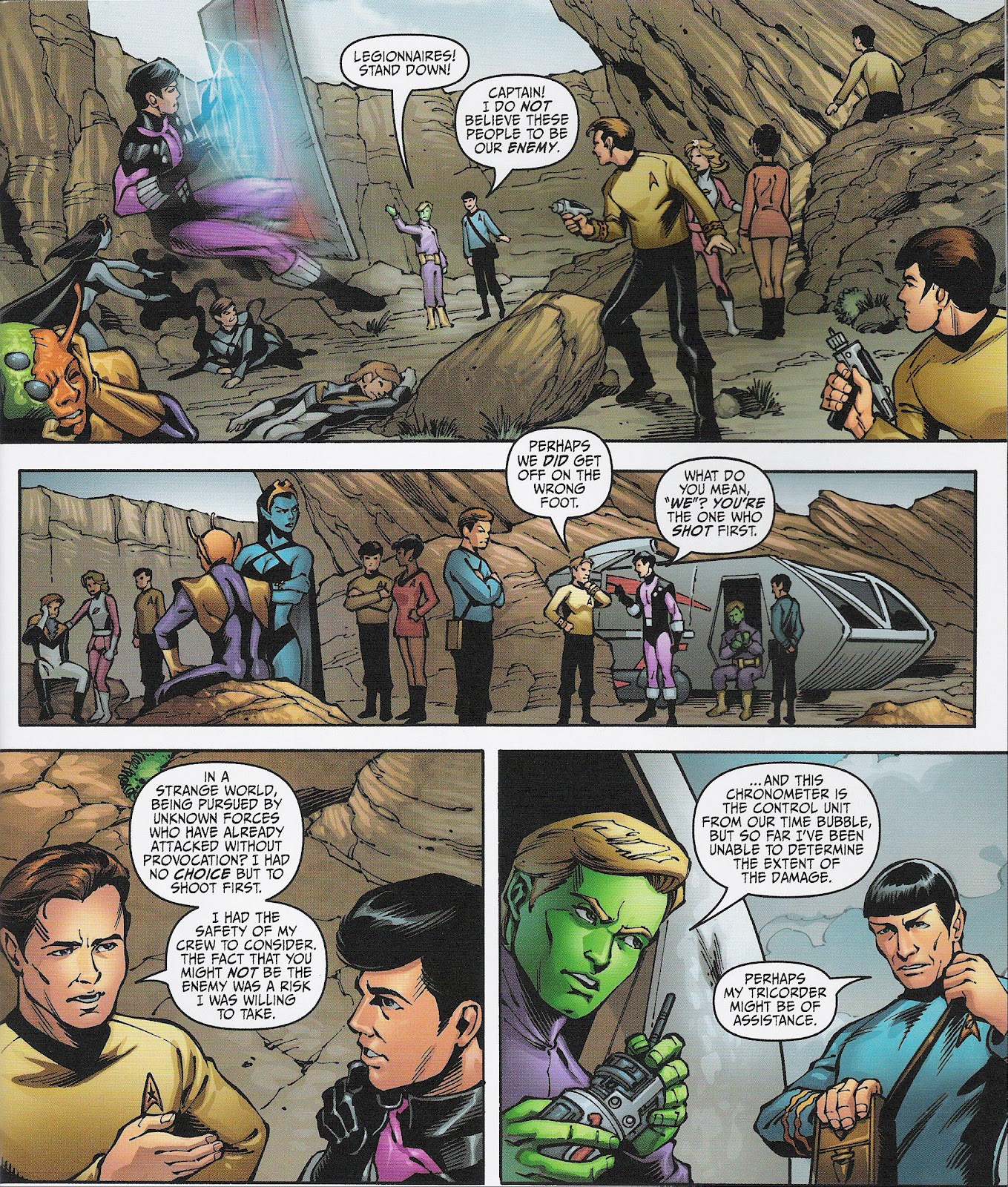
Star Trek/Legion of Super-Heroes 1-6
IDW Publishing/DC Comics
Chris Roberson, writer
Jeffrey Moy, artist


It's just a given when two unrelated teams of good guys meet in the pages of some crossover comic: There will be a misunderstanding that leads them to fight before everyone involved realizes that they are all good guys and they finally join forces to defeat the real bad guys. The exact reasoning or setup behind the misunderstanding varies from story to story; some are better and some are weaker.

Bringing two completely different properties like the original crew of the starship Enterprise and the Legion of Super-Heroes seems like it should be an entertaining mash-up. Not only are each of these groups of people from different realities and genres, they are from different times, as well. The original "Star Trek" is set in the 23rd century, while the Legionnaires are from the 30th. Bringing both together involves enough manipulation that each group could be forgiven for not immediately knowing who the good guys and bad guys are in what they are being confronted with. However, I took issue with the fact that when these two teams find each other, it is clearly the Enterprise crew "throwing the first punch." Once the misunderstanding is resolved, Kirk offers an explanation for his actions, and some others might disagree, but I think the rationalization offered is out of character for Jim Kirk.

Once all of the good guys are friends and join forces, there is what might be another slight continuity gaffe in the pages of this crossover. As the two teams are attacked by an amalgamation of the Fatal Five and several menacing aliens opposed to the United Federation of Planets, Lt. Nyota Uhura from the Enterprise compares one of the combined villains to her Orion roommate from Starfleet Academy. Now the rebooted Lt. Uhura in the J.J. Abrams "Star Trek" film was shown to have an Orion roommate at the Academy, but I don't know that this is canon for the Nichelle Nichols classic version of Uhura, and it is indeed the classic versions of these Star Trek characters who appear to be in this story. Of course, there is also nothing in the classic Trek canon to contradict Uhura having an Orion roommate, so maybe that isn't a change in the Abrams film, but just the way things always were. So, I guess I'm being nit-picky with that observation.

Remove those two things, and this was a fun series throwing these two sets of characters together. The interior art by Moy is very nice. And to further bump up the art scale, covers for the series were illustrated by Phil Jimenez and longtime Legion artist Mike Grell, among others.

All in all, this was a fun series making great use of the histories from both properties to craft a new tale well worth reading.

Friday, July 27, 2012

One To Beam Aboard

Star Trek Ongoing 1-3
IDW Publishing
Mike Johnson, writer
Stephen Molnar, artist


IDW has produced some great Star Trek comics since obtaining the license several years ago. This comic, set in the rebooted film universe, looks to be another fine addition to their catalog of Trek.

The first two issues of the series revisit events from the classic original series episode "Where No Man Has Gone Before," and the third issue begins a two-part re-examining of the events from the episode "The Galileo Seven." That doesn't mean these tales are simple re-tellings of events already played out. Keeping consistent with the premise of the J.J. Abrams movie from 2009, these tales incorporate some subtle and some not-so-subtle changes to what fans recall. And the art has just the right level of modeling the new actors' features one would expect from a property based on live-action television or film.

Of course, it would be nice to see these creators stretch and produce some completely original tales with these characters traveling a slightly different path than expected, but these initial three issues are a delight for long-time fans who can quote chapter and verse of what has gone before, and seem quite accessible and entertaining for someone new to the franchise.