Nightwing 5
DC Comics
Kyle Higgins, writer
Eddy Barrows, artist
We're still in the middle of the first story arc of this title wherein Nightwing travels back to Haly's Circus where he grew up. He reconnects with some old friends and uncovers a mystery tied to the circus just in time to be handed control of the entire circus operation. At the same time, an assassin sets out to kill Dick Grayson, who he believes to be the "fiercest killer in all of Gotham." While trying to eliminate Grayson, the assassin, Saiko, learns that Grayson and Nightwing are one and the same.
This issue sees the circus traveling to New Orleans where one of the clowns is attacked by a voodoo-conjured demon. Adding a supernatural element like this seems a little out of left field for a book like Nightwing, but even moreso, this particular plot line has nothing to do with the overall story of the assassin or the circus mystery.
The book does contain two pretty key scenes that advance the circus story line and serve to tie that mystery in with the one of the assassin. This is achieved by both revealing the true identity of Saiko at last, and revealing another character who seems to be setting Nightwing up for betrayal, but neither scene is crucial to the other events in this issue.
To be fair, Higgins comes up with a very logical way for the non-superpowered Nightwing to use his detective training and defeat the demon with only his wits and acrobatic skills. And this isn't a bad stand-alone story judged on its own merits. But in this age of writing for the trade, this story feels like extra padding and breaks the natural flow of the overall tale.
Tuesday, September 11, 2012
Sunday, September 09, 2012
More Of The Same, But That's OK
The Lone Ranger Vol. 2 1-2
Dynamite Entertainment
Ande Parks, writer
Esteve Polls, artist
The cover for the first issue of this series, at least on my copy, is a beautiful rendering of the Masked Man and Tonto by Alex Ross which evokes the spirit of the late Clayton Moore and Jay Silverheels. That's certainly "my" Lone Ranger and Tonto as I grew up watching reruns of "The Lone Ranger Show", but it might be a tad misleading if you were picking up this series for the first time.
Brett Matthews, Sergio Cariello and John Cassaday did a spectacular job and took their time reimagining the origins of the Lone Ranger in the 25-issue Volume 1 of this series. The story they wanted to tell is done, so Dynamite chose to end that series and start over with a new No. 1 and a new creative team. However, this new series picks up where the first left off. John Reid is still new to his masked role as a bringer of justice to the West, and Tonto is still his often silent, but very wise and sarcastic partner in his quest. Polls' art even mimics the depictions of the two men that Cariello and Cassaday created for the first volume, helping to ease the transition for readers of the first volume.
This incarnation of the Lone Ranger and Tonto is certainly not Clayton Moore and Jay Silverheels, but it is not impossible to envision these two men getting used to each other and their mission one day growing into that pair. And especially in the case of Tonto, and the depiction of other Native American characters in the series so far, the change is for the better. In this series, Tonto is by far the more experienced fighter, quite possibly a little older and definitely a little wiser and more even-tempered than his companion.
These first two issues are the opening chapters in a story arc called Hard Country. In the first issue, the Lone Ranger and Tonto come to the aid of a rancher and his children being attacked by thieves set on stealing a "secret stash" of money. The second issue, picking up where the first leaves off, deals with a famous lawman and gunslinger facing his own mortality. So these two comics provide nice done-in-one stories that are rare these days while still providing a continuing arc that is telling another story about the realities of life on the frontier.
Overall, these first two issues provide a nice opening to what I hope will be a long and prosperous run for this title.
Friday, September 07, 2012
It's Criminal ... With A Twist
Fatale 1-3
Image Comics
Ed Brubaker, writer
Sean Phillips, artist
***mature content warning***
This is the same creative team that produced Sleeper in 2003 and 2004 from DC Comics and the more recent Criminal stories from Marvel Icon. Like Criminal, this story focuses on a collection of ne'er-do-wells with nary a cape or superpower in sight. In fact, the story so far focuses on three distinct time periods' worth of folks -- the first in a contemporary framing sequence story, the second events from the 1950s which preceded the modern occurrences, and the third, and so far area where the least has been revealed, a fictional manuscript written by one of the players from the 1950s drama and discovered in the modern sequence of events.
So what sets Fatale apart from the other Criminal story arcs produced by this pair? The addition of a supernatural element to the story, not limited to but certainly focused on the character of Josephine, the titular femme fatale, who plays a role in all three settings so far.
The modern hero is Nicolas Lash, the godson of recently deceased crime noir author Dominic Raines. Lash meets Josephine at Raines' funeral, and in less than a day, Lash finds the previously hidden manuscript and has his life threatened multiple times, each time being saved by the mysterious Josephine, often in ways Lash cannot explain.
The flashback sequences to the 1950s focus on Raines' early life as a journalist, newlywed and soon-to-be father. Raines is trying to bring down a pair of corrupt police officers and enlists the help of one of those officer's girlfriend -- you guessed it -- Josephine. Raines becomes involved with Josephine romantically, though he isn't certain why, and though she is helping him to bring down the corrupt officers, one gets the sense it is more for her own benefit than for justice.
Mixed in with all of the noirish crime-drama, however, are a trio of enforcers who seem to appear out of thin air. They answer to a boss they refer to as "the bishop," who has oddly glowing red eyes, has promised one individual a cure for his life-threatening cancer, and seeks to control Josephine.
I opted to try this series based on the Criminal work by Brubaker and Phillips. I am intrigued enough to continue with this series even though it isn't quite the same flavor of story. The supernatural elements, at least so far, have been downplayed somewhat, and I'm enjoying the mystery of what exactly is going on.
Tuesday, September 04, 2012
Talk About Your Uneven Match-Ups
Green Arrow 5
DC Comics
Keith Giffen and Dan Jurgens, writers
Dan Jurgens and Ray McCarthy, art
I didn't find fault with this title in the first four issues, reviewed here, but others did. That prompted this first of two recent creative shakeups on the title.
Keith Giffen joins Dan Jurgens to split plotting duties with this issue and the results are a somewhat mismatched mash-up.
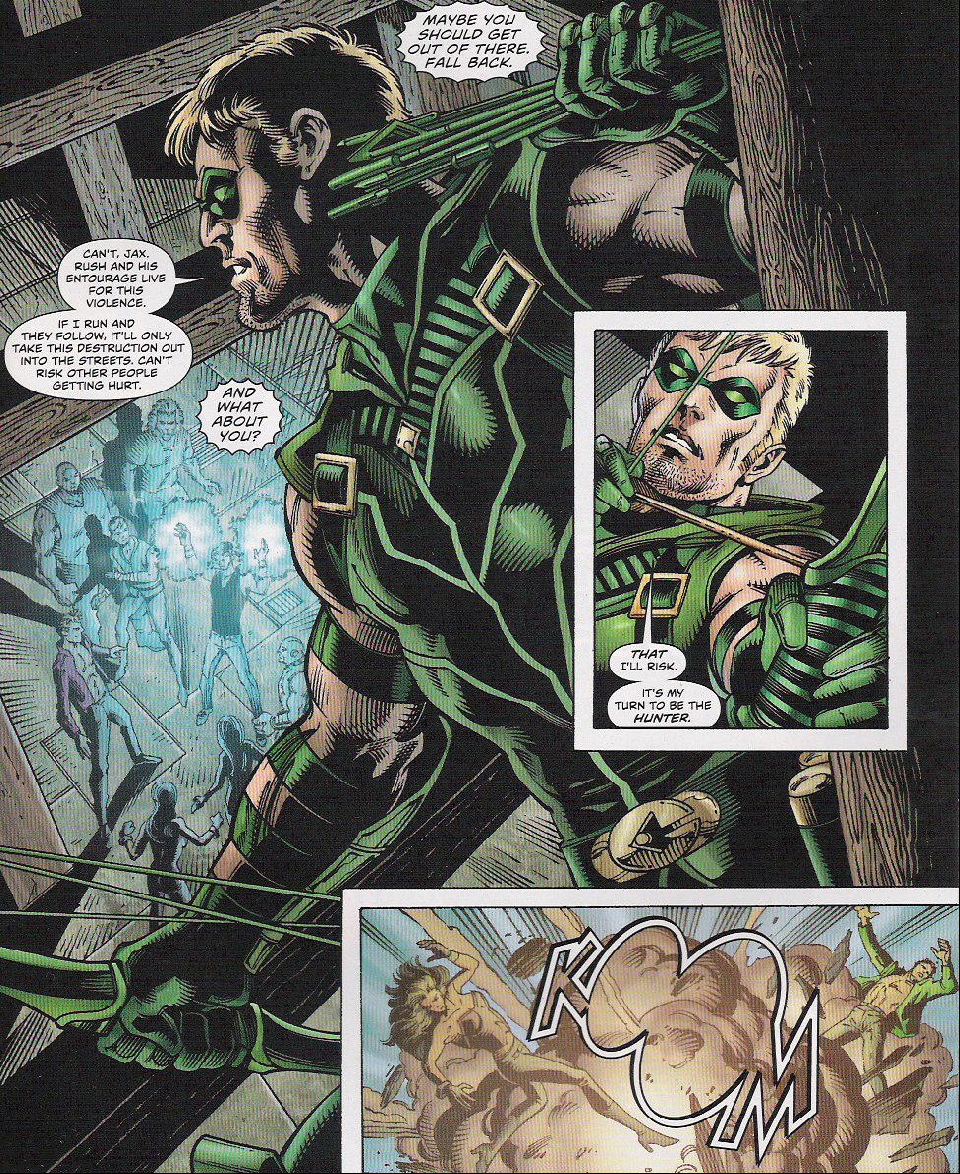
A red-clad ninja attacked Oliver Queen in the previous issue and was surprised when Green Arrow showed up and defeated her. This issue finds her returning to her partner to rest up before challenging the Emerald Archer once again. Her partner, a dark hulking figure, is revealed for the first time in this issue as a Swamp Thing-type creature composed entirely of toxic substances. This individual, not named in the issue at all (but I'm guessing he's the "Midas" from the story's title), decides to go after Green Arrow himself to prevent the ninja, Blood Rose, from being defeated again.
This seems like it would be a rather uneven fight, especially in the panels above when Midas strikes Green Arrow in the face with his toxic hand and draws blood. Who knows how many toxic substances entered our hero's blood stream in that moment and the fight likely would be over right there. But no, GA emerges from this and a few other direct contact moments with seemingly few ill effects.
As a friend pointed out, this is superhero comics, which often rely on a healthy suspension of disbelief, but this seems like a glaring inconsistency, and far less than I would expect from two solid creators. Hopefully Giffen and Jurgens come up with better for the next round promised in issue 6. But if not, thankfully, yet another writer is soon to take over the reins of this book.
Sunday, September 02, 2012
Beware The Dreaded Kryptonian Calf
Action Comics 5
DC Comics
Grant Morrison, writer
Andy Kubert, artist
This issue of Action Comics might seem a bit out of place at first glance, telling as it does the origin of Superman. But the events being related here by the on-board computer in baby Kal-el's rocket ship make a sort of sense, not to mention reveal the punchline of a joke begun in issue No. 2.
The issue opens on Krypton as that dying planet's final moments begin, as one might expect, but the differences in this continuity become immediately apparent. Kryptonian scientist Jor-el plans to save his entire family -- himself, wife Lara, infant son Kal-el and dog Krypto -- by sending all of them into the Phantom Zone. This plan quickly goes awry, however, when the Phantom Zone criminals -- inmates sentenced there by Krypton's Science Council -- try to exact revenge on the Zone's discoverer, Jor-el. There is little time to develop a back-up plan, and so the doomed parents try to save their baby in an untested model rocket, ordering the on-board Brainiac computer to find a suitable world to take their son.
The rocket also relays how it came to arrive on Earth, crash-landing in Kansas. We see the young couple who happen upon the rocket and discover the baby inside. And we see the military's quick response to an unidentified flying object entering Earth's atmosphere and crashing down in the middle of the country. (This is also where we discover the true origins of what the military brass think is the true appearance of Kryptonians, as revealed in Action Comics No. 2.)
So why place this story after we've seen Superman's public debut in Metropolis and after he's captured and tested/tortured by the U.S. Army and Lex Luthor? When Superman escapes from military custody in issue No. 4, he sees his rocket ship being held by the military. This is the first time Superman has seen the ship since he was a baby, and when he touches the rocket, it "awakens" from a dormant state and speaks to him. I like to think the ship is speaking in this issue to Superman. His touch caused it to relate his history to the young man who previously knew nothing of Krypton or his true origins.
We also see the aftermath of that encounter with the military as Superman must leave without the ship. He tells it to protect itself and that he will be back. The ship speaks next of events we have yet to see and a dawning age of superhumans. And then we see four strange visitors arrive and break through the protective layering surrounding the ship.
Before the issue ends, we are also given a small back-up story which gives more details of the lives of Jonathan and Martha Kent before the arrival of the rocket ship from Krypton. These details aren't of the everything-you-know-is-wrong variety, but rather serve to flesh out the early lives of these characters who are so important to Superman's story, but often overlooked in and of themselves.
All in all, not a bad issue, and certainly a nice segment in the masterpiece Morrison and company are weaving.
Friday, August 31, 2012
Just How Much Can These People Take?
The Walking Dead tpb Vol. 15: We Find Ourselves (collecting issue Nos. 85-90)
Image Comics
Robert Kirkman, writer
Charlie Adlard and Cliff Rathburn, artists
I've talked about discovering The Walking Dead before here and here. Here we are again at Volume 15.
These trades don't read like superhero trade collections. Collecting six issues is a standard length for a trade these days. Depending on story content, some might be only four or five, other might include seven or eight or more regular issues of a series. But with a typical superhero trade collection, there is a definite issue break. Often, specific covers are reprinted before each "chapter" of the story in a trade, but even without those, I suspect most readers would have little problem pinpointing the transition point between issues. Not so with The Walking Dead trades. Sure, I could count pages if I wanted to or maybe even spot the issue breaks in other ways, if I really wanted to. But my point is that these trades truly read like one long ongoing story. The transition from issue to issue is smoother in these books as one chapter naturally flows into the next and each book flows into the next and these people's journey just plays on and on. That's not meant to be a criticism or a subtle way of complaining that the writing is boring and drudges on. For me, it helps give me that sense of how much these survivors have faced since their world turned upside down.
This trade opens after a rather horrific zombie attack seen in the last trade. After losing the prison they'd called home for several issues (and a few more cast members), Rick Grimes and company make their way to a walled community. They find a group of people living there in relative peace, but these folks have become somewhat complacent by their circumstances. That's what led to the attack in the last trade. Now the folks who are left must clean up the zombie carcasses, some of whom used to be friends the day before and repair the damage to the wall. They don't stop there, however; Rick, now in charge of this larger group, solicits ideas to fortify the community's defenses, make them stronger and more secure. And the newcomers must also deal with some of the long-timers who aren't too keen on Rick being in charge.
As this tale wears on, it is becoming more and more obvious the toll being the leader is taking on Rick. He feels responsible for all the life and death decisions he is forced to make, and fears that they are becoming easier to cope with.
This continues to be a story not about zombies so much as about the people trying to continue to survive in a world filled with zombies -- what they are forced to do to survive, what they are willing to do to survive, and how those changes and decisions affect and change them. Yep, still very much enjoying this series.
Tuesday, August 28, 2012
The Sense Of Wonderment Is The Key
Superman: Secret Origin tpb
DC Comics
Geoff Johns, writer
Gary Frank and Jon Sibal, artists
When this miniseries debuted, I was still of a mind to try anything and everything I might possibly like (if I could afford it). My thoughts at the time and for a few years prior were that, sure, I would end up buying some stinkers, but I would miss far fewer gems. In the interest of saving some money, however, I would often try to trade-wait limited series such as this one rather than buy the individual issues. Then, once the trade for this series was solicited, I had shifted my mindset to reflect my new conservative attitude toward buying. I don't necessarily intend to keep every single issue or trade I buy now, some will still be sold, either because I don't ultimately care for them or because they were good, but not likely to be reread so why take up space by keeping them, but I'm definitely buying a lot fewer books these days. So I almost didn't buy this trade. Do I really need another retelling of the origin and early days of Superman? Even folks who don't read comics know that basic story, right?
I'm glad I decided to take a chance on this one anyway. Johns and Frank had a solid run on Adventures of Superman prior to this series coming out, and it was partially on the strength of those issues that I took a chance here. And they didn't let me down.
Johns skips over the parts of the story most people can quote verbatim, instead focusing on key moments in Clark Kent's early childhood -- re-establishing his time as Superboy into the character's continuity along the way -- and debut in Metropolis. And there's something about the way Johns handles the character that brings out the sense of wonder at someone discovering he can fly and deflect bullets and help people. This book and Johns' characterization of not only Superman, but the other characters around him, help the reader rediscover what it was like to be a kid and enjoy such adventures from that perspective. From Clark's first learning of his true origins, learning to cope with his emerging powers, his first encounters with Lex Luthor and the Legion of Super-Heroes to his first day at the Daily Planet and his public debut in costume -- this book is pure fun and wonder.
Of course, it doesn't hurt that Frank's art is nice to look at, too, but I especially love the way both his depictions of Clark Kent and Superman are modeled on Christopher Reeve, the true Superman of my generation. I've enjoyed old episodes of "The Adventures of Superman" with George Reeves, and the more modern "Lois & Clark" with Dean Cain and "Smallville" with Tom Welling, but I was 11 when "Superman the Movie" debuted, and Christopher Reeve is "my" Superman brought to life. It doesn't hurt that this character looks and feels like him.
Sunday, August 26, 2012
One Great Story, One Long Greek Tragedy
The Manara Library Vol. 1 hardcover
Dark Horse Books
Hugo Pratt, writer
Milo Manara, artist
***mature content warning***
This volume contains two stories: Indian Summer and The Paper Man. Of the two, the much shorter Paper Man is the better. Indian Summer is not bad because of its length. In fact, it's not a bad story at all. I just prefer the secondary tale.
Indian Summer opens with two young braves spotting a lone white girl along the beach in Colonial times. The youths assault the girl, and afterward begin to frolic together in the ocean. A third young man comes upon the scene, and deducing what has happened, shoots and kills both of the young Indians. Feeling himself a hero, this young man gives the girl back her torn clothing, kisses her despite her protests, and decides to take her back home where his mother will know what to do next. Almost this entire opening scene takes place without dialogue.
What follows is a tale of Puritan America, hypocrisy, incest, sexual and physical violence, friends attacking friends only to go along with peers -- it is NOT a happy story by any stretch of the imagination. A story doesn't have to be happy for me to enjoy it, and certainly the subject matter would seem to preclude happiness, but I just didn't care for this tale. None of the huge cast of characters is really very likable. This reader, at least, was left feeling pity and contempt for most of them rather than empathy.
The Paper Man is also set in Frontier America. It also is not a very happy story. But this tale, unlike the first one, has moments of whimsy that override the sadness. The title character is a young man traveling through Arizona on his way to Canada. Along the way, he happens across first a lone British soldier seemingly still wrapped up in the Revolutionary War, and a young Sioux woman charged with some unspecified crime. Circumstances throw these three travelers together again and again despite attempts to go their separate ways, and the reader feels their growing affection for each other along the journey in spite of their various protestations. These characters, I developed an affection and appreciation for.
I hope to get the other volumes in the Manara series because his art is very good, but this first volume was a bit uneven for my tastes.
Friday, August 24, 2012
Now It's Her Turn To Suffer A Broken Heart
Black Widow: Web of Intrigue hardcover
Marvel Comics
various writers and artists
This is another collection of Black Widow tales from Marvel Comics, but not necessarily all-inclusive. This volume contains the four-part Black Widow story from Marvel Fanfare Nos. 10-13, a black-and-white Widow tale from Bizarre Adventures magazine No. 25, and the Black Widow graphic novel, The Coldest War.
The Marvel Fanfare series in its original printing was my first exposure to the character. The tale is very convoluted but nicely told by co-writers Ralph Macchio and George Perez. The art in this four-parter is also by Perez, so you know it's highly detailed and very gorgeous. The two creators pit Natasha against a succession of villains and assassins, much of it playing on her relationship with her companion and father-figure, Ivan.
The black-and-white tale is more a straight-forward espionage tale as befits Marvel's magazine content from the time period, which was often geared for an older audience. Natasha wears her trademark skintight bodysuit, but she is the only costumed individual in the story which is otherwise populated by uniformed soldiers and trenchcoated spies and double-agents.
The Coldest War is a tour of the Black Widow's past, bringing her former husband, the Red Guardian, back into the mix while also focusing on her former relationships with other costumed heroes Hawkeye and Daredevil. Ultimately, the resurrection of Natasha's husband is not quite what it seemed, and the Widow is once again left alone at the end of the tale.
Overall, this hardcover was a nice return visit to a tale I enjoyed several years ago, and a chance to read two tales I hadn't previously been exposed to. I'm glad I had a chance to read them, but there was little here that made me think I would revisit these stories any time soon again.
Tuesday, August 21, 2012
Good, Just Not What I Was Expecting
Unknown/Unknown: The Devil Made Flesh trades
BOOM! Studios
Mark Waid, writer
Minck Oosterveer, artist
I'm on a Mark Waid kick, I guess. This is the third and fourth series by him I've read recently. But man, can that man write some truly intriquing, interesting characters!
I happened upon a 10-page preview of the initial Unknown either in some other book I was reading or maybe online somewhere. That preview introduced the situation and two main characters for this four-issue series originally published in 2010. There's Catherine Allingham, a world-famous detective known for her keen ability to crack "unsolvable" cases. We also learn quickly that she is being "haunted" by hallucinations. And we learn that the cause of those hallucinations is an inoperable tumor, which prompts Allingham to hire James Doyle to assist her with what she believes will be her last case. We see Doyle's powers of observation and his own considerable deductive skills at work when he busts a co-worker for stealing from his "friends," which is what impresses Allingham enough to hire Doyle on the spot.
After all that, I wanted to read more, and seeing Oosterveer's fantastic art on those preview pages only sweetened the deal. I've never heard of him prior to this series, but the man draws real pretty. Yet, his work has a down-to-earth quality I thought worked well with what I believed to be a grounded story much like Waid's earlier Potter's Field.
Now, in all fairness, on the very first page of the book (and the preview I'd seen), we see one of Allingham's hallucinations, and the guy she is seeing can only be described as creepy looking, vaguely vampire-like, but definitely something of a supernatural nature. That likely should have been my tipoff that things might not stay as grounded as I was expecting, but it didn't. Allingham wakes up to see this figure calmly sitting by her bed, watching her sleep. She stares at him for a beat, neither saying a word. Then she takes a few pills from a bottle on her nightstand, swallows them, and the guy fades away. Straight-up hallucination is what I thought. That's my story, and I'm sticking to it.
As it turns out, however, I should have read more into that hallucination. The unknown of the title refers to the afterlife, and Allingham's determination to find out what awaits her after death before she reaches that point naturally. So there is a DEFINITE supernatural element to this story. Now, that isn't necessarily a bad thing. It can be quite a good thing in some stories. And I in no way mean to imply that this is a bad story. But I went in expecting a grounded-in-reality story and didn't get that. SO I WAS a tad disappointed.
I was so certain I would like the story, however, based on the 10-page preview, that I didn't just buy the trade collection of Unknown, but also the follow-up trade, Unknown: The Devil Made Flesh, which opens with Doyle trying to land a job in Italy. One year has passed since the first arc, but it quickly is made obvious that Doyle has little memory of Allingham or their adventure together. When chance reunites the pair, it is also clear Allingham has no memory of Doyle, either. What's more, she is still alive and kicking despite her inoperable tumor, and is telling a new acquaintance that she has been given six months to live. Obviously, another adventure follows, this one even more steeped in the supernatural than the previous one. Again, not a bad story at all, but not what I was initially expecting from this series.
Put these down as definitely worth a read, but mildly disappointing due to my own LACK of observation skills, I guess.
Sunday, August 19, 2012
Be Careful: She'll Break Your Heart
Black Widow: The Sting of the Widow hardcover
Marvel Comics
various writers and artists
This volume collects some of the earliest appearances of Marvel's Back Widow, Natasha Romanova. In fact, these are so early in her career, the character still doesn't even have a last name by the end of this volume, still being referred to in her civillian identity as simply Madame Natasha.
The Widow's first appearance, facing off against Iron Man from the pages of Tales of Suspense No. 52, is the lead-off story in this collection. This volume is not for completists, however, as the next story included is Amazing Spider-Man No. 86, wherein the Widow first adopts her modern costume. The intervening adventures for the character are summed up in a text piece, but one gets the idea this involves several years' worth of guest appearances in many Marvel books.
Following her appearance in Amazing Spider-Man, the Black Widow moved to headlining Marvel's Amazing Adventures comic with the Inhumans. The first eight issues of that title's Black Widow stories are included, followed by her guest-appearance in Daredevil No. 81, which is the last adventure reprinted here.
Overall, these stories depict a Black Widow who goes from villainous Russian saboteur to immigrant-American superheroine and espionage agent. She is a very competent fighter employing martial arts skills along with her trademark Widow's sting and weblines. She tackles some villains along with a few social injustices, as comics of this time period sometimes did, but there is a heavy soap opera quality that is also present in comics from this time period which starred a female lead. That melodramatic quality might detract for some, but overall this is a solid read for anyone curious about the beginnings of the Black Widow character.
Friday, August 17, 2012
It's All About Character
Potter's Field
BOOM! Studios
Mark Waid, writer
Paul Azaceta, artist
This is another series that passed below my radar when it first came out in 2007, but I've since heard good things about the three-issue series, and I've come to appreciate the writing of Mark Waid whether it is on iconic company-owned characters or his own creations. Finally managed to get my hands on copies of the individual issues earlier this year and enjoyed this series enough to hope BOOM! produces more at some point.
The title of this series refers to the generic term given to cemeteries where unnamed individuals are buried. Many big cities will have a community burial spot for unidentified bodies never claimed by family or other survivors.
The central character, about whom little is known, is simply called John Doe by those few who know of him. For unknown reasons, he makes it his mission to identify these unnamed dead, giving survivors a sense of closure but also giving the dead the respect that comes with not dying anonymously, unmourned.
Through his various investigations, John Doe comes into contact with many people, some of whom might have skills which can aid him in the future, so he maintains "contacts" with a select few. One of these associates inadvertently divulges some of the mystery man's secrets, allowing a living client for the first time to reach out to Jon Doe for help.
This title is populated by some truly fascinating characters. I guess that is one of the appeals I find in Waid's writing. The man creates some truly interesting, layered individuals who are engaging to read about.
Tuesday, August 14, 2012
All About The Gotcha!
Empire 1-2/1-6
Image Comics/DC Comics
Mark Waid, writer
Barry Kitson, artist
***mature content warning***
I don't know the entire history of this title, but it debuted from Image Comics in 2000 and saw two issues published before disappearing. I first heard of the series in 2003 when DC Comics agreed to publish the limited series by the popular writer/artist team. DC released a special 0 issue which reprinted the earlier Image books, and then completed the series as a six-issue mini. I bought the six new DC issues, but preferred to hunt down the original two from Image for the beginning of the story and recently reread this series while in the process of trying to winnow down my enormous collection to a more manageable size.
This series holds up to multiple readings and will continue to take up space in my collection; it's just that good.
The basic concept of a major villain winning the day and taking control of the planet is not a new concept. Many writers and artists both in and out of comics have tackled the premise before to varying degrees of success. Even series co-creator and writer Mark Waid has mined this popular concept in his current BOOM! title Irredeemable, which I also enjoy.
I just find Empire to be a step above in originality and surprise factor. Because the core concept has been done so many times, it is easy to fall into cliche and that much harder to surprise readers with story developments. But Waid is operating on all cylinders with Golgoth and crew and produces some truly great twists. There are several developments which were perfectly foreshadowed in retrospect but which nevertheless caught me off-guard on first reading. I won't reveal them here to preserve the shock value, but seek out this series, if you've never read it before. Waid's writing and Kitson's gorgeous art make it well worth a look!
Sunday, August 12, 2012
Anticipation Is Making Me Wait
Elephantmen Vol. 4: Questionable Things
Collects issues 24-30 and more
Image Comics
Richard Starkings, writer
various artists
***mature content warning***
I first tried and reviewed Elephantmen here. This is still a great book, that's why I'm still buying it four humongous trades in. Rather than spoil details from this collection, I'm gonna discuss these wonderful trades in general.
I started out with the trades because I was coming into this series late. I've stuck with the trades because it is always hard to know when to start picking up single issues to avoid duplication until you know what the next trade will contain, and by then, it is too late to order some of the singles in between.
Some potential buyers might be put off by the higher price tag that comes with these Elephantmen trades. They typically run $24.99 retail, whereas most other trade collections run between $12.99 to $18.99, depending on how many issues are included and how popular the title. The thing to remember is, these Elephantmen trades tend to be four or five times as big as the average trade, typically containing an average of seven or eight complete issues of the regular series and tons of extras like sketches, behind-the-scenes notes and more. Seriously, these things are huge, so you are actually getting more bang for your buck with these trades than with most others.
That means the only real drawback to buying this series in trade is the slightly longer than normal release time between trades because of how much content each one contains. But again, they are worth the wait.
Friday, August 10, 2012
Strolling Down Memory Lane
Captain America & Bucky 622-625
Marvel Comics
Ed Brubaker and Marc Andreyko, writers
Chris Samnee, artist
These are the final three issues of this arc looking back at the history of Bucky's partnership with Captain America and continuing through some revelations about his time as the Winter Soldier. This book continues the numbering from the previous Captain America series and is featuring rotating co-writers with Ed Brubaker and rotating artists for each arc.
This look back at Bucky's history isn't so much an everything-you-know-is-wrong retcon as comics are somewhat notorious for. Rather, Brubaker and Andreyko craft several solo stories narrated by the modern Bucky about his past relationships with Cap, the Invaders and Black Widow, among others, which serve to flesh out the character -- especially his current incarnation as created by Brubaker -- and add some welcome depth to Bucky's backstory. Nothing here contradicts what has come before, but rather adds to the mythology, building on what other creators have done.
That isn't a new idea; in fact, it's a convention that is quite popular now (and much appreciated by this longtime fan). Comics don't always get credit for building on what has gone before, but when done right, these kinds of stories give continuity a good name.
Well done, all!
***************************************
On a housekeeping note, I think the Tuesday/Friday schedule is working well enough that I want to add a third post each week. Sunday would seem to be the next natural day to add, so check back here this Sunday for another all-new post in addition to the ones on Tuesday and Friday. Hope to see you then!
Tuesday, August 07, 2012
Plumbing The Depths
Aquaman 1-4
DC Comics
Geoff Johns, writer
Ivan Reis and Joe Prado, artists
This was the title I saved for last because it was going to hold the least surprises. I get too much Aqua-info from almost daily visits to Rob Kelly's Aquaman Shrine (and am typically behind enough in my reading) that sitting down with these four books brought little new information. They've all already been reviewed on the Shrine.
That doesn't mean these four books weren't a joy to read. Johns "gets" Aquaman in a way true fans have always appreciated the character. What's more, with his writing, Johns is not just showing why Aquaman isn't just a lame hero who talks to fish; he's taking those jabs and dealing with them head-on by including them in his narrative. This is a hero who lives in a world where many common folk DO think Aquaman is a joke and aren't shy about telling him that to his face. And Aquaman gets back at them not by fuming or shouting, but by showing them just how awesome and inspirational he can be.
Johns is crafting some truly original, highly imaginative stories that still manage to incorporate what other creators have done and build upon that foundation, much as he has done with other characters in recent years. It's no wonder Johns is the chief creative officer at DC. And Reis and Prado are doing simply beautiful work illustrating what Johns is writing.
If you aren't picking up this book, do yourself a favor and get it in back issues or trade. You'll be glad you did.
Friday, August 03, 2012
There's Promise, But Just Not Quite Enough
Teen Titans 1-4
DC Comics
Scott Lobdell, writer
Brett Booth, artist
This was another title that DC made pretty easy for me to drop.
The New 52 version of Red Robin/Tim Drake isn't too far removed from his characterization from before Flashpoint, but then, I think Tim/Red Robin was being written a little too dark, brooding and bossy -- a little too Batman at his worst portrayals -- for my tastes both in his own book and some of those later pre-New 52 Teen Titans issues. The new Wonder Girl/Cassie Sandsmark is just not likable at all, and the new Bart Allen/Kid Flash is Impulse-annoying at his worst. Add a Superboy regressed back into being a footsoldier for the bad guys, and the existing characters in this team aren't much of a draw for me.
The new characters introduced with the reboot show promise. Bunker is the only character who seems to have a sense of humor about anything, but he's also a bit too flamboyant for my tastes. I'm intrigued by Skitter and Solstice, but they're deliberately being kept mysterious at this point, so there's really not much draw in their promise, either.
Add to that the announcements (current at the time I read these four issues) of a major crossover between this book and two other existing titles I don't normally get which would lead into the creation of yet another tie-in title, and Teen Titans just seemed too expensive to follow for the very little bit of enjoyment the title was bringing me. This title got dropped before the pending crossover could begin. And if sales figures are an indicator, the new title springing out of the crossover, The Ravagers, is not doing so well.
Tuesday, July 31, 2012
The Man Of Steel Gets Pouty
Superman 1-4
DC Comics
George Perez, writer and breakdowns
Jesús Merino, pencils and inks (Nicola Scott, artist on issue No. 3)
We're back to being slightly underwhelmed with a title from DC's the New 52. These first four issues are not a complete story arc, and I confess I AM curious how the story will end, so in that regard, they've got me.
Unlike with the Frankenstein title discussed a few weeks ago, the art is not a problem this time out. Perez's covers are gorgeous, as one would expect from this longtime fan favorite artist. The same goes for the art from series regular Jesús Merino and fill-in artist Nicola Scott. This time, the problem is more the story, and to a lesser extent, the pacing.
When Perez reinvented Wonder Woman in 1986, his first turn as a writer and not just an artist, he took a great deal of time revealing the history of the Amazons and the Greek gods along with the tale of his main heroine, Princess Diana. He seems to be following a similar formula here. Perez is not dealing overly much with the history of Krypton, leaving that to his Action Comics counterparts, Grant Morrison and Rags Morales, who are detailing Superman's early career. Instead, Perez is focused on the tapestry of Metropolis, the Daily Planet and familiar faces like Perry White, Lois Lane, Jimmy Olsen, and of course, Clark Kent.
The difference is that the Wonder Woman story being told back in 1986 was engaging on all levels: the story was interesting, and the heroine was challenged by a threat she truly might not be able to overcome. In this tale, Superman is mysteriously confronted by a series of seemingly alien threats. I'm curious about the nature of the aliens and what their true goal is, but almost any hero could be substituted for Superman so far with only minor changes. Having Superman be an easily replacable character in his own book isn't a great way to engage a reader.
The other draw for New 52 books, of course, is how have things changed from the staus quo readers knew before the reboot. Most of the changes to Metropolis, the Daily Planet and familiar faces like Perry White, Lois Lane and Jimmy Olsen are pretty minor so far. The only character greatly changed is Clark Kent, and he is no longer as easily likable, which can only hurt the title.
I'm just not feeling it with this book.
Friday, July 27, 2012
One To Beam Aboard
Star Trek Ongoing 1-3
IDW Publishing
Mike Johnson, writer
Stephen Molnar, artist
IDW has produced some great Star Trek comics since obtaining the license several years ago. This comic, set in the rebooted film universe, looks to be another fine addition to their catalog of Trek.
The first two issues of the series revisit events from the classic original series episode "Where No Man Has Gone Before," and the third issue begins a two-part re-examining of the events from the episode "The Galileo Seven." That doesn't mean these tales are simple re-tellings of events already played out. Keeping consistent with the premise of the J.J. Abrams movie from 2009, these tales incorporate some subtle and some not-so-subtle changes to what fans recall. And the art has just the right level of modeling the new actors' features one would expect from a property based on live-action television or film.
Of course, it would be nice to see these creators stretch and produce some completely original tales with these characters traveling a slightly different path than expected, but these initial three issues are a delight for long-time fans who can quote chapter and verse of what has gone before, and seem quite accessible and entertaining for someone new to the franchise.
Tuesday, July 24, 2012
Hitting The Ground Running
Nightwing 1-4
DC Comics
Kyle Higgins, writer
Eddy Barrows, artist
I'd been actually dreading this title quite a bit. I'd heard bad things about Green Arrow and had really low expectations going in, which likely helped me see the positives of that title. Aquaman, another favorite hero of mine, has gotten nothing but good press so far. So I'm anxious to read it and not nervous at all. Nightwing though, I haven't heard much about. I've always liked Dick Grayson, so I had high hopes for this book. But I don't care for the redesigned costume. I can live with it, but I prefer the previous version. I was afraid the same might be true of the story.
Well, the first story arc isn't quite over yet, but this is still MY Dick Grayson. I can see this character as being a slightly altered version of the one I've been reading for years, which is what I want from the New 52 when I already liked the character to begin with. Please, sir, just give me more of the same.
This has acrobatics, Haly's circus, a cameo by Barbara "Batgirl" Gordon, some sleuthing, some levity.
Kudos to the creative team of this series. Please, keep up the good work.
Friday, July 20, 2012
Two For the Price of One, But Both Disappointing
Catwoman 1-4
DC Comics
Judd Winick, writer
Guillem March, artist
Not much to say about this title. There have been some really good runs on Catwoman in recent years making her a solid headlining character in her own right and not just a Batman rogue. This series seems kind of like a step backward. I've liked Winick's writing on past titles, but he's rather disappointing here. There just doesn't seem to be much new territory here, and if all the title is going to do is rehash existing material, the first time around was often better.
Red Hood and the Outlaws 1-3
DC Comics
Scott Lobdell, writer
Kenneth Rocafort, artist
Another disappointing title. This one didn't even stay on my pull list for the fourth issue. I initially ordered the book for its ties to former Titans characters, but apparently only the names were being used. These two aren't the Arsenal and Starfire I know. I'd rather keep my untarnished memories of the past exploits of characters I enjoyed than try to find some semblance of those characters in these travesties.
DC Comics
Judd Winick, writer
Guillem March, artist
Not much to say about this title. There have been some really good runs on Catwoman in recent years making her a solid headlining character in her own right and not just a Batman rogue. This series seems kind of like a step backward. I've liked Winick's writing on past titles, but he's rather disappointing here. There just doesn't seem to be much new territory here, and if all the title is going to do is rehash existing material, the first time around was often better.
Red Hood and the Outlaws 1-3
DC Comics
Scott Lobdell, writer
Kenneth Rocafort, artist
Another disappointing title. This one didn't even stay on my pull list for the fourth issue. I initially ordered the book for its ties to former Titans characters, but apparently only the names were being used. These two aren't the Arsenal and Starfire I know. I'd rather keep my untarnished memories of the past exploits of characters I enjoyed than try to find some semblance of those characters in these travesties.
Tuesday, July 17, 2012
All-Ages Honest-To-Goodness FUN!
Super Dinosaur 1-6, Origin Issue
Image Comics
Robert Kirkman, writer
Jason Howard, artist
This creative team was responsible for the 25-issue Astonishing Wolf-Man series which I very much enjoyed. They followed that title up with this one. The book follows the adventures of Derek Dynamo, a pretty brilliant young boy, his super-scientist dad, and his genetically altered tyrannosaurus Rex best friend. The T-Rex wears battle armor to enhance his natural, dino-fighting skills. There are other enhanced dinos, but they're some of the bad guys. So this series is all about fighting dinosaurs in battle armor. This is a truly fun book! Do you really need to know more?
Friday, July 13, 2012
He's the MONSTER; Frankenstein is the DOCTOR!
Frankenstein, Agent of S.H.A.D.E. 1-4
DC Comics
Jeff Lemire, writer
Alberto P, artist
I don't like to ever call someone else's art bad. Even if I don't care for it, someone else may see merit and appreciate it, and even if no one does, odds are, the artist in question has done a much better job than I could've done. That said, this art is not for me. Especially when it is placed behind those gorgeous J.G. Jones covers this series features; that's what I would like the interiors of this book to look like.
I'm curious if this is a completely original take on the Frankenstein's monster character or if this version is based on the re-imagining of the character from Grant Morrison's Seven Soldiers series. If the latter is true, I'm even more curious about finally checking out that series. So how about it, anyone out there who can give me an answer on this question?
Anyway, back to this title, I've always liked the concept of the Creature Commandos, and I liked the ideas used in the Flashpoint title which preceded this relaunch, Frankenstein and the Creatures of the Unknown. I like some of the basic concepts presented here by writer Jeff Lemire and really want to follow this title. But that art is just ruining this book for me. I've been trying to make some cuts of late, and this title didn't survive the cut despite my wanting to enjoy it. Chalk it up to the art, at least in the case of this cut.
Tuesday, July 10, 2012
Great Setup; Uneven Follow-Through
Supreme Power (2011) 1-4
Marvel Max
Kyle Higgins, writer
Manuel Garcia, artist
The biggest problem with this limited series is its ending.
I first came to the concept of the Squadron Supreme with the 1985 12-part series from Marvel. The characters pre-date that limited series as occasional secondary characters in The Avengers and several other Marvel titles. Each of the various heroes on the team is a direct analogue of a member of the Justice League. A few years ago, the concept was rebooted as Supreme Power. The series ran for 18 issues, and then has had several follow-up limited series.
That initial reimagining by Gary Frank was very good, but some of the later series seemed to wander away from the core concepts a little too far. This series, focusing on Joe Ledger and Hyperion, returns the series to that core concept and is a very good read because of that fact and a marvelous story from Higgins. In fact, the only shortcoming of the series, as mentioned above, is the ending, or rather, the lack thereof. Obviously, this series is intended to lead right into another one, one which hasn't yet materialized almost two years later. That is a little disappointing.
Friday, July 06, 2012
Return of the Bat ... girl
Batgirl 1-4
DC Comics
Gail Simone, writer
Ardian Syaf and Vicente Cifuentes, artists
I've always liked the Barbara Gordon Batgirl, and I sincerely hope her book succeeds. Simone is a terrific writer who handled the character superbly as the brains behind the Birds of Prey team, and now that Barbara has been restored to her unassisted mobility, Simone is going gangbusters. Little detail has so far been given for how Barbara was healed and left her wheelchair behind, but the wheelchair history is not ignored, either.
Batgirl is again on the rooftops of Gotham City, enjoying the night, when she thwarts the plans of some thrill-seeking serial killers. While terrorizing a family, the killers freely admit they are breaking into homes, torturing and killing people, all for kicks. Batgirl interrupts the quartet's "fun," sending one of the thugs to the hospital. It is here that Batgirl first confronts the main villain of her debut DCnU adventure, a mysterious masked figure calling himself Mirror. His m.o. is to kill those who have cheated death somehow after first showing them their "true" face. Both the face of his mask and the inside of his dark cape seem to be constructed by shattered mirror fragments, reflecting back at his intended victims cracked visions of reality.
Between confrontations with Mirror and trying to track down his identity and motivations, Barbara sets herself up in a new apartment with a new roommate and a new post-Birds life that promises to be an interesting journey. And the art in this book is top notch. No complaints on that score this time out.
Batgirl is a keeper!
Tuesday, July 03, 2012
Fresh Face, But Same Attitude
Green Arrow 1-4
DC Comics
J.T. Krul, writer
Dan Jurgens and George Perez, artists
Now this is a book I can sink my teeth into.
I've read some complaints online that Green Arrow is leaving readers cold, but as a longtime fan of the character, I like this book, and I think it lives up to what I believe the DCnU is trying to do. The hero of this title is not the same archer I was reading about before the rebooted universe came into existence, so it is a new start for new readers looking for something fresh to latch onto. Having said that, though, there are quite a few similar traits in this Oliver Queen to not alienate a longtime fan such as myself with a character I can no longer feel a connection to.
This first arc introduces us to a young, confident Oliver Queen who has inherited Queen Industries from his father. But instead of having a young heir run what is likely a multi-billion dollar conglomerate of companies, Oliver heads the trendy gadget division Q-Core, which produces Q-phones and Q-pads and other high-tech toys for those who can afford them. Q-Core also secretly produces the special arrows and other devices Oliver uses in his covert work as a superhero, and a small team of creative types at Q-Core help the young adventurer create his arsenal of weapons and coordinate his costumed activities.
It makes sense that if GA really existed, he wouldn't be as effective operating completely alone, without the help of a team of support folks. And it is also more realistic that he would have a board of directors and numerous division heads over the various aspects of a real company such as Queen Industries.
Continuing that reality-based theme, this first arc pits GA against a gang of young, super powered villains who don't commit crimes so much for the monetary gain as for the celebrity they receive filming themselves committing crimes and terrorizing people, then posting those videos online. These individuals thrive on the ego-boost they receive from hits and views online.
I hear this is one of the books slated for some creative personnel changes in the near future. I hope I continue to like this book, because so far, for this fan, this one has not disappointed.
Friday, June 29, 2012
Ewwwwwww ...
Animal Man 1-4
DC Comics
Jeff Lemire, writer
Travel Foreman, artist
Not quite sure what to make of this book.
I initially became aware of the Buddy Baker Animal Man character with Grant Morrison's re-imagining of the title as a Vertigo comic before Vertigo even existed. I liked the first five issues, and then dropped the title for some reason I can no longer recall, likely money and/or too many other titles I liked better. I later purchased the entire Morrison run on the title through the three trades DC collected them in. Not sure I was ready for the title when the individual issues came out, but I liked it enough to keep an eye out for the remainder of the series as it went through several subsequent writers. I have since purchased all of the issues of the Vertigo Animal Man after Morrison's run, but have not yet had/taken time to read them.
I next got a taste of Animal Man in the pages of 52, which returned him to a more super-hero style, in my mind, but I like that Animal Man. He wants to be a hero and has super powers, but he's also a family man and the superheroing is kind of like a part-time hobby for him. It's an interesting and not too common dynamic for a superhero title.
Then with the announcement of the DCnU, I learned that Animal Man would be one of the new titles DC was starting out with. I was excited by the idea of a monthly Animal Man book, while also trepidacious about all the talk of it being a horror title by a writer known for horror.
Buddy still has his wife and two kids, and he's a former stunt man who developed the ability to draw on the strengths of various animals. He's a part-time hero/adventurer and a full-time family man. But that family life is threatened when his young daughter, Maxine, begins displaying some abilities of her own. Dead animals seem to be re-animating and being drawn to her. They share with her, and she tries to tell her father, about the dangers of something called The Rot about the same time three monsters, agents of The Rot, show up to try to destroy her. It seems Maxine is a defender of The Red — kind of a carnivore's equivalent to The Green for plants in Swamp Thing — and The Rot wants to corrupt her to its own ends. All of this is new to Animal Man, and he must defend his daughter from these opposing forces.
Well, now that I've read the first four issues, I'm not sure I would exactly call this horror, but it isn't exactly my taste either. This title also seems like it will be heavily interacting and crossing over with Swamp Thing and a few other similarly themed books I don't have much interest in buying. Not sure this is my style of book plus it will tie in with several other books I'm not reading equals this is looking like a book for me to drop.
And, unless this is a completely original take on Lemire's part, it is making me think I might not like some of those later issues of that earlier Animal Man run I have yet to read.
Tuesday, June 26, 2012
Back To Basics, And It Feels So Wrong
Justice League International 1-4
DC Comics
Dan Jurgens, writer
Aaron Lopestri and Matt Ryan, artists
I wanted to like this book. It features Booster Gold prominently as team leader and is written by the man who created the character and later helped bring Booster to, in my opinion at least, true greatness following the events of 52 and Geoff Johns' efforts to reshape him into the time-policing "greatest hero you've never heard of." And maybe, given time, Jurgens will bring that feel of competence and confidence back to Booster. But it isn't there yet.
Yeah, the whole point of the DCnU is to restart these heroes' careers, but Booster really feels like he's coming out a loser from this reboot. And while the characters might not remember what has gone before, I read and liked the stories which preceded the DCnU relaunch and feel shortchanged on their behalf.
This title follows the efforts of the United Nations to create an international super-powered group of heroes they control. You know, because the Justice League has only been around for five years according to the set-up and has saved the world how many times in that history, so they have no allegiance to any nation and can't be trusted. Anyway, weak rationale aside, they pick a known pitch man, Booster, to lead the team because he ought to be controllable, right? Then they fill out the team with Ice from Norway, Vixen from Zambesi, Fire from Brazil, Rocket Red from Russia, August General in Iron from China and Godiva from Great Britain. They also select Guy Gardner to include a powerhouse Green Lantern on the team, but Guy balks at first, especially if he has to take orders from Booster. Oh, and they decide they don't want Batman involved, but the Dark Knight, as always, has his own plans. Not a bad roster of characters, many of whom have been on this team during past timelines, so there's a nod to tradition.
The team's first mission does not go well, however, and it takes first Batman's uncharacteristic encouragement to Booster, and then August General's additional support to hold the various heroes together. They are not yet a cohesive team by the end of the fourth issue, but then, neither is the story arc over yet, so there's time.
As I said, I wanted to like this book. And really, it's not bad. It is, in fact, an entertaining read. But in trying to winnow down my pull list and re-assess my current collecting, I'm afraid this title isn't quite good enough to stay. These days, I'm not just looking for good; I'm looking for great. Sadly, this book is falling short of that so far.
Update: After I read these first four issues but before this post was published, it has been announced that JLI is being canceled following its 12th issue. Guess I wasn't the only one who found this title somewhat lacking.
Friday, June 22, 2012
Everything Old Is New Again
Action Comics 1-4DC Comics
Grant Morrison, writer
Rags Morales and Gene Ha, artists
This book has been so hyped, it offered few surprises; but it DOES offer a solid read with some pretty pictures to go with it.
The story line returns Superman/Clark Kent to his activist, ultra-liberal, fighting against The Man's injustice, 1938 roots. A young Clark Kent is finding his way in Metropolis as a reporter for the Daily Star, making friends with Jimmy Olsen, a photographer from a rival newspaper, The Daily Planet, and butting heads with Lois Lane, a reporter for the Planet. Clark's portrayal is more nerdy than bumbling.
And as for Superman, he's more angry, lone vigilante than his usual portrayal, but that works for this early stage in his career. The first time we see the Man of Steel in action, he plows effortlessly through the hired muscle, straight to one of the city's worst robber-baron types, a man Superman quickly suspends upside down from the top of a building (in a patented Batman move) while he works to scare a confession out of the "rat."
There are changes in this book -- the S-symbol is a bit more stylized, life on Krypton isn't quite like previous portrayals, relationships are tweaked here and there for several familiar faces -- but all of the basics of the story remain the same. I'll continue to pick this book up for a while for Morrison's fresh take on the character.
Tuesday, June 19, 2012
It's A Team Book, Dammit
Justice League 1-4
DC Comics
Geoff Johns, writer
Jim Lee, artist
I've heard a lot of people complain that for a writer known for his character work, Geoff Johns has dropped the ball with this title because it lacks any real characterization, instead opting for little more than slam-bam fights and too-cutesy quips. The criticism is usually joined with the charge that this book, above all others as the flagship title of The New 52! relaunch, deserves better.
After finally having a chance to read some of the DCnU debut titles, I say that Johns DOES add character moments in this title, albeit small ones, and that because this is the BIG team book leading off the relaunch effort, it must be mostly big and splashy or fans would decry the effort as lackluster.
Those of you who've been to this blog before know I tend to be somewhat behind in my comics reading. Life intrudes and quiet moments to sit and read are often precious and few, especially with a new baby in the house. So now that I've finally reached the beginnings of the relaunched titles from DC, I opted to read the first four issues of the titles I bought to get a real feel for the books before commenting. I'm so behind much of the time anyway, maybe I should just trade-wait most of my comic purchases, and do on some titles, but haven't made that switch completely.
Anyway, back to Justice League. This book in particular benefits from reading four issues at once, or even the entire arc. I have no defense for anyone wishing to complain about this book being a little slow in monthly form. This truly is an arc that would be better as a trade so the reader doesn't lose momentum between issues. Because momentum is what a book featuring this many big guns is all about. Early on in their careers, these heroes all give new meaning to the term big guns. Each of these heroes is new to superheroing, and even newer to working with others. I can handle the excess bravado and one-upmanship amply on display here because of that lack of experience. Those attitudes should not continue once this book leaves behind the League's origin and moves to more contemporary stories where the heroes are seasoned by five years of working together.
Also, let's face it: Most of these characters -- all of them, in fact, except Cyborg -- star in at least one title of their own. Those books, most written by other creators, are where the early character development will happen for Aquaman, Batman, Flash, Green Lantern, Superman and Wonder Woman. Those other creators would resent Johns stealing their individual character-defining moments for his group book.
This is a fun superhero romp, and I'm enjoying the ride. If you are wanting deeper characterization, seek out these heroes' individual titles. This book is all about the larger dynamic.
Friday, June 15, 2012
Let's Just Keep Them A Secret
Secret Avengers 16-20
Marvel Comics
Warren Ellis, writer
various, artist
I liked the first couple story arcs of this covert Avengers team operating under the guiding hand of a costumeless Steve Rogers. The book had several characters I like teamed for specific missions alongside series regulars Rogers, the Black Widow and Beast. They were fun team-book stories under the authorship of Ed Brubaker. Between Brubaker's tenure and the announced new writer, Rick Remender, taking charge, this title featured several done-in-one tales penned by Warren Ellis. I like the done-in-one concept, something all too often missing from today's comics, and there's no denying that Ellis is a fantastic writer. These five issues are imaginative, filled with both action and character moments, and the artwork provided by each creator matches the tone of the respective story nicely. And yet, these five issues left me feeling ... meh. The characterization for Steve Rogers seemed sometimes a bit too harsh. Cap is a soldier and has no problem giving orders, but he seemed a little on the cold and distant side, almost mean-spirited, in some segments where he is interacting with other members of his team. That is NOT Steve Rogers, at least not for me. That's a deal-breaker on this series for me.
Tuesday, June 12, 2012
Pulling It All Together
Zorro Rides Again 1-6
Dynamite Entertainment
Matt Wagner, writer
Esteve Polls, artist
I've always liked Zorro, so picking up Dynamite's first Zorro series penned by Matt Wagner was a no-brainer. That series lasted for 20 issues and served to re-tell the origins of the character in details that, if not completely original, were certainly new to me. Diego de la Vega received much of his training at the hands of a secret society of masked vigilantes in Spain. His adopting the identity of el Zorro, the fox, is in keeping with the traditions of this secret society, as all of the adventurers in the society have similar names and spirit animals.
After a marvelous 20-issue run, Wagner took a short break, but promised to return to the series. In the interim, Dynamite published a pair of limited series centered on the character. First was a four-issue tale by Don MacGregor, no stranger to Zorro tales. The second served to link the legends of Zorro and the Lone Ranger.
Now Wagner has returned for Zorro Rides Again, which has been billed as only a 12-issue run. These first six issues make it clear that Zorro has had many adventures since the origin tale Wagner first told and that this may well prove to be the hero of California's final outing. Already in just the first six issues, several characters long-associated with the legend of Zorro have either met a final fate or been changed in quite drastic ways. In the hands of a lesser writer, that might make this seem like less a Zorro tale than one featuring some other hero masquerading as the true Zorro. But in Wagner's hands, the story unfolds in a manner that seems quite natural for the characters, and gives the events a weight that makes the reader feel for these characters as though they were flesh and blood individuals.
The artwork in these issues is also top-notch. Polls brings a fluidity to the characters' movements that evokes the swordplay they are known for, and his California countryside backgrounds look spectacular. Adding to the feel of the artwork is the wonderful use of colors, so thanks and praise must also be extended to colorist Oscar Manuel Martin.
Friday, June 08, 2012
Everything(in this miniseries)'s Archie
Criminal: The Last of the Innocent 1-4
Marvel Icon
Ed Brubaker, writer
Sean Phillips, artist
***mature content warning***
This is another series I picked up based on the strength of previous work by these same creators, and once again, I was not disappointed. I've enjoyed Brubaker's and Phillips's Criminal titles and hope they return to that world before long. As with previous outings from this series, the pair showcase a world in which few of the characters are "good" people, but I still find myself empathizing with the characters and rooting for them to triumph despite the often long odds against them. The particular twist in this four-issue story arc is that while the names of the characters are not at all familiar, it is not much of a stretch to see them living out very nearly the same lives in a little town called Riverdale.
Brubaker tells the story both in the present and with flashbacks to the characters' childhood days. To further the mental connection with another gang of high school characters, Phillips uses his usual gritty, realistic style for the contemporary sequences and a style similar to that found in Archie Comics for the flashback scenes. Kudos to this team as they knock another one out of the park.
Check back Tuesday for another review!
Tuesday, June 05, 2012
What Is Up With That Chick's Eyes?
Rachel Rising 1-4
Abstract Studio
Terry Moore, writer and artist
The publicized premise of this black-and-white comic is that the title character mysteriously cannot die. The series opens with Rachel discovering that fact along with the readers as she has to dig herself out of a shallow grave. Upon doing so and making her way home from the woods where she was left, Rachel learns that she has been missing for three days. The young woman shows physical signs of having been strangled but doesn't recall that happening or who might have been responsible.
As if that weren't bad enough, some of her friends don't even seem to recognize Rachel. And those who do aren't much help trying to help her remember the circumstances from her missing three days.
But Rachel's problems aren't the only odd occurrences readers of this series are privy to. A mysterious blonde woman stood watching from a hillside as Rachel freed herself from the shallow grave in which she'd been buried. This same woman has just as mysteriously appeared to other residents of the town in which Rachel lives (lived?) and has compelled or goaded them into doing horrible things, sometimes without uttering a single word.
Moore is a wonderful writer, and I have enjoyed his previous series, Strangers in Paradise and Echo. I gave this series a try based on his talent displayed in those previous works. It can sometimes be hard to scare a reader with a book which can simply be put down and walked away from. But Moore has crafted a genuinely intriguing and downright creepy first few issues of this series, and I look forward to more of the same.
As a side note: I'm going to add another post on Friday and see how things go twice a week. Not saying the change will be permanent at this point, but definitely for a few weeks, I'm going to give it a try and see how it goes. So come back next Tuesday, as usual, but also look for an extra review on Friday, Kiddie Cops!
Update: Just realized you really can't see Rachel's eyes in the image above, so anyone unfamiliar with the series might not get the post header. Take my word for it that Moore draws Rachel's eyes in this series in a downright creepy way.
Tuesday, May 29, 2012
These Heroes Are Lost In More Ways Than One
Project: Superpowers
Dynamite Entertainment
I really enjoyed the initial volume of this title from Dynamite Entertainment. While he wasn't handling all the art chores, who doesn't like a little Alex Ross eye-candy in the form of covers and character sketches? But I find that I am typically more a story person, and Project: Superpowers Volume 1 was an interesting idea presented very well.
The concept of the series is to take any and all golden-age comic characters who have since disappeared from the publishing world and not only bring them back, but make an in-story reason for their many decades' absence. In Volume 1 of this title, readers learn that many of these colorful heroes and heroines were trapped in a magical urn, the mythical Pandora's Box, in the 1940s. There's the story of the man responsible for their entrapment, not necessarily the evil villain one might suspect. There is the way the world has changed after having an abundance of super-powered humans show up and then just as mysteriously vanish. And when the entrapment is ended in modern times, the heroes must not only deal with being people in a time and world unfamiliar to them, they must also deal with how they themselves have been changed by their time away. Volume 1 made for a great read.
Then after a break, Volume 2 came out and the series seemed to lose some of its focus and direction. The story from Volume 1 was being continued, but also several of the characters were broken off into solo series with varying degrees of success. The overall narrative seemed to suffer under the weight of its own scope along with trying to incorporate events from the various other series. More and more characters were spotlighted and given a chance to shine, but there were so many, few of them really seemed to reach any kind of potential.
It's been about a year since any new books in this line were published or solicited, so I can only guess that I'm not the only reader who felt the series began to suffer in its second year. That doesn't mean there aren't any gems among the various titles and issues of Project: Superpowers Chapter Two. And, as I've already said, I found the first volume to be an excellent tale both told and illustrated well.
Check them out and see what you think or feel free to chime in with your thoughts if you've already read either series. And check back next Tuesday for more.
Tuesday, May 22, 2012
You CAN Go Home Again ... But Should You?
Going to talk today about the most recent incarnation of DC Comics' The Warlord. I did not buy the original series when it debuted in First Issue Spectacular back in 1975. Instead, I discovered the series' creator, Mike Grell, in the pages of Green Arrow: The Longbow Hunters. From there, I went back and learned more about Grell's earlier comics work on Jon Sable, Freelance, from First Comics, and The Warlord from DC, slowly collecting various back issues of each series.
The Warlord character starts out as Travis Morgan, a U.S. Air Force pilot, flying a spy mission to photograph equipment over Russia. Morgan is spotted and intercepted by Russian MiG fighters and ends up being shot down over the North Pole. But instead of crashing, his plane descends through an opening in the earth, landing in an inner world of eternal daylight. This fantastic inner world is filled with dinosaurs, mythological creatures, magic, science and warriors. Morgan earns the title Warlord and finds a mate while adventuring in this new land called Skartaris. The Warlord's adventures continued through more than 130 issues, but Grell left the series after issue No. 71.
The series was brought back by DC and its creator in 1991 for a six-issue miniseries. The title was next re-imagined, albeit unsuccessfully in 2006 by Bruce Jones, and finally relaunched in 2009, once again with Grell at the helm.
This latest incarnation of the Warlord, like Grell's return to the characters in 1991, was really a continuation of his earlier run, and in all honesty, I have to say was somewhat lackluster. Not bad, just not really great, either.
If you are a fan of Grell's Warlord stories, there is little new territory covered in either the 1991 series or the 2009 version. The stories included are mostly re-treads of plots and situations handled in the initial run of the series. Completists will like that Grell finally resolves one major plot thread left dangling from the initial series' first couple years in this latest series. The most recent series also serves to bring Morgan's story to a close, if the reader so desires. While it was nice to have Tinder's and Morgan's dangling plot thread at last resolved, and while the writing was still good and the art truly excellent, this latest relaunch was still little more than eye-candy, unfortunately.
Tuesday, May 15, 2012
You Can Go Home Again
New Teen Titans: Games
DC Comics
Marv Wolfman, writer
George Perez, artist
I've been thinking about getting back into the habit of posting reviews, and I have a number of them lined up in the coming weeks. But when I decided I definitely wanted to resume the blog, I wanted to wait until I'd had a chance to read this book and review it as my first entry back.
It was the New Teen Titans by Wolfman and Perez that got me into serious comic collecting, so it seemed appropriate. After all, this book was begun in the mid 1980s when the Titans popularity was at its height and finally saw completion and release in time for the group's 30th anniversary celebration. I'll let you look elsewhere on the web (or even in the foreword and afterword of the book itself) for the details behind that long creation process, but this book has been rumored and promised many times and very anxiously awaited by fans of the series.
And it does not disappoint.
These two creators who have worked on so many characters over their respective careers have flawlessly returned to these characters, bringing them to readers in a way that feels like visiting old friends. Much has happened in the intervening years in the fictional lives of Nightwing, Starfire, Cyborg, Troia, Changeling, Raven, Jericho and Danny Chase. They are all very different characters today, the ones still around, but this is not meant to be a contemporary story, and these are YESTERDAY'S Titans.
The story doesn't fit quite perfectly into the existing continuity of the time; fans so inclined would have difficulty trying to place the events of Games firmly between two issues of the regular Titans series of the time. It obviously would have to happen before the tragedies involved in the Titans Hunt story line yet after Raven's redemption and adoption of her white costume, and after the arrival of Danny Chase. Much pinpointing beyond that would be difficult, but should not diminish what is a wonderful story.
If you were a fan of the Wolfman/Perez Titans in the past, do yourself a favor and seek out this book. If you've never read a Titans story from that era, but enjoy more recent incarnations of the team, I imagine you'd still like this glimpse of what came before. And even if you've never read a Titans story before, but enjoy a good superhero thriller with elements of espionage and mystery thrown in for good measure, you could do a lot worse than this tale.
This is one of the great ones, Kiddie Cops!
Be back next Tuesday for more.
Subscribe to:
Posts (Atom)