Nightwing 7-8
DC Comics
Kyle Higgins, writer
Eddy Barrows and Geraldo Borges, artists
These two issues of Nightwing bring the initial story arc to its conclusion, but also serve to springboard from there, tying Nightwing more closely to the “parent” title and setting up Nightwing’s role in the Court of Owls Bat-verse crossover.
We learn why Saiko believes Dick Grayson is the “fiercest killer in all of Gotham” and what has motivated him to stage this elaborate bid for revenge. Issue No. 7 brings Saiko’s threat to an end and continues to fill in the blanks for Saiko’s motivations through a visit to the Batcave. All of this serves to give a very personal reason for Nightwing to be included in the Court of Owls crossover because his family is a part of the conspiracy. Then issue No. 8 serves as a prelude for the Court of Owls crossover pitting Nightwing against one of the Talons, the Court’s assassins.
This book is still providing straight-on action and adventure with a Nightwing/Dick Grayson character I can still recognize and enjoy. My only complaint about these issues is the characterization of Batman/Bruce Wayne.
Admittedly, I have stayed away from the main Bat titles, and so I have no first-hand knowledge of Bruce’s DCnU characterization outside of Justice League. My understanding from things I’ve read online and backed up by Batman’s depictions in Justice League are that he is a more grounded individual now. He’s still a driven avenger, master detective and brilliant strategist, but he’s not quite the standoffish loner some writers in the last few decades have written him to be. That’s an improvement in my opinion. But his portrayal in this Nightwing cameo is of a secretive, angry, anti-social individual who trusts no one but himself. If that depiction by Kyle Higgins is not accurate with the other Bat-books, then an editor should have corrected it or encouraged Higgins to better explain why it was an accurate portrayal. Since that didn’t happen, I’m left feeling more glad than ever that I’m not buying Batman, Detective or any of the other Batman-focused books.
Sunday, October 14, 2012
Friday, October 12, 2012
Justification For Shooting First And Asking Questions Later
Star Trek/Legion of Super-Heroes 1-6
IDW Publishing/DC Comics
Chris Roberson, writer
Jeffrey Moy, artist
It's just a given when two unrelated teams of good guys meet in the pages of some crossover comic: There will be a misunderstanding that leads them to fight before everyone involved realizes that they are all good guys and they finally join forces to defeat the real bad guys. The exact reasoning or setup behind the misunderstanding varies from story to story; some are better and some are weaker.
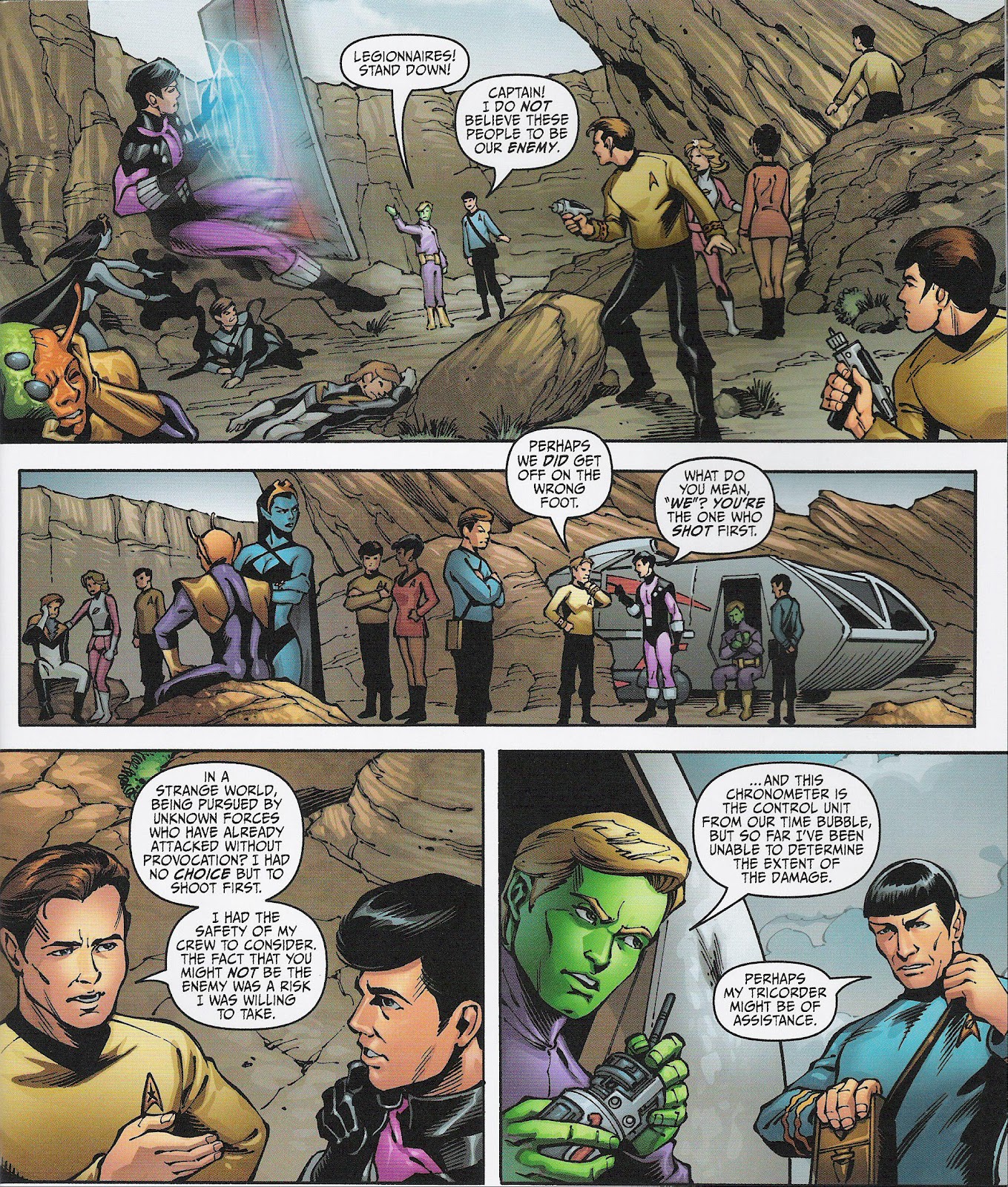
Bringing two completely different properties like the original crew of the starship Enterprise and the Legion of Super-Heroes seems like it should be an entertaining mash-up. Not only are each of these groups of people from different realities and genres, they are from different times, as well. The original "Star Trek" is set in the 23rd century, while the Legionnaires are from the 30th. Bringing both together involves enough manipulation that each group could be forgiven for not immediately knowing who the good guys and bad guys are in what they are being confronted with. However, I took issue with the fact that when these two teams find each other, it is clearly the Enterprise crew "throwing the first punch." Once the misunderstanding is resolved, Kirk offers an explanation for his actions, and some others might disagree, but I think the rationalization offered is out of character for Jim Kirk.
Once all of the good guys are friends and join forces, there is what might be another slight continuity gaffe in the pages of this crossover. As the two teams are attacked by an amalgamation of the Fatal Five and several menacing aliens opposed to the United Federation of Planets, Lt. Nyota Uhura from the Enterprise compares one of the combined villains to her Orion roommate from Starfleet Academy. Now the rebooted Lt. Uhura in the J.J. Abrams "Star Trek" film was shown to have an Orion roommate at the Academy, but I don't know that this is canon for the Nichelle Nichols classic version of Uhura, and it is indeed the classic versions of these Star Trek characters who appear to be in this story. Of course, there is also nothing in the classic Trek canon to contradict Uhura having an Orion roommate, so maybe that isn't a change in the Abrams film, but just the way things always were. So, I guess I'm being nit-picky with that observation.
Remove those two things, and this was a fun series throwing these two sets of characters together. The interior art by Moy is very nice. And to further bump up the art scale, covers for the series were illustrated by Phil Jimenez and longtime Legion artist Mike Grell, among others.
All in all, this was a fun series making great use of the histories from both properties to craft a new tale well worth reading.
Tuesday, October 09, 2012
I'm Curious Enough To Stick With It
Saga 1-2
Image Comics
Brian K. Vaughan, writer
Fiona Staples, artist
The advance artwork for this series caught my eye; the description of what the series would be and Vaughan's name made me decide to give it a try. Both of those facts are somewhat off for different reasons.
I know Vaughan to be a popular writer and I have purchased a few books by him, but haven't actually read many of them yet. I bought and read the first trade collection for Y: The Last Man and liked it enough to want to buy the subsequent trades, but since the story was designed to have a definite end, I opted to wait to read any more until I had them all, and since just haven't made the time yet. I also bought Pride of Baghdad based on Vaughan's reputation and advance solicitation material, but have yet to read the graphic novel. So, I'm really just hoping I'll agree with other folks that he is a good writer.
As for the eye-catching art that first drew my attention, now that I've seen the first few installments of the monthly title, my reaction to the art is uneven. I very much like Staples' depictions of the main characters, Alana, Marko and Hazel. The other recurring characters we've seen so far are also drawn well and consistent, their features not fluctuating from panel to panel making them less than recognizable at times. Even the backgrounds and landscape panels are beautifully rendered. It's more some of the creatures and fantastical elements in Saga which can sometimes seem a tad uneven. Relative sizes fluctuate a bit or a gigantic creature just really doesn't look quite plausible, in some way. It's hard to describe, really. I don't hate the art at all, but sometimes it seems just a bit "off."
The plot so far hinges on a war between two species that has spread out across the known galaxy. Alana was a soldier on one side and Marko a soldier on the other. The two met when Marko was captured and Alana was assigned to be his jailer. Apparently, they fell in love and ran away from the fighting, or tried to. Despite being on the run, the pair has obviously gotten married somewhere along the way, and both factions in the war are trying to recapture the couple for treason. That's the back story.
The series opens with the introduction of Hazel, the child of Alana and Marko, who is born on the first few pages of the story. Moments after Hazel's birth, the new family is surrounded by some of Alana's former comrades. Obviously, they manage to escape or this would have been a very short-lived series, but before Alana, Marko and Hazel can obtain a ship and leave the planet they are on, they find themselves in the middle of the shifting front lines of battle and pursued by bounty hunters hired by Marko's people.
I immediately liked this couple and their newborn, and I'm curious where their story will take them. Maybe that's because my wife and I had our own first child just about a year ago. Whatever the reason, I'm definitely going to stick around for a while to see where Vaughan and Staples take things.
Sunday, October 07, 2012
Exactly What I Expected -- Delightful!
Fairest 1-2
DC Vertigo
Bill Willingham, writer
Phil Jimenez, artist
I've read a number of underwhelming books in the past week. I'm not going to name-drop them here as that would serve no constructive purpose and there's more than enough animosity in our little hobby on the "Internets" anyway. I won't even say that any of these books were bad, as I did finish them all instead of dropping them unfinished in disgust. They just weren't as good as I'd hoped when, in some cases, I specifically sought out these particular story arcs and bought titles or issues I might not have otherwise purchased.
That wasn't the case for this newest offshoot from the Fables title by Willingham et al. In fact, although some time has passed, this story begins directly from events in the main Fables title.
The title, Fairest, refers to the beautifully illustrated women who populate the Fables stories from Snow White to Rose Red to Cinderella to Rapunzel to Belle to Briar Rose, to name just a few. In fact, Briar Rose -- Sleeping Beauty, if you don't already know -- is the central character in this first arc, but the story actually begins with a young man named Ali Baba, prince of thieves.
Ali finds himself in the middle of the charred ruins of the Adversary's former Imperial City, looking to loot anything of value left behind. What he finds is a bejeweled bottle that holds not a genie but a "lowly little bottle imp." The imp, it seems, doesn't possess a great deal of magic for granting wishes, but rather has the ability to secure knowledge: he "knows" things. The imp/comedy relief sidekick tells Ali that he only needs to awaken a sleeping princess to get the untold riches and wealth he craves.
For anyone not familiar with the main Fables book, a long-running story theme dealt with these Fable-folk being driven from their native magical lands by an Adversary who seized control of everything and created a vast empire. In a large war between the denizens of Fabletown and the Adversary, the true power behind the Emperor was captured and most of his minions were defeated. The plan included taking out much of the Imperial City with a sneak attack making use of Briar Rose's unique curse: She was smuggled into the city and put to sleep. As anyone who knows the story of Sleeping Beauty knows, once Briar Rose was put to sleep, everyone within the sphere of her curse's influence also fell asleep. Thus were many of the Adversary's most powerful lieutenants caught off-guard and removed from the battle.
So naturally, once Ali Baba finds the sleeping Briar Rose and awakens her with a kiss, she isn't the only one to wake up, and the trio (don't forget the bottle imp) must contend with some mighty annoyed villains, not least of which is the Ice Queen.
This book, like the main Fables title, is a fun read filled with exotic locales, high adventure, smart writing and let's don't forget gorgeous art. Rumor has it that this title will feature different art teams for each of its different story arcs. Who better to kick the series off than with two artists known for drawing beautiful women: Phil Jimenez on interiors and Adam Hughes on covers.
Kudos, gentlemen!
Friday, October 05, 2012
Don't Call Her Aquawoman
Aquaman 6
DC Comics
Geoff Johns, writer
Joe Prado and Ivan Reis, artists
This issue is a solo Mera story focusing on her activities while Aquaman had the solo adventure depicted in issue No. 5, and boy, was she busy. Mera steps out alone to get some dog food for the couple's new companion and finds herself immediately exposed to the dregs of humanity. First, she runs into a lecherous store manager. Then, that leads to a confrontation with the police who are both condescending and aggressive toward the former queen of Atlantis. While battling the officers who refused to listen to her explanations, Mera overhears a call for backup on their radios. She cleverly defuses her own situation and intervenes in a deadly domestic dispute, none of which redeems humanity in Mera's eyes. That moment comes when one person who witnessed the initial altercation between Mera and the store manager performs a simple act of kindness for Mera and offers a hand in friendship. The issue finishes up with Mera arriving back home shortly after Aquaman's return at the end of the previous issue, and the pair are set to investigate the mystery he uncovered in his own adventure.
Interspersed within the contemporary Mera story are some key flashback scenes to her DCnU history. As revealed in the earlier Brightest Day series, Mera's history has been subtly altered. She no longer came innocently from another dimension filled with water-dwelling inhabitants, but instead was sent here to kill Aquaman. She ultimately fell in love with the aquatic hero and betrayed her mission. These flashbacks reveal more of that back story and change in attitude.
All in all, a well-done, done-in-one tale well worth the time and cost. Kudos, gentlemen!
Tuesday, October 02, 2012
Shades Of Pufnstuf
Fables 114
DC Vertigo
Bill Willingham, writer
Mark Buckingham, artist
You have to be of a certain age and know who Sid and Marty Krofft are to "get" the header for this post, I imagine, but the main point is a young child is led astray by an evil boat in disguise.
I haven't talked much about Fables in this most recent tour of the blogosphere, but that doesn't mean I'm not enjoying the book. Month-in and month-out, it is a joy to read, and I bow before Willingham and his illustrators for their creation of this universe. It's just a book I enjoy after this much time, though, and I don't often stop to think about why or try to put the enjoyment into words. I decided to give it a try with this issue, however, since it is the beginning of a new arc, and while Fables arcs tend to run far and wide of the main story most of the time, this one will center on the Wolf family, some of my favorite characters.
For those not familiar with this series, it involves any and all fairy tale and folklore characters you've ever heard of. They are all real and living in secret in our "mundane" world. Most have come to live among the "mundies," as they refer to normal humans, because of a fierce adversary who long ago drove most of them from their traditional homelands. That adversary was revealed and dealt with among many other tales in the first 100 issues of this series. The Wolf family sprang from the courtship and union of Bigby Wolf (the Big Bad Wolf, a werewolf descended from the North Wind, hence his prowess at blowing things down) and Snow White (her name is a little more readily recognizable). These two started off as co-workers in the Fabletown administration, but they didn't really like each other much. Their love story, a fan favorite of the series, evolved over time and has led to a litter of seven children -- three girls and four boys.
It's always fun to drop in on the Wolf family and see their adventures, especially with the addition of the children, six of whom inherited the ability to fly from their grandfather, the North Wind, and the ability to transform into wolf cubs from their father. These six -- Winter, Blossom, Therese, Connor, Ambrose and Dare -- all appear human most of the time. But what of the seventh, you ask? Ghost is aptly named as he is invisible, as all gusts of wind are. Their antics are always fun to read.
The current story arc beginning in this issue is titled Cubs in Toyland, so one can assume the destination the absconding boat has in mind for its passenger. And by the use of the plural form of "cub" in the title, one can further assume that the one child abducted will soon be joined by at least some of her siblings. But this introductory installment concerns itself with a toy boat cajoling young Therese to find some water in which they can play together. Once Therese finds some non-frozen water in the winter landscape near her home, however, the boat grows to a size which can carry her and sets off. Despite its new size, the boat itself still looks quite toy-like, but its reflection in the water looks much more sinister.
All of this happens against a backdrop of other snippets to keep other story lines advancing. For instance, Bigby and daughter Winter are not at home with the rest of the Wolf clan. Recently, the North Wind died and fate has decreed that one of Snow and Bigby's children is destined to be the new North Wind. While Ghost might seem an obvious choice, few people outside his family know of Ghost's existence, since he's invisible. It seems Winter is the one destined to be the new North Wind, as decided in a previous arc. Winter is being trained for her new role by her grandfather's servants, and Bigby has gone along to protect his daughter as she is only 9 years old. We also spend a few pages checking in with the majority of the denizens of Fabletown, who are trying to reclaim their secret neighborhood in the middle of New York City, an area that was recently lost to them in a battle with an entity know as Mr. Dark. If you've never read an issue, most of this background will mean very little, but this series has such wide appeal, I have little doubt most readers who find the basic premise even a tad interesting would enjoy catching up on the story through the various trade collections available.
Sunday, September 30, 2012
"From The Pages Of ..."
Winter Soldier 1-2
Marvel Comics
Ed Brubaker, writer
Butch Guice, artist
Ed Brubaker accomplished a great many things with his incredible run on Captain America (A run which is just wrapping up with Brubaker's departure after scripting Cap's adventures for eight years.), but if you wanted to sum that run up in just a few words, those words would have to be: Brubaker brought back Bucky.
Yes, it's true Brubaker's run also saw Steve Rogers -- Captain America -- killed, but we all knew Steve would be back, and sure enough, he is. But Brubaker's run took one of the pillars of comics continuity, the fact that Cap's World War II partner, Bucky Barnes, was dead, and changed that reality. Through the course of the first 20 issues of Brubaker's run, we learned that the Soviets recovered Bucky's body, reanimated it, replaced the broken parts with cybernetics, and reprogrammed Bucky's brain to make him the ultimate assassin. They renamed him the Winter Soldier and kept him in suspended animation, reviving him only briefly for specific missions over the years. Few people left alive had glimpsed the Winter Soldier in the intervening decades, thus the assassin's true identity was not known.
Brubaker wove a narrative wherein Cap discovers the true identity of the Winter Soldier and sets out to rescue his former partner. He succeeds in not only finding Bucky and freeing him from his controllers, but also in restoring Bucky's memory of his true identity and all of the crimes he committed as the Winter Soldier. As if that weren't enough to deal with for the former sidekick, it isn't long after these events that the Red Skull and his agents appear to have succeeded in slaying Captain America, and Bucky must also deal with that grief.
For a time after Steve Rogers' death, Bucky picked up the shield and mask and became Captain America, not so much because he felt worthy to do so but more to keep someone else from doing so and disgracing the memory of his friend. While serving as the new Cap, Bucky and several other heroes learned that Steve Rogers was not dead, but merely "dislodged in time" (Just go with it, or better yet, pick up the issues and read 'em; they're good stuff!). They rescue him and for a very brief time, there were two Captain Americas in the Marvel Universe.
Now, Bucky has again adopted the name Winter Soldier, but this time he's working to make up for the things he did while under Soviet control. These first two issues read very much like some of the better issues of Captain America under Brubaker's hand. Even the artwork is similar as Butch Guice was one of the frequent Cap artists during Brubaker's run. Along with Bucky is the Black Widow, another former Soviet operative now working with America's forces. This book reads like a natural continuation of what Brubaker started, and I imagine it will continue to do so as long as he helms the adventures.
Friday, September 28, 2012
Let The Main Event Commence
Nightwing 6
DC Comics
Kyle Higgins, writer
Eddy Barrows and Geraldo Borges, artists
I made a few comments about Nightwing No. 5 being mostly a departure from the main story of Nightwing and Saiko and Haly's Circus and Raya and Dick. This issue solidifies that feeling about issue No. 5 since most trades collect an average of six issues for one complete story arc. Rather than bringing this arc to a conclusion, this issue serves as the climax before the finale, spending most of its time bringing Nightwing to the awareness of Saiko's real identity and some of his motivations, but only bringing about the final attack in the final closing pages. That likely means the next issue will be a slam-bang all-fight issue.
That's not to say that this issue is unnecessary. Without it, we readers wouldn't have seen how Nightwing puts together some of the few clues he has at this point. And even more importantly, we get what I think are some pretty big hints as to how things will ultimately wrap up with Nightwing triumphant.
*** POSSIBLE MAJOR SPOILER ALERT ***
Normally I try not to reveal major spoilers, but this issue's plot makes it a little hard to avoid. Throughout this arc we have learned that Raya was a childhood friend of Dick Grayson's, and likely, if Dick's parents hadn't been murdered prompting Dick to leave the circus and become the ward of the Batman, then these two would have grown up to be a couple. The pair have rekindled that budding romance since Dick has rejoined the circus while trying to solve this mystery. Last issue, it was revealed that Raya is a willing collaborator with the character we now know is Saiko, so she is setting Dick up for all that is to come. This issue, we see that Raya is beginning to have some second thoughts about carrying out Saiko's plan for revenge against Dick.
Maybe I'm wrong, but I think Raya will ultimately change sides and end up helping Nightwing defeat Saiko. That's not an original idea, so maybe Higgins is merely setting his readers up for a plot twist, but I feel strongly that Raya will be redeemed by the end of this tale, despite the fact I doubt she will be a long-term, recurring character in the book beyond this arc.
Time will tell.
Tuesday, September 25, 2012
" ... And If You're Not Careful, You Might Learn Something Before It's Done"
Walt Disney's Donald Duck: "Lost in the Andes" (The Complete Carl Barks Disney Library) hardcover
Fantagraphic Books
Carl Barks, writer/artist
This is a nice book featuring a number of Donald Duck stories of varying lengths and boundless imagination. The title story, "Lost in the Andes," takes Donald and his three nephews -- Huey, Duey and Louie -- to South America in search of the source of square eggs. Subsequent stories pit the Disney Ducks against a Christmas-hating wicked witch, running from a genuine Voodoo zombie named Bombie, and racing against Donald's cousin, the ever-lucky Gladstone Gander, to be the first to find a ship-wrecked Uncle Scrooge McDuck. And those are just the novel-length stories included.
More than just a collection of funny stories appropriate for all ages, however, this tome includes a brief history of Carl Barks' career, before, during and after his time with Walt Disney Studios. It also lists the original publication information for each of the stories included, as well as background information on the times and trends in which the stories were written. That can be useful knowledge considering most of these stories were written in the early 1950s and much has changed in America since that time.
I don't know if I will spend the money on each of these volumes as I would likely never have a full set anyway. The reasons behind that are twofold: First, I would be much more likely to buy the Donald Duck collections than the Uncle Scrooge collections. Nothing against Scrooge McDuck. I have some collections already of stories featuring him, most of them by Barks. I just prefer Donald. And second, Barks has such an enormous amount of Duck stories to his credit, that I doubt I could ever afford to own all of them anyway. He crafted so many tales -- some single-page gags, some 10-page stories and many more book-length adventures -- that his career with the Disney Ducks spans almost a quarter-century and countless narratives.
Sunday, September 23, 2012
I'm Sensing A Trend Here
The Manara Library Vol. 2 hardcover
Dark Horse Books
Hugo Pratt and Mino Milani, writers
Milo Manara, artist
***mature content warning***
This volume, like the first one, contains a pair of stories; and once again, I liked one selection more than the other. I'm not sure how many of these volumes Dark Horse plans on producing (although I've recently read online that nine volumes are planned), but they are a bit costly if I am going to continue to only really like half of each hardcover.
The first selection in this second volume is "El Gaucho," an historical fiction set in Buenos Aires in the summer of 1806, when the British invaded Argentina. The story follows a young British drummer aboard one of the invading ships and tells of his fictional adventures during those real events. I've never been a history buff, but I enjoy a good story. This is a good story, but it felt a bit disjointed as portions of the young man's time in Argentina are skipped over. In the story's defense, I read the lengthy tale in several sittings, and this made it a bit hard to follow the narrative at times, and therefore hard to really get into the story.
The second selection in this volume is a series of 10 "trials" wherein Manara and Milani present the historical facts of a famous person's life as if they were defending their actions before a jury in a courtroom, hence the title, "Trial By Jury." The premise is that the facts of the person's life and actions will be related "impartially and faithfully" and that "the readers will serve as the jury, and render judgment according to their own understanding of the case, tempered by their compassion."
No final verdict is clearly reached in the narrative of each case, because it is up to the reader to decide the validity or unjustness of each person's actions. The defendants in the series include figures such as George Armstrong Custer, Attila the Hun, Alfred Nobel, Maximilien Robespierre and Julius Oppenheimer.
Both selections in this volume rely greatly on the inclusion of historical facts, and in all honesty, some installments of "Trial By Jury" were of more interest to me than others, but this piece was definitely the better of the two, in my opinion. Its combination of prose and illustrated segments helped to ease the reader through what was intended to not always be a linear account of the events related. I'm not sure that the "trials" changed my mind on my previous ideas about each of the historical figures presented, but these tales did serve to teach me some things about history I did not previously know. Not bad for a comic book.
Friday, September 21, 2012
More Cliches Burst
Aquaman 5
DC Comics
Geoff Johns, writer
Ivan Reis and Joe Prado, artists
This issue starts out smack in the middle of another derisive dismissal of Aquaman as a hero: What good is he without water? Our hero is falling from the sky only to crash land alone in the middle of the desert. What's a water-based hero to do now?!?
Flashbacks are used to fill us in on how Aquaman came to find himself in this dire situation. Military scientists have discovered an Atlantean artifact and call in Aquaman to answer some questions about it. Armored individuals show up to take the artifact, Aquaman gives chase, and ends up falling out of their airship during battle. While trying to survive on sheer determination alone, Aquaman recovers the artifact and discovers many more questions related to Atlantis and its history, before being rescued by a military helicopter.
All this ends with a teaser for a Mera solo story next issue.
Fun stuff!
Tuesday, September 18, 2012
Pull It Together, Guys, You're Running Out Of Arc
Justice League 5
DC Comics
Geoff Johns, writer
Jim Lee, artist
Again, some nice moments in this book, but the "team" of heroes still isn't working together as an efficient unit, although they do finally make a bit of progress toward that goal, and there is only one issue left before this story wraps up. They better get it together in a hurry!
So what happens in this issue? Superman gets captured and the rest are knocked senseless repeatedly. Blowhard Green Lantern gets his arm broken after challenging Darkseid directly and alone, but continues to slug away at the threat. Batman steps in to try to redirect GL's rage into a more productive strategy, that of rallying all of the heroes into working together while he, Batman, sets out alone to free Superman. That doesn't seem too different from the old DCU -- Batman touting the benefits of working as a team to others, but stubbornly going it alone himself.
What IS different about his approach in the DCnU is his method in convincing GL to calm down and work with the others. Bruce actually talks to Hal somewhat as an equal, appealing to his sense of duty and purpose, even unmasking to prove his point.
Aquaman, Cyborg, Flash and Wonder Woman don't get much to do in this issue, but hopefully that will change in the slugfest the next issue must be in order to wrap this conflict up.
Sunday, September 16, 2012
Curiouser And Curiouser
Rachel Rising 5
Abstract Studio
Terry Moore, writer and artist
There's not a great deal of advancement in Rachel's story in this issue. She speaks with her best friend, and we find out more details of what little Rachel remembers about being buried alive and escaping from the shallow grave. Beyond that, there is just a rather shocking announcement about Rachel from a new character, and since this character is a new one, we the readers have no real basis for knowing how valid this person's declaration might ultimately prove to be.
However, we do get some more insight into the little girl whose entire family just met tragic ends, either at the hands of the mysteriously silent woman who witnessed Rachel's "resurrection," or at the hands of the little girl taking cues from the silent woman. First off, we get a name for the little girl -- Zoe Mann. Zoe is in the hands of child protective services following her family's deaths in a house fire. A genuinely well-meaning social worker arranges to have a couple of "old reliable" foster parents take charge of Zoe until something more permanent can be arranged. The silent woman apparently reveals to Zoe that this couple, the Boyles, are not quite on the up and up, especially the husband who has a history of child abuse. When Mr. Boyle threatens Zoe, the silent woman intervenes, quite effectively protecting Zoe. And we have more evidence that the silent woman is not visible to everyone.
One more tidbit on this silent woman: I've read some online reviews that refer to her as also being Rachel or another aspect of Rachel. I don't think we have been given enough information at this point to rule anything definitively as fact or nonsense. But I will say that Rachel and the silent woman are drawn so that they certainly don't look like the same person. I did not get the impression that they are one and the same on my own. Hopefully, time will tell.
Friday, September 14, 2012
It's Not Bad, But It's Not The Original
Lord of the Jungle 1-2
Dynamite Entertainment
Arvid Nelson, writer
Roberto Castro, artist
This series is starting out by retelling the origin of Tarzan, adapting the novel by Edgar Rice Burroughs. The first issue focuses on Lord and Lady Greystoke, how they came to be stranded in the jungles of Africa and how they died, leaving behind their only son to be adopted by Kala, a female ape whose own child has just been killed. The second issue moves things along to the point that Jane Porter, her father and their other companions come to be marooned in the same spot several years later.
I usually find that comic adaptations of works first created in other media usually pale compared to the originals, be they movies or books or something else. Take the characters and treat them faithfully while telling new, original tales that continue their respective stories, and I'm right there with you. But retelling what has been done before tends to feel simply like a retelling. If I want to revisit the original novel or film or show, I can do that. I don't need someone to try to re-create it for me.
Again, these issues aren't bad, they just aren't as great as I'd hoped they'd be. I'm left hoping they wrap up the retelling quickly and move on to something original before I lose interest completely.
Tuesday, September 11, 2012
Now This Is An Odd Little Diversion
Nightwing 5
DC Comics
Kyle Higgins, writer
Eddy Barrows, artist
We're still in the middle of the first story arc of this title wherein Nightwing travels back to Haly's Circus where he grew up. He reconnects with some old friends and uncovers a mystery tied to the circus just in time to be handed control of the entire circus operation. At the same time, an assassin sets out to kill Dick Grayson, who he believes to be the "fiercest killer in all of Gotham." While trying to eliminate Grayson, the assassin, Saiko, learns that Grayson and Nightwing are one and the same.
This issue sees the circus traveling to New Orleans where one of the clowns is attacked by a voodoo-conjured demon. Adding a supernatural element like this seems a little out of left field for a book like Nightwing, but even moreso, this particular plot line has nothing to do with the overall story of the assassin or the circus mystery.
The book does contain two pretty key scenes that advance the circus story line and serve to tie that mystery in with the one of the assassin. This is achieved by both revealing the true identity of Saiko at last, and revealing another character who seems to be setting Nightwing up for betrayal, but neither scene is crucial to the other events in this issue.
To be fair, Higgins comes up with a very logical way for the non-superpowered Nightwing to use his detective training and defeat the demon with only his wits and acrobatic skills. And this isn't a bad stand-alone story judged on its own merits. But in this age of writing for the trade, this story feels like extra padding and breaks the natural flow of the overall tale.
Sunday, September 09, 2012
More Of The Same, But That's OK
The Lone Ranger Vol. 2 1-2
Dynamite Entertainment
Ande Parks, writer
Esteve Polls, artist
The cover for the first issue of this series, at least on my copy, is a beautiful rendering of the Masked Man and Tonto by Alex Ross which evokes the spirit of the late Clayton Moore and Jay Silverheels. That's certainly "my" Lone Ranger and Tonto as I grew up watching reruns of "The Lone Ranger Show", but it might be a tad misleading if you were picking up this series for the first time.
Brett Matthews, Sergio Cariello and John Cassaday did a spectacular job and took their time reimagining the origins of the Lone Ranger in the 25-issue Volume 1 of this series. The story they wanted to tell is done, so Dynamite chose to end that series and start over with a new No. 1 and a new creative team. However, this new series picks up where the first left off. John Reid is still new to his masked role as a bringer of justice to the West, and Tonto is still his often silent, but very wise and sarcastic partner in his quest. Polls' art even mimics the depictions of the two men that Cariello and Cassaday created for the first volume, helping to ease the transition for readers of the first volume.
This incarnation of the Lone Ranger and Tonto is certainly not Clayton Moore and Jay Silverheels, but it is not impossible to envision these two men getting used to each other and their mission one day growing into that pair. And especially in the case of Tonto, and the depiction of other Native American characters in the series so far, the change is for the better. In this series, Tonto is by far the more experienced fighter, quite possibly a little older and definitely a little wiser and more even-tempered than his companion.
These first two issues are the opening chapters in a story arc called Hard Country. In the first issue, the Lone Ranger and Tonto come to the aid of a rancher and his children being attacked by thieves set on stealing a "secret stash" of money. The second issue, picking up where the first leaves off, deals with a famous lawman and gunslinger facing his own mortality. So these two comics provide nice done-in-one stories that are rare these days while still providing a continuing arc that is telling another story about the realities of life on the frontier.
Overall, these first two issues provide a nice opening to what I hope will be a long and prosperous run for this title.
Friday, September 07, 2012
It's Criminal ... With A Twist
Fatale 1-3
Image Comics
Ed Brubaker, writer
Sean Phillips, artist
***mature content warning***
This is the same creative team that produced Sleeper in 2003 and 2004 from DC Comics and the more recent Criminal stories from Marvel Icon. Like Criminal, this story focuses on a collection of ne'er-do-wells with nary a cape or superpower in sight. In fact, the story so far focuses on three distinct time periods' worth of folks -- the first in a contemporary framing sequence story, the second events from the 1950s which preceded the modern occurrences, and the third, and so far area where the least has been revealed, a fictional manuscript written by one of the players from the 1950s drama and discovered in the modern sequence of events.
So what sets Fatale apart from the other Criminal story arcs produced by this pair? The addition of a supernatural element to the story, not limited to but certainly focused on the character of Josephine, the titular femme fatale, who plays a role in all three settings so far.
The modern hero is Nicolas Lash, the godson of recently deceased crime noir author Dominic Raines. Lash meets Josephine at Raines' funeral, and in less than a day, Lash finds the previously hidden manuscript and has his life threatened multiple times, each time being saved by the mysterious Josephine, often in ways Lash cannot explain.
The flashback sequences to the 1950s focus on Raines' early life as a journalist, newlywed and soon-to-be father. Raines is trying to bring down a pair of corrupt police officers and enlists the help of one of those officer's girlfriend -- you guessed it -- Josephine. Raines becomes involved with Josephine romantically, though he isn't certain why, and though she is helping him to bring down the corrupt officers, one gets the sense it is more for her own benefit than for justice.
Mixed in with all of the noirish crime-drama, however, are a trio of enforcers who seem to appear out of thin air. They answer to a boss they refer to as "the bishop," who has oddly glowing red eyes, has promised one individual a cure for his life-threatening cancer, and seeks to control Josephine.
I opted to try this series based on the Criminal work by Brubaker and Phillips. I am intrigued enough to continue with this series even though it isn't quite the same flavor of story. The supernatural elements, at least so far, have been downplayed somewhat, and I'm enjoying the mystery of what exactly is going on.
Tuesday, September 04, 2012
Talk About Your Uneven Match-Ups
Green Arrow 5
DC Comics
Keith Giffen and Dan Jurgens, writers
Dan Jurgens and Ray McCarthy, art
I didn't find fault with this title in the first four issues, reviewed here, but others did. That prompted this first of two recent creative shakeups on the title.
Keith Giffen joins Dan Jurgens to split plotting duties with this issue and the results are a somewhat mismatched mash-up.
A red-clad ninja attacked Oliver Queen in the previous issue and was surprised when Green Arrow showed up and defeated her. This issue finds her returning to her partner to rest up before challenging the Emerald Archer once again. Her partner, a dark hulking figure, is revealed for the first time in this issue as a Swamp Thing-type creature composed entirely of toxic substances. This individual, not named in the issue at all (but I'm guessing he's the "Midas" from the story's title), decides to go after Green Arrow himself to prevent the ninja, Blood Rose, from being defeated again.
This seems like it would be a rather uneven fight, especially in the panels above when Midas strikes Green Arrow in the face with his toxic hand and draws blood. Who knows how many toxic substances entered our hero's blood stream in that moment and the fight likely would be over right there. But no, GA emerges from this and a few other direct contact moments with seemingly few ill effects.
As a friend pointed out, this is superhero comics, which often rely on a healthy suspension of disbelief, but this seems like a glaring inconsistency, and far less than I would expect from two solid creators. Hopefully Giffen and Jurgens come up with better for the next round promised in issue 6. But if not, thankfully, yet another writer is soon to take over the reins of this book.
Sunday, September 02, 2012
Beware The Dreaded Kryptonian Calf
Action Comics 5
DC Comics
Grant Morrison, writer
Andy Kubert, artist
This issue of Action Comics might seem a bit out of place at first glance, telling as it does the origin of Superman. But the events being related here by the on-board computer in baby Kal-el's rocket ship make a sort of sense, not to mention reveal the punchline of a joke begun in issue No. 2.
The issue opens on Krypton as that dying planet's final moments begin, as one might expect, but the differences in this continuity become immediately apparent. Kryptonian scientist Jor-el plans to save his entire family -- himself, wife Lara, infant son Kal-el and dog Krypto -- by sending all of them into the Phantom Zone. This plan quickly goes awry, however, when the Phantom Zone criminals -- inmates sentenced there by Krypton's Science Council -- try to exact revenge on the Zone's discoverer, Jor-el. There is little time to develop a back-up plan, and so the doomed parents try to save their baby in an untested model rocket, ordering the on-board Brainiac computer to find a suitable world to take their son.
The rocket also relays how it came to arrive on Earth, crash-landing in Kansas. We see the young couple who happen upon the rocket and discover the baby inside. And we see the military's quick response to an unidentified flying object entering Earth's atmosphere and crashing down in the middle of the country. (This is also where we discover the true origins of what the military brass think is the true appearance of Kryptonians, as revealed in Action Comics No. 2.)
So why place this story after we've seen Superman's public debut in Metropolis and after he's captured and tested/tortured by the U.S. Army and Lex Luthor? When Superman escapes from military custody in issue No. 4, he sees his rocket ship being held by the military. This is the first time Superman has seen the ship since he was a baby, and when he touches the rocket, it "awakens" from a dormant state and speaks to him. I like to think the ship is speaking in this issue to Superman. His touch caused it to relate his history to the young man who previously knew nothing of Krypton or his true origins.
We also see the aftermath of that encounter with the military as Superman must leave without the ship. He tells it to protect itself and that he will be back. The ship speaks next of events we have yet to see and a dawning age of superhumans. And then we see four strange visitors arrive and break through the protective layering surrounding the ship.
Before the issue ends, we are also given a small back-up story which gives more details of the lives of Jonathan and Martha Kent before the arrival of the rocket ship from Krypton. These details aren't of the everything-you-know-is-wrong variety, but rather serve to flesh out the early lives of these characters who are so important to Superman's story, but often overlooked in and of themselves.
All in all, not a bad issue, and certainly a nice segment in the masterpiece Morrison and company are weaving.
Friday, August 31, 2012
Just How Much Can These People Take?
The Walking Dead tpb Vol. 15: We Find Ourselves (collecting issue Nos. 85-90)
Image Comics
Robert Kirkman, writer
Charlie Adlard and Cliff Rathburn, artists
I've talked about discovering The Walking Dead before here and here. Here we are again at Volume 15.
These trades don't read like superhero trade collections. Collecting six issues is a standard length for a trade these days. Depending on story content, some might be only four or five, other might include seven or eight or more regular issues of a series. But with a typical superhero trade collection, there is a definite issue break. Often, specific covers are reprinted before each "chapter" of the story in a trade, but even without those, I suspect most readers would have little problem pinpointing the transition point between issues. Not so with The Walking Dead trades. Sure, I could count pages if I wanted to or maybe even spot the issue breaks in other ways, if I really wanted to. But my point is that these trades truly read like one long ongoing story. The transition from issue to issue is smoother in these books as one chapter naturally flows into the next and each book flows into the next and these people's journey just plays on and on. That's not meant to be a criticism or a subtle way of complaining that the writing is boring and drudges on. For me, it helps give me that sense of how much these survivors have faced since their world turned upside down.
This trade opens after a rather horrific zombie attack seen in the last trade. After losing the prison they'd called home for several issues (and a few more cast members), Rick Grimes and company make their way to a walled community. They find a group of people living there in relative peace, but these folks have become somewhat complacent by their circumstances. That's what led to the attack in the last trade. Now the folks who are left must clean up the zombie carcasses, some of whom used to be friends the day before and repair the damage to the wall. They don't stop there, however; Rick, now in charge of this larger group, solicits ideas to fortify the community's defenses, make them stronger and more secure. And the newcomers must also deal with some of the long-timers who aren't too keen on Rick being in charge.
As this tale wears on, it is becoming more and more obvious the toll being the leader is taking on Rick. He feels responsible for all the life and death decisions he is forced to make, and fears that they are becoming easier to cope with.
This continues to be a story not about zombies so much as about the people trying to continue to survive in a world filled with zombies -- what they are forced to do to survive, what they are willing to do to survive, and how those changes and decisions affect and change them. Yep, still very much enjoying this series.
Subscribe to:
Posts (Atom)